If you want to market a new business online, the hard part is not a lack of channels. It is choosing the few that suit your customers, setting them up in the right order and sticking with them long enough to work. This guide gives you a simple seven-step launch plan: who to target, what to build first, which channels to test and how to measure what is working in your first 90 days.
✔ Key takeaways
⏱ About 10 min read · the short version is right here
- Start with one clearly defined customer and one problem you solve, not a vague audience of everyone.
- Build a home base first: a simple website or landing page with a clear call to action and an email sign-up.
- Pick one or two channels where your customers already spend time and commit to them for at least 90 days.
- Collect email addresses from day one. Your list is the only audience no algorithm can take away.
- Set a small test budget for paid ads only after your page converts visitors organically.
- Track every campaign with UTM links and review the numbers every week so you can double down on what works.
📋 In this guide
- Why new businesses struggle to get noticed online
- Before you market: three foundations
- How to market a new business online in 7 steps
- Which online channels to start with
- How much to spend in your first 90 days
- Rules to follow in the US, UK and EU
- Common launch marketing mistakes
- A lean tool stack for new businesses
- FAQ
🔍 Updated 17 Nov 2026: fully rewritten for readers in the US, UK and Europe. Tool prices were checked on the official sites on 17 November 2026 and can change, so always confirm on the vendor page before you buy.
Why new businesses struggle to get noticed online
A brand-new business starts with zero awareness, zero reviews and zero search rankings. That is normal, but it means the usual advice of being everywhere at once does not work. Small teams that spread themselves across six social networks, a blog, a podcast and paid ads usually burn out before any single channel has time to deliver.
The businesses that grow fastest online do the opposite. They get very specific about who they serve, make one strong offer, and push it through a small number of channels consistently. Once one channel brings customers reliably, they add the next. Marketing a new business online is less about clever tricks and more about this kind of focus and patience.
📌 Who this guide is for
Founders, freelancers and small-business owners in the US, UK and Europe who are launching a new business, product or service and need customers without a big agency budget. If you are still choosing what to sell, start with my guide on how to start an online business and come back here when you are ready to launch.
Before you market: three foundations
Skipping the groundwork is the most common reason launch marketing fails. Spend a few days on these three foundations before you post, publish or pay for a single ad. If you do not have a business idea yet, start with my guide on how to find a business idea.
Foundation 1
Know exactly who you serve
Describe one ideal customer: their job, budget, daily frustrations and where they look for answers online. My buyer persona guide walks through it.
Foundation 2
Make one clear offer
State what you sell, who it is for and the result it delivers in one sentence. If a stranger cannot repeat it back, simplify it.
Foundation 3
Decide your next step
Choose the single action you want visitors to take: buy, book a call or join your email list. Every page and post should point there.
💡 Listen before you shout
Spend an hour reading the forums, Reddit threads, Facebook groups and review sites where your customers complain. Copy the exact words they use into your notes, then reuse that language on your website and in your posts.
How to market a new business online in 7 steps
Follow these steps in order. Each one builds on the last, and together they give you a simple marketing system you can run in a few hours a week.
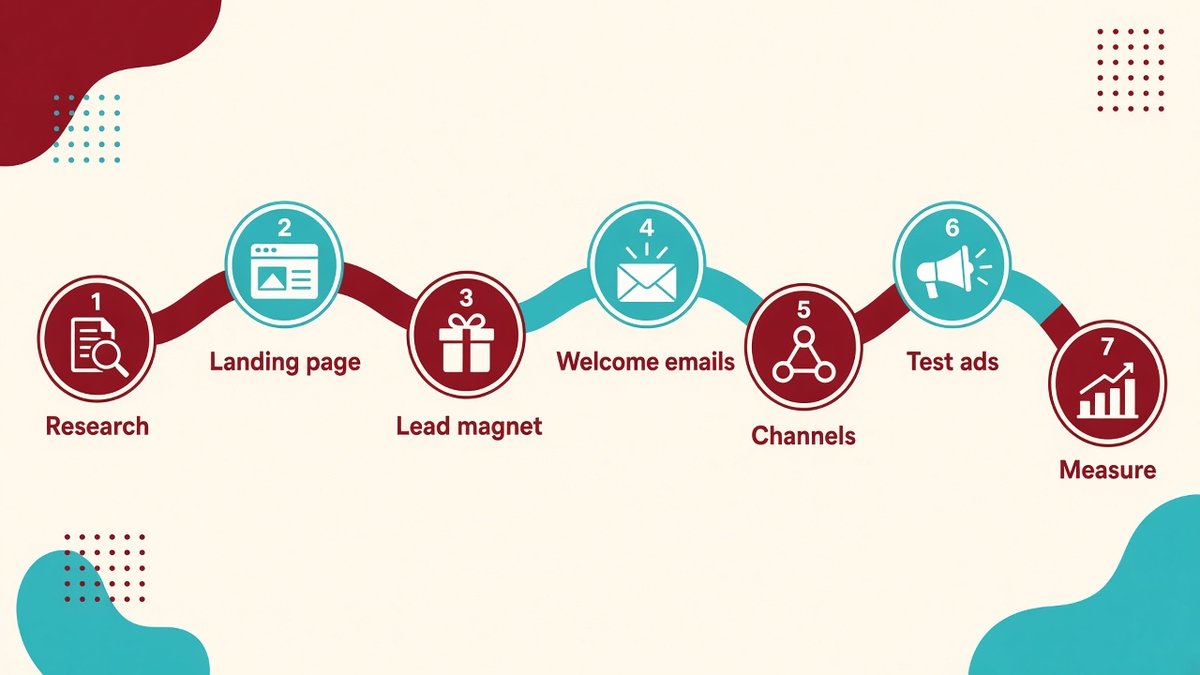
The seven-step launch plan for marketing a new business online.
Research your audience and competitors
Find out where your ideal customers hang out online, what they search for and what they already buy. Look at three competitors: their prices, their offers, their best-performing content and the gaps their reviews reveal. Note the conversations and key messages that would resonate with your audience.
Build your home base
Create a simple website or a single landing page that explains your offer, shows proof such as testimonials or samples, and has one clear button. You do not need a big site on day one. An all-in-one tool like Systeme.io lets you build pages, an email list and checkout in one place, and its free plan covered up to 2,000 contacts and 3 sales funnels when I checked on 17 November 2026. For other options, see my comparison of the best landing page builders.
Create a reason to join your email list
Offer something useful in exchange for an email address: a checklist, a short guide, a discount or a free consultation. A focused lead magnet turns curious visitors into contacts you can follow up with for months.
Set up a welcome email sequence
Write three to five automatic emails that introduce you, share your best advice and make a clear offer. Creator-focused tools such as Kit make this easy to automate even if you have never sent a newsletter before.
Choose one or two channels and create content
Pick the channels where your customers already spend time (see the table below) and publish helpful content on a fixed schedule. Each post should answer a real question and point people back to your home base.
Test a small paid campaign
Once your page converts some organic visitors, test a small ad budget on the platform your audience uses most. Start with one audience and one offer so the results are easy to read.
Measure, learn and repeat
Tag every link with UTM parameters, check your numbers weekly and keep what works. My guide on how to track marketing campaigns shows a simple set-up you can copy.
⚠️ Do not skip the call to action
Many new businesses get traffic but no customers because their content never tells readers what to do next. End every post, video and email with one clear step: download, book or buy.
Which online channels to start with
You do not need every channel. Choose based on how your customers buy, how much time you have and how quickly you need results.
| Channel | Best for | Time to results | Effort |
|---|---|---|---|
| Search engine optimisation (SEO) | Businesses whose customers search Google for solutions | 3 to 12 months | Medium to high, but compounds over time |
| Email marketing | Every business; turns visitors into repeat buyers | Weeks, once you have subscribers | Low to medium |
| Social media (organic) | Visual products, personal brands, local businesses | 1 to 6 months | Medium, needs consistency |
| Paid social ads | Products with clear visual appeal and a tested offer | Days | Low time, needs budget |
| Search ads | High-intent services such as plumbers, lawyers, software | Days | Low time, can be costly per click |
| Partnerships and guest content | B2B services and niche products | 1 to 3 months | Medium, relationship-driven |
| Local listings and reviews | Shops, clinics, trades and restaurants | Weeks | Low |
For most new small businesses, a strong starting pair is one content channel (SEO or social) plus email marketing. SEO takes longer but keeps bringing visitors for free. If you go that route, a tool such as SE Ranking helps you find keywords and track your rankings; on 17 November 2026 its Core plan was listed at $129 a month, or $103.20 a month billed annually, with a 14-day free trial.
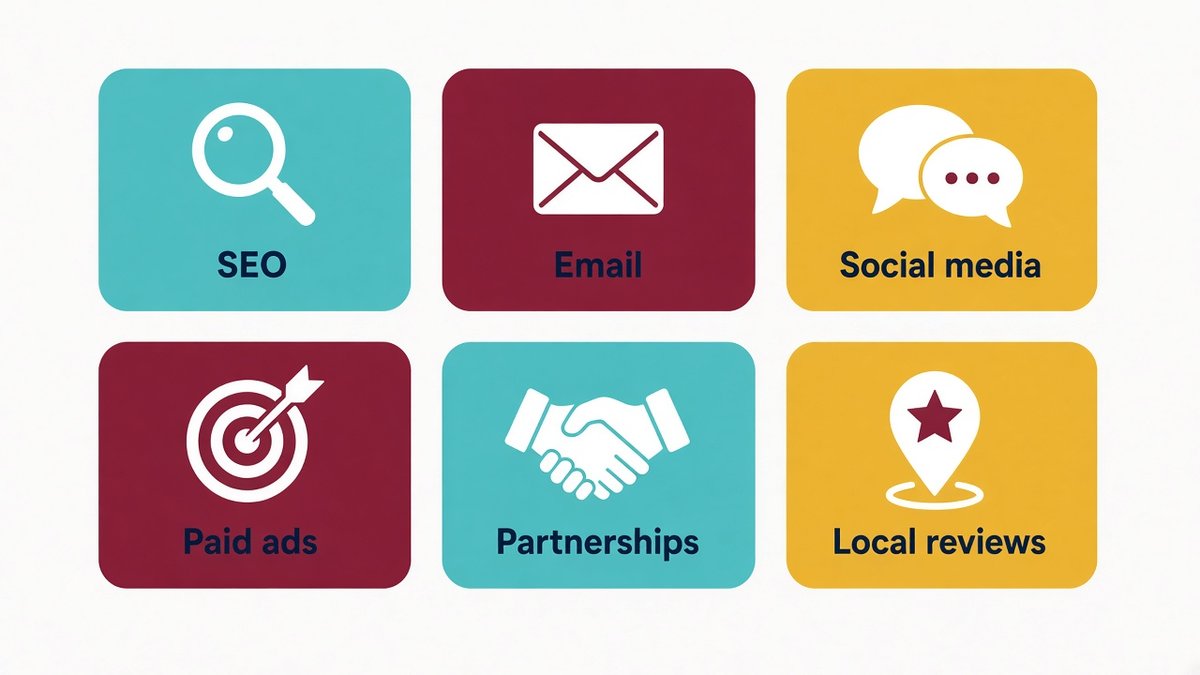
Six online channels to consider; start with one or two.
How much to spend in your first 90 days
There is no single right budget, but it helps to split your spending into clear buckets so you do not waste money early. Here is a sensible approach for the first three months:
- Month 1: build. Spend mostly time, not money. Use free plans for your website, email and design tools, and invest in a domain name and professional email address.
- Month 2: create and test. Publish content consistently and run a small ad test only after your landing page has turned some organic visitors into sign-ups or sales.
- Month 3: double down. Move money and time toward whichever channel produced the cheapest customers, and cut the rest.
💡 A simple rule of thumb
Never spend more to win a customer than that customer is likely to be worth to you over time. If you are unsure, start smaller and scale up as your data improves. For more low-cost ideas, read small business marketing on a budget.
Rules to follow in the US, UK and EU
Online marketing comes with rules, and breaking them can cost you fines or a banned ad account. Keep these basics in mind:
- Email consent. In the EU and UK, GDPR and PECR generally require clear opt-in consent before you send marketing emails. In the US, the CAN-SPAM Act requires an accurate sender, a physical address and an easy unsubscribe link.
- Cookies and tracking. If you use analytics or ad pixels for EU or UK visitors, show a cookie banner that asks for consent before non-essential tracking.
- Honest advertising. The FTC in the US, the ASA in the UK and consumer bodies across the EU expect claims, reviews and testimonials to be genuine, and paid endorsements to be disclosed.
- VAT and sales tax. If you sell digital products to EU customers, VAT usually applies based on the buyer’s country. Check the rules with your accountant before you launch.
📌 Not legal advice
These are general pointers to help you ask the right questions. Rules differ by country and change over time, so confirm details with an official source or a qualified adviser.
Common launch marketing mistakes
- Trying every channel at once. Pick one or two and give them 90 days.
- No clear offer. Traffic is useless if visitors cannot tell what you sell or why it matters.
- Ignoring email. Social reach rises and falls with each algorithm change; your list stays yours.
- Paying for ads too early. Ads amplify what already works. They rarely fix a weak offer or page.
- Not tracking results. Without data you will keep doing what feels busy instead of what brings customers.
- Giving up after a few weeks. Most organic channels need months of steady effort before they pay off.
If you want to turn these steps into a written plan with goals and dates, my guide on how to write a marketing plan gives you a simple template.
A lean tool stack for new businesses
Keep your tool stack small. One all-in-one platform plus a couple of specialist tools is enough for most launches:
| Need | Tool | Why it fits a new business |
|---|---|---|
| Website, landing pages, email and checkout | Systeme.io | Free plan to start; paid plans from $17 a month (checked 17 Nov 2026) |
| Newsletter and email automation | Kit | Free plan for new creators; Creator plan $33 a month billed yearly for 1,000 subscribers (checked 17 Nov 2026) |
| SEO and rank tracking | SE Ranking | Keyword research, site audits and rank tracking with a 14-day free trial |
| Content planning | A shared calendar or spreadsheet | Keeps your posting schedule consistent; see my content calendar guide |
Want to compare more tools first? Browse my tool reviews or read the in-depth Systeme.io review.
Launch your new business online for free
Build your landing page, email list and checkout in one place with the Systeme.io free plan, then upgrade only when you are making sales.
Affiliate link. I may earn a commission at no extra cost to you.
Frequently Asked Questions
What is the best way to market a new business online?
Start with a clear offer and a simple landing page, then focus on one content channel plus email marketing. Add paid ads only once your page turns visitors into leads or customers.
How long does it take for online marketing to work for a new business?
Paid ads can bring visitors within days, email works within weeks once you have subscribers, and SEO usually takes three to twelve months. Plan for at least 90 days of steady effort.
Can I market a new business online with no money?
Yes. You can use free website and email plans, post helpful content on social media, join online communities and ask early customers for reviews. Your main investment will be time.
Do I need a website to market my business online?
A full website is not required on day one, but you do need a home base you control, such as a landing page with an email sign-up. Social profiles alone leave you dependent on platforms.
Which social media platform is best for a new business?
The one your customers already use. LinkedIn suits B2B services, Instagram and TikTok suit visual consumer products, and Facebook groups work well for local and community businesses.
Do GDPR rules apply to my small business?
If you collect personal data from people in the EU or UK, such as email addresses, GDPR rules generally apply regardless of your size. Get clear consent, explain how you use data and make unsubscribing easy.
Affiliate disclosure: some links in this post are affiliate links, so I may earn a commission at no extra cost to you. I only recommend tools I’d use myself.