The best online business ideas are not secret or magical. They are simple models that let you sell your skills, knowledge or attention over the internet, with low start-up costs and no shop to rent. In this guide I walk you through 12 practical online business ideas, how to choose the one that fits your skills and budget, and a six-step plan to land your first paying customer within about 90 days.
✔ Key takeaways
⏱ About 12 min read · the short version is right here
- Pick an online business idea that matches a skill you already have and a problem people already pay to solve.
- Service ideas (freelancing, consulting, coaching) bring money fastest; product ideas (courses, templates, newsletters) scale better later.
- Validate before you build: get 5 to 10 real conversations or pre-orders before you spend weeks on a website.
- You can start most online businesses for under $100 a month using free plans and one all-in-one tool.
- Register correctly where you live (LLC or sole proprietor in the US, sole trader in the UK, local registration in the EU) and keep VAT rules in mind for digital sales.
- Build an email list from day one. It is the one marketing asset you fully own.
📋 In this guide
- Why online business ideas are easier to start in 2026
- How to pick the right idea for you
- 12 online business ideas you can start this year
- Quick comparison: cost, skills and time to first sale
- How to launch your online business in 6 steps
- How much money do you need to start?
- Legal and tax basics: US, UK and EU
- Common mistakes new online founders make
- Tools to run an online business cheaply
- FAQ
🔍 Updated 16 Nov 2026: fully rewritten for readers in the US, UK and Europe. Tool prices and plans were checked on the official sites on 16 Nov 2026 and can change, so always confirm on the vendor page before you buy.
Why online business ideas are easier to start in 2026
Entrepreneurship has always fascinated me. There is a special kind of pride in building something of your own, and even when an attempt fails you learn lessons that make the next one far more likely to succeed. The good news is that starting has never been cheaper. Ten years ago you needed a developer for a website, a payment gateway contract and a server. Today a laptop, a free website builder and a payment account are enough.
You also do not need a once-in-a-lifetime idea. Most successful founders take a proven business model and serve a specific group of people better than anyone else. A bookkeeping course for Etsy sellers, a newsletter for remote nurses or a design service for dentists can all become real businesses, because the market already exists and you only need to find your corner of it.
📌 Who this guide is for
First-time founders, side hustlers and freelancers in the US, UK and Europe who want to earn money online without big savings or a technical background. If you have very little to invest, read my guide on starting a business with less money alongside this one.
How to pick the right idea for you
Before you look at the list, answer three questions honestly. They will save you months of trying ideas that do not suit you.
Question 1
What can I already do?
List skills people have thanked you for or paid you for: writing, design, spreadsheets, fitness, languages, a job skill.
Question 2
Who would pay for it?
Name a specific group: busy parents, small accountancy firms, new dog owners. “Everyone” is not a market.
Question 3
How much time do I have?
Five hours a week suits a newsletter or templates. Twenty hours a week can support a service business.
💡 Use the overlap rule
The sweet spot is where your skill, a group that already spends money and the time you really have overlap. If one of the three is missing, pick a different idea rather than forcing it.
12 online business ideas you can start this year
Here are 12 online business ideas that work well for beginners. I have grouped them so you can see which ones pay quickly and which ones build long-term value.
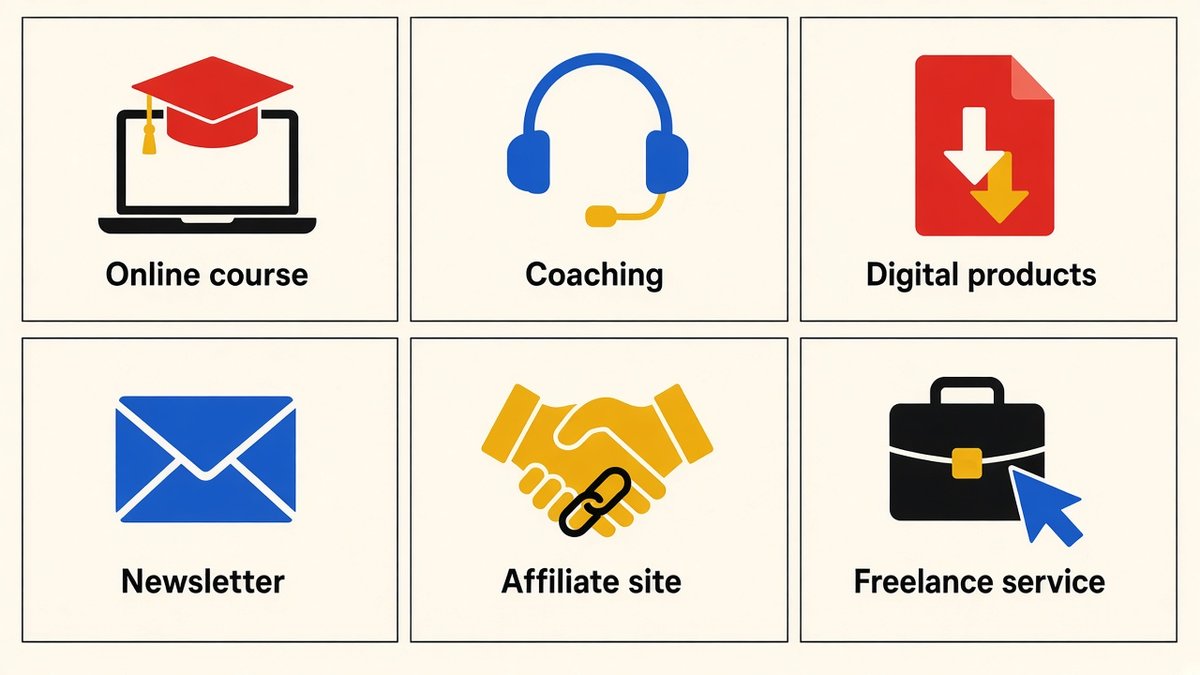
Six popular types of online business: courses, coaching, digital products, newsletters, affiliate sites and freelance services.
Service ideas: the fastest way to your first sale
Freelance service (writing, design, development, video editing)
Best for: people with a marketable skill who want income in weeks, not months.
Sell your time to businesses on a project basis. Start with two or three clients from your own network or freelance platforms, then raise prices as your portfolio grows.
Start with: a one-page portfolio and three sample pieces.
Social media or ads management
Best for: marketers who understand Facebook, Instagram, TikTok or Google Ads.
Many local businesses know they should advertise online but have no time to learn it. Offer a monthly retainer that covers ad set-up, content and a simple monthly report.
Start with: a free audit for one local business to get a case study.
SEO services for small businesses
Best for: people who enjoy research and steady, long-term results.
Search engine optimisation helps businesses get found on Google. Offer keyword research, on-page fixes and local SEO. A rank tracker such as SE Ranking lets you show clients clear monthly progress.
Start with: one niche, such as dentists or law firms, so your pitch is specific.
Online coaching or consulting
Best for: experienced professionals, trainers and specialists.
Sell one-to-one or small-group sessions over video. Coaching works for careers, fitness, business, languages and much more, and it often turns into a course later.
Start with: a booking page and three discounted pilot clients.
Virtual assistant or online bookkeeping
Best for: organised people who like systems and routine.
Founders happily pay someone to handle inboxes, calendars, invoices and bookkeeping. Package tasks into monthly bundles instead of charging by the hour.
Start with: a clear list of tasks you will take off a client’s plate.
Product ideas: build once, sell many times
Online course
Best for: people who can teach a skill step by step.
Turn your knowledge into video lessons, worksheets and quizzes. All-in-one tools such as Systeme.io let you host the course, take payments and email students from one dashboard.
Start with: a short paid workshop to test demand before recording a full course.
Digital products and templates
Best for: designers, planners, spreadsheet fans and writers.
Sell Notion or spreadsheet templates, planners, Canva designs, checklists or e-books. They cost almost nothing to deliver and can sell on autopilot.
Start with: one product that solves one narrow problem.
Paid newsletter or sponsored newsletter
Best for: writers who enjoy one topic and can publish weekly.
Grow a free email list, then earn through sponsors, paid subscriptions or your own products. Email tools like Kit are built for creators who run newsletters.
Start with: a free weekly issue and a simple sign-up page.
Membership community
Best for: experts with an engaged audience.
Charge a monthly fee for access to a community, monthly live calls and a resource library. Recurring revenue makes planning far easier.
Start with: a founding-member price for your first 20 members.
Content and commerce ideas: slower, but they compound
YouTube channel or podcast
Best for: people comfortable on camera or on the microphone.
Video and audio keep growing. Earn from ads, sponsors, affiliate links and your own products. A modern smartphone and a basic microphone are enough to start.
Start with: one show format you can repeat every week.
Niche affiliate website or blog
Best for: patient writers who like research.
Write helpful reviews and guides, and earn a commission when readers buy through your links. See my tips for succeeding in affiliate marketing before you start.
Start with: 10 in-depth posts in one narrow niche.
Print-on-demand or small online shop
Best for: creative people with a clear audience.
Sell your designs on T-shirts, mugs or posters without holding stock, or run a small shop selling a focused product range.
Start with: five designs for one passionate niche, such as hikers or cat owners.
Quick comparison: cost, skills and time to first sale
| Idea | Start-up cost | Main skill | Typical time to first sale |
|---|---|---|---|
| Freelance service | Very low | Your craft | 2 to 6 weeks |
| Ads or social media management | Very low | Marketing | 3 to 8 weeks |
| SEO services | Low | Research and analysis | 4 to 10 weeks |
| Coaching or consulting | Very low | Expertise and listening | 2 to 6 weeks |
| Online course | Low | Teaching | 1 to 3 months |
| Digital products | Very low | Design or writing | 1 to 3 months |
| Newsletter | Very low | Writing | 3 to 9 months |
| Affiliate website | Low | Writing and SEO | 6 to 12 months |
| YouTube or podcast | Low | Presenting | 6 to 12 months |
📌 These are rough ranges
Time to first sale depends on your network, niche and effort. The ranges above are typical patterns, not promises, so treat them as a guide for planning.
How to launch your online business in 6 steps
Whichever idea you pick, the launch process is almost the same. Follow these six steps in order and resist the urge to build a fancy website first.
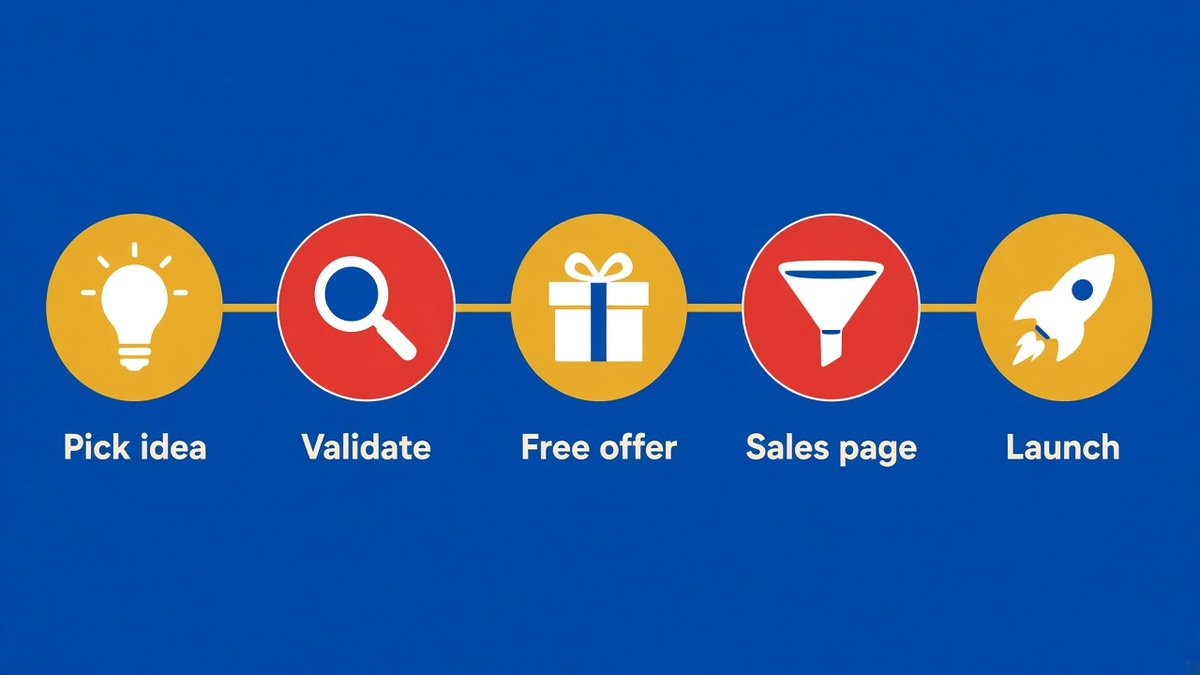
The launch path for any online business idea: pick, validate, create a free offer, build a sales page and launch.
Pick one idea and one audience
Write one sentence: “I help [who] get [result] with [service or product].” If you cannot fill it in, keep narrowing.
Validate with real people
Talk to 5 to 10 people in your target group. Ask about their problem, what they tried and what they paid. Better still, offer a pre-sale or a paid pilot. Money is the only real validation.
Create a free offer to collect emails
Offer a checklist, mini-course or template in exchange for an email address. This starts your list and shows you who is interested.
Build a simple sales page and checkout
One page that explains the problem, your solution, the price and a clear button. My guide on how to create a landing page walks you through it.
Connect the pieces into a simple funnel
Free offer, welcome emails, then your paid offer. If you want this all in one place, Systeme.io covers pages, email and payments, and ClickFunnels is a more advanced option if you plan to run paid ads. See how to build a sales funnel for the full method.
Launch, measure and improve
Share your offer with your list, your network and one marketing channel. Track sign-ups and sales weekly, and improve the weakest step first.
⚠️ Do not wait for perfect
Most new founders spend months polishing a logo and website that nobody visits. Launch a simple version in weeks, learn from real buyers, then improve.
How much money do you need to start?
You can start most of these online business ideas for less than $100 a month, and some for close to zero. A typical lean budget looks like this:
| Item | Lean option | Typical monthly cost |
|---|---|---|
| Domain name | Any registrar | About $1 (around $10 to $15 a year) |
| Website, email and checkout | Free plan of an all-in-one tool | $0 to start |
| Design | Free plan of a design tool | $0 |
| Video calls | Free plan of a video-call tool | $0 |
| Optional upgrade when sales start | Paid plan of your main tool | Varies, often $15 to $50 |
Systeme.io, for example, shows a free plan and paid plans from $17 a month on its pricing page (checked 16 Nov 2026), while ClickFunnels offers a 14-day free trial. Spend money only after an idea has made its first sales. Until then, your time is the real investment.
Legal and tax basics: US, UK and EU
I am not a lawyer or accountant, so treat this as a starting checklist and confirm the details for your country.
- United States: many solo founders start as a sole proprietor and later form an LLC for liability protection. Track income for self-employment tax, and check whether your state needs a business licence.
- United Kingdom: register as a sole trader with HMRC once you earn more than the trading allowance, or set up a limited company. VAT registration is required only above the VAT threshold.
- European Union: register your activity locally. For digital products sold to consumers in other EU countries, VAT is usually charged at the buyer’s rate, which the EU’s One-Stop Shop (OSS) scheme simplifies.
- Privacy: if you collect emails from people in the UK or EU, follow GDPR: clear consent, a privacy policy and an easy unsubscribe link.
💡 Keep business money separate
Open a separate account for business income and costs from day one. It makes tax time far easier. My guide to business record keeping shows a simple system.
Common mistakes new online founders make
- Chasing too many ideas at once. Pick one and give it at least 90 days of steady effort.
- Building before validating. Talk to customers first, then build what they ask for.
- Pricing too low. Cheap prices attract difficult clients and make it hard to grow. Price on the value of the result.
- Ignoring email. Social platforms change their rules; your list stays yours.
- Copying a big competitor’s model. Start smaller and more specific than them, then expand.
Tools to run an online business cheaply
You do not need a big tool stack. Start with one main platform and add tools only when you feel real pain. Here is a lean stack I recommend for most online business ideas:
| Need | Tool | Why it fits |
|---|---|---|
| Website, funnels, courses, email and payments | Systeme.io | All-in-one with a free plan, ideal for courses, coaching and digital products |
| Advanced funnels for paid ads | ClickFunnels | Strong funnel templates and split testing, 14-day free trial |
| Newsletter and creator email | Kit | Built for creators, with landing pages and simple automations |
| SEO and rank tracking | SE Ranking | Keyword research and rank tracking for blogs, affiliate sites and SEO services |
| Learning the business side | The $100 Startup (UK: Amazon.co.uk) | Real case studies of people who started with very little money |
Want to compare more options first? Browse my tool reviews, or read the Systeme.io review and ClickFunnels review.
Start your online business for free
Build your sales page, email list and course in one place with Systeme.io’s free plan, then upgrade only when you are making sales.
Affiliate link. I may earn a commission at no extra cost to you.
Frequently Asked Questions
What is the easiest online business to start?
A freelance service based on a skill you already have is usually the easiest. You need no product, only a simple portfolio and a few first clients, and you can earn money within weeks.
Which online business ideas need no money?
Freelancing, coaching, consulting, virtual assistance and newsletters can all be started with free tools. Your main investment is time. Spend money only after your first sales.
How long does it take to make money online?
Service businesses often make a first sale within one to two months. Content businesses such as blogs, YouTube channels and newsletters usually take six to twelve months to earn steady income.
Can I start an online business while working a full-time job?
Yes. Choose an idea that suits five to ten hours a week, such as digital products, a newsletter or a small freelance service, and check your employment contract for side-business rules.
Do I need to register my online business?
In most countries you must tell the tax authority once you earn income. In the US many start as a sole proprietor, in the UK as a sole trader, and in the EU you register locally. Check the rules where you live.
What is the most profitable online business idea?
There is no single winner. Courses, memberships and software scale best because they are built once and sold many times, but services usually bring profit faster. The most profitable idea is the one you will stick with.
Affiliate disclosure: Some links in this post are affiliate links. If you buy through them, I may earn a commission at no extra cost to you. I only recommend tools and books I believe are genuinely useful. As an Amazon Associate I earn from qualifying purchases.