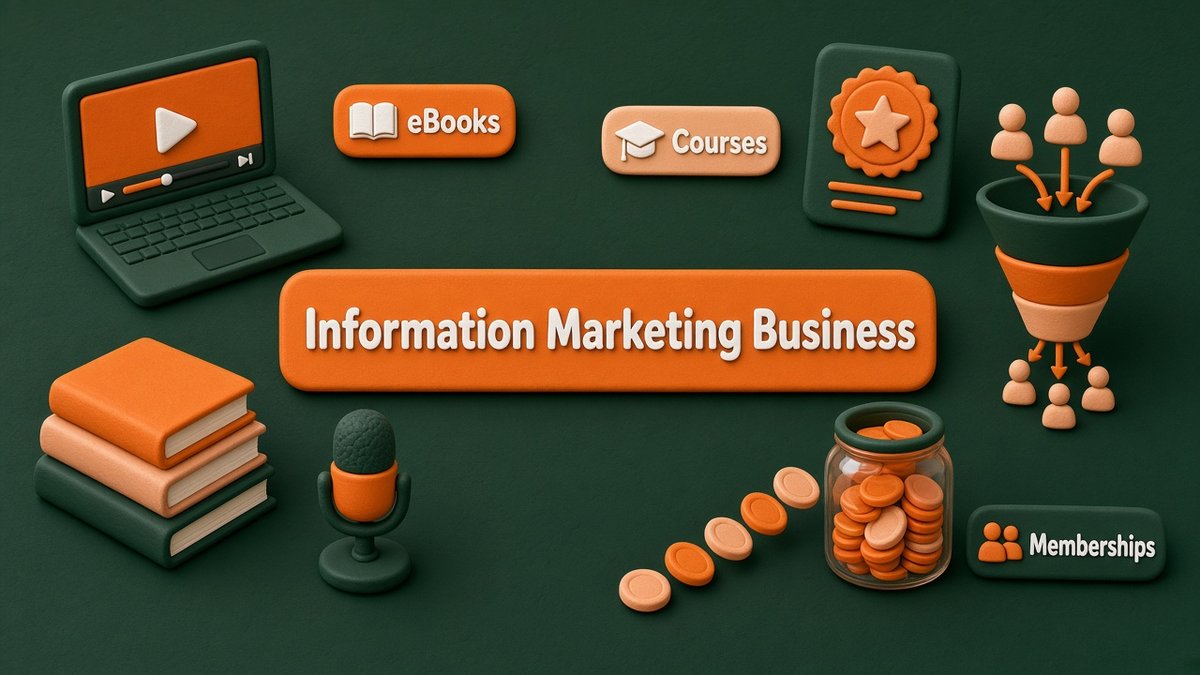
An information marketing business turns what you know into products people can buy again and again: ebooks, online courses, memberships, templates and paid coaching. You create the product once, build a simple system that brings in buyers, and sell it many times with almost no extra cost per sale. This guide explains how an information marketing business works in 2026, which products to start with, a seven-step launch plan, the funnel behind most successful info businesses, and the tax and legal basics for selling to customers in the US, UK and EU.
✔ Key takeaways
⏱ About 11 min read · the short version is right here
- Information marketing means packaging useful knowledge into digital products and selling them online to a clearly defined audience.
- The best first product is usually small and specific: a $19–$49 guide or template that solves one painful problem.
- Validate demand before you build: pre-sell, run a waitlist or ask your audience what they would pay for.
- Most info businesses run on one funnel: free lead magnet, email sequence, sales page, then an upsell.
- You can start for $0 with an all-in-one tool’s free plan and upgrade only when you hit real limits.
- Selling digital products to EU and UK consumers means charging VAT at the buyer’s local rate, so pick a checkout that handles it.
📋 In this guide
- What is an information marketing business?
- Why information marketing still works in 2026
- 7 information products you can sell
- Comparing the main business models
- How to start an information marketing business in 7 steps
- The simple funnel behind most info businesses
- Tools and costs: what you actually need
- VAT, refunds and earnings claims (US, UK, EU)
- Common mistakes to avoid
- FAQ
🔍 Checked on 12 Nov 2026: tool prices below come from my Systeme.io pricing and ClickFunnels pricing guides, both checked against the official pricing pages on 10–11 Nov 2026. Prices are in USD and may change.
What is an information marketing business?
An information marketing business creates, promotes and sells information-based products. The product is knowledge in a useful format: a step-by-step course, a short ebook, a library of templates, a private community or a coaching programme. Because the product is digital, it costs almost nothing to deliver to the tenth customer or the ten-thousandth.
The core idea is simple. Find a group of people with a strong, specific problem. Package the answer in the format they prefer. Then build a repeatable way to reach them and sell to them, usually through content, email and a sales page. The marketing system does the selling while you focus on making the product better.
📌 Information marketing is not the same as content marketing
Content marketing gives away free articles, videos and posts to build trust. Information marketing sells the deeper, structured version. Most info businesses use both: free content attracts the audience, and paid products serve the people who want the fast, complete path.
Why information marketing still works in 2026
People still pay for information even though so much is free online. The reason is time. A free blog post answers one question; a well-built course or template saves someone weeks of searching, testing and guessing. Buyers are paying for structure, curation and a clear result.
Margin
High profit per sale
After the product exists, each extra sale costs only payment fees and hosting. Margins of 80–95% are normal.
Startup cost
Low barrier to entry
No stock, no warehouse and no shipping. A laptop, a free tool plan and your expertise are enough to start.
Leverage
Sell while you sleep
An evergreen funnel and email sequence can sell around the clock to buyers in any time zone.
There is also an authority benefit. When someone buys a good product from you, they trust you more and are far more likely to buy the next one, hire you for a service or recommend you to a friend. Many consultants and coaches use a small info product as the first step in a bigger customer relationship.
⚠️ It is not passive income on day one
The first product takes real work: research, creation, testing and marketing. The leverage comes later, once the product and funnel are proven. Treat the first six months as building an asset, not cashing in.
7 information products you can sell
Pick a format that matches how your audience prefers to learn and how much support they need. You do not need all seven; most successful sellers start with one and add a second when the first one sells reliably.

Seven formats, from quick wins to premium programmes. Start small, then move up.
| Product | Typical price (USD) | Effort to create | Best for |
|---|---|---|---|
| Ebook or short guide | $9–$49 | Low | Testing a topic, first product |
| Templates, checklists, swipe files | $15–$99 | Low | Practical, “done for you” buyers |
| Mini-course (1–2 hours) | $29–$149 | Medium | Teaching one specific skill |
| Flagship online course | $197–$997 | High | Full transformation, proven topic |
| Membership or paid community | $9–$49 per month | Ongoing | Recurring income, continuing support |
| Group coaching or cohort | $300–$2,000 | Medium, live | Accountability and faster results |
| Paid newsletter or report | $5–$20 per month | Ongoing | Research-heavy, fast-moving niches |
If you are not sure where to start, a template pack or short guide is the lowest-risk option. If you already teach a skill, my guide on how to create an online course walks through outlining, recording and launching a full course.
Comparing the main business models
An information marketing business sits between freelancing and e-commerce. It scales better than trading hours for money and carries far less risk than buying physical stock. Here is how it compares with other common online business models.
| Model | Startup cost | Scales without you? | Main risk |
|---|---|---|---|
| Information marketing | Very low | Yes, once the funnel works | Building something nobody buys |
| Freelancing or consulting | Very low | No, income tied to hours | Burnout and income ceiling |
| E-commerce (physical products) | Medium to high | Partly | Stock, shipping and returns |
| Affiliate marketing | Low | Yes | Depends on traffic and partner programmes |
| Software or SaaS | High | Yes | Development cost and support load |
Many creators combine models. A consultant might sell a $39 toolkit, run a $99 a month membership and still take a few high-ticket clients. If you are still choosing a model, my list of ways to start an online business covers the wider options.
How to start an information marketing business in 7 steps
Choose a narrow, hungry market
Pick an audience with a specific, urgent problem and a habit of spending money to fix it. “Freelance designers who want to raise their rates” beats “people interested in design”. Look for active forums, Reddit threads, YouTube comments and paid competitors; competition is a sign of demand.
Validate before you build
Ask your audience what they struggle with, then test interest with a waitlist or a pre-sale page. If ten to twenty people pay or join before the product exists, you have a real offer. If nobody does, you saved yourself weeks of work.
Create a minimum useful product
Build the smallest version that delivers a clear result. A 40-page guide or a 90-minute course that solves one problem completely sells better than a sprawling course that tries to cover everything.
Price for value, not page count
Price according to the result and how much the problem costs your buyer, not how long the product is. My guide on how to price your product or service explains value-based pricing with examples.
Build your lead magnet and email list
Offer a free checklist, mini-guide or short video in exchange for an email address. Email is the channel you own; social reach can disappear overnight. See how to create a lead magnet for formats that convert.
Write the sales page and automate the funnel
Connect your opt-in page, a short welcome email sequence, the sales page and checkout. An all-in-one tool such as Systeme.io puts funnels, email, courses and payments in one account, so you are not stitching five apps together.
Drive traffic, measure and improve
Publish helpful content, use SEO, short videos or partnerships, and track three numbers: opt-in rate, email-to-sale conversion and refund rate. Improve the weakest number first, then add an upsell or second product.
💡 Pre-sell with a deadline
Offer founding buyers a lower price for a limited window, deliver the product live or in weekly modules, and use their questions to shape the final version. You get paid to build and you build what people actually want.
The simple funnel behind most info businesses
Almost every profitable information marketing business uses the same four-stage funnel. The names change, but the logic stays the same: give value first, build trust by email, then make a clear offer.
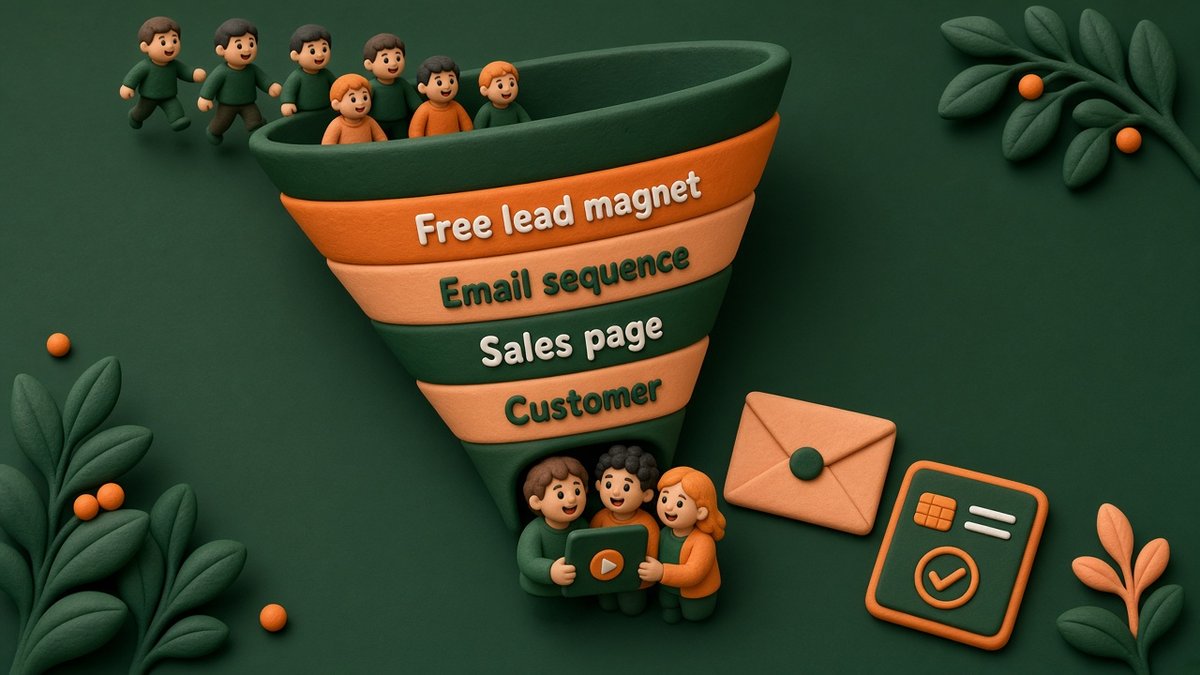
The classic info-product funnel: free value, email trust-building, a clear offer, then a happy customer.
| Stage | What happens | Benchmark to aim for |
|---|---|---|
| 1. Lead magnet | Visitor swaps an email for a free, useful resource | 20–40% opt-in on a focused landing page |
| 2. Email sequence | 5–7 emails teach, tell stories and introduce the offer | 40%+ open rate on welcome emails |
| 3. Sales page | Clear promise, proof, curriculum, price and guarantee | 1–3% of subscribers buy a low-ticket offer |
| 4. Upsell and follow-up | Order bump, upgrade or next product for buyers | 10–30% take a relevant order bump |
These benchmarks are rough starting points that vary widely by niche and traffic source, so compare your funnel against your own numbers month to month. For a full walkthrough, read my guide on how to build a sales funnel.
Tools and costs: what you actually need
You need four things: a place to host the product, a way to collect emails, a sales page and a checkout. You can buy separate tools for each or use one platform that does them all. For most beginners, all-in-one is simpler and cheaper.
| Tool | Starting price | Good for | Watch out for |
|---|---|---|---|
| Systeme.io | Free plan; paid from $17/month | Beginners: funnels, email, courses and checkout in one, 0% platform transaction fees | Fewer design options than premium builders |
| ClickFunnels | From $97/month (14-day trial) | Established sellers who want advanced funnels and A/B testing | Higher monthly cost before you have sales |
| Separate stack (course host, email tool, page builder) | Often $60–$150/month combined | Teams with specific needs | Integrations break and costs add up |
If you want to compare the two all-in-one options in depth, see my Systeme.io vs ClickFunnels comparison, the full Systeme.io review or my wider software reviews.
Start your info business for $0
Systeme.io’s free plan includes 2,000 contacts, 3 funnels, 1 course and unlimited emails, enough to launch and validate your first product.
Affiliate link. I may earn a commission at no extra cost to you.
VAT, refunds and earnings claims (US, UK, EU)
Digital products cross borders instantly, so a few rules apply even to a one-person business. This is general information, not tax or legal advice; check with an accountant in your country.
- EU VAT: sales of digital products to EU consumers are taxed at the VAT rate of the buyer’s country. EU-based sellers have a €10,000 cross-border threshold; non-EU sellers generally owe VAT from the first sale and can report through the One-Stop Shop (OSS) scheme.
- UK VAT: non-UK businesses selling digital services to UK consumers usually need to register and charge UK VAT from the first sale.
- US sales tax: taxability of digital products varies by state. A checkout or merchant-of-record service that calculates tax automatically saves a lot of admin.
- EU refund rules: EU consumers have a 14-day withdrawal right, which they lose for digital content only if they expressly agree to immediate access and acknowledge losing the right at checkout. Add that tick-box.
- Earnings claims: in the US, the FTC treats unsupported income claims as deceptive. Show typical results honestly and avoid “make $10k a month” promises.
- GDPR: collect only the data you need, get clear consent for marketing emails and link your privacy policy on every opt-in form.
Common mistakes to avoid
- Building for months before selling. Validate first; a waitlist or pre-sale tells you more than any survey.
- Choosing a topic that is too broad. “Marketing” is not a product; “email marketing for wedding photographers” is.
- Underpricing. Very low prices attract buyers who rarely finish the product and signal low value.
- No email list. Relying only on social media or marketplaces means you do not own your audience.
- Ignoring completion. Customers who finish and get results become testimonials and repeat buyers. Add checklists, short lessons and progress emails.
- Paying for advanced tools too early. Start on a free or entry plan and upgrade when contacts or features actually limit you.
Frequently Asked Questions
What is an information marketing business?
An information marketing business creates and sells knowledge-based products such as ebooks, online courses, templates, memberships and coaching. Products are made once and sold many times, usually through an email list and an automated sales funnel.
How much does it cost to start an information marketing business?
You can start for close to $0 using the free plan of an all-in-one tool such as Systeme.io. Most beginners spend under $50 a month in their first year, mainly on a domain, a paid tool plan and optional design help.
What is the best first information product?
A short, specific product such as a guide, template pack or mini-course priced around $19 to $49. It is quick to build, easy to validate and gives you buyers you can later offer a bigger course or membership.
Is information marketing still profitable in 2026?
Yes, when the product is specific and genuinely useful. Generic courses struggle against free content, but focused products that save time for a clear audience still sell well, especially with a strong email list.
Do I need to be an expert to sell information products?
You need to be meaningfully ahead of your buyer and able to get them a result, not a world-famous expert. Real experience, case studies and honest results matter more than credentials.
Do I need to charge VAT on digital products?
Often yes. Sales to EU and UK consumers are generally subject to VAT at the buyer’s local rate, and some US states tax digital goods. Use a checkout that calculates tax and confirm the rules with an accountant.
Ready to plan your first product? Start with the lead magnet, build your list, and let your first buyers tell you what to create next.
Affiliate disclosure: some links in this post are affiliate links, so I may earn a commission at no extra cost to you. I only recommend tools I’d use myself.