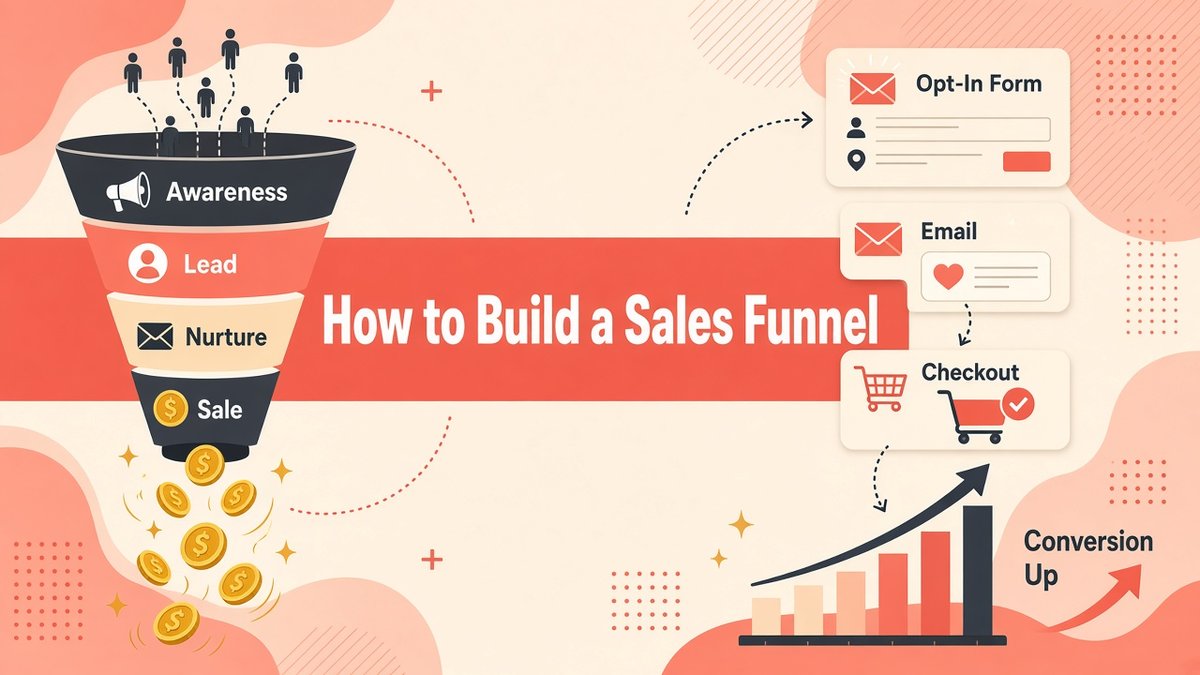
Learning how to build a sales funnel is one of the most useful skills for any small business, coach, freelancer or online creator. A sales funnel is simply the path a stranger takes from first hearing about you to buying, and then buying again. Without one, you rely on luck and one-off visitors. With a simple, well-planned funnel, you capture interested people, build trust by email and make offers at the right moment. In this guide, I explain each stage, walk through a full worked example with real numbers and show you the metrics that tell you whether your funnel is working, with notes for readers in the US, UK and Europe.
✔ Key takeaways
- A sales funnel turns strangers into leads, leads into customers and customers into repeat buyers.
- The core stages are awareness, opt-in, nurture, offer, checkout, upsell and retention.
- Start simple: one traffic source, one lead magnet, a 5-email sequence and one clear offer.
- Track conversion rate at each stage so you know exactly where people drop off.
- An all-in-one tool keeps pages, email, checkout and automation in one place.
- In the UK and EU, get clear consent for marketing emails to stay GDPR compliant.
📋 In this guide
What is a sales funnel?
A sales funnel is the series of steps that moves people from awareness to purchase. It is called a funnel because many people enter at the top and fewer reach the bottom. That is normal. The job of a good funnel is not to keep everyone, but to guide the right people forward and make each next step obvious.
In practice, a basic online funnel is a few connected pieces: content or ads that attract visitors, a landing page with a free offer, an email sequence that builds trust, a sales page, a checkout and a follow-up after purchase. You can build it in a weekend and improve it for years.
| Funnel part | Classic name | Main job |
|---|---|---|
| Top | TOFU (top of funnel) | Attract attention and visitors |
| Middle | MOFU (middle of funnel) | Capture leads and build trust |
| Bottom | BOFU (bottom of funnel) | Turn leads into paying customers |
| After the sale | Retention / loyalty | Increase lifetime value and referrals |
The 7 stages of a sales funnel
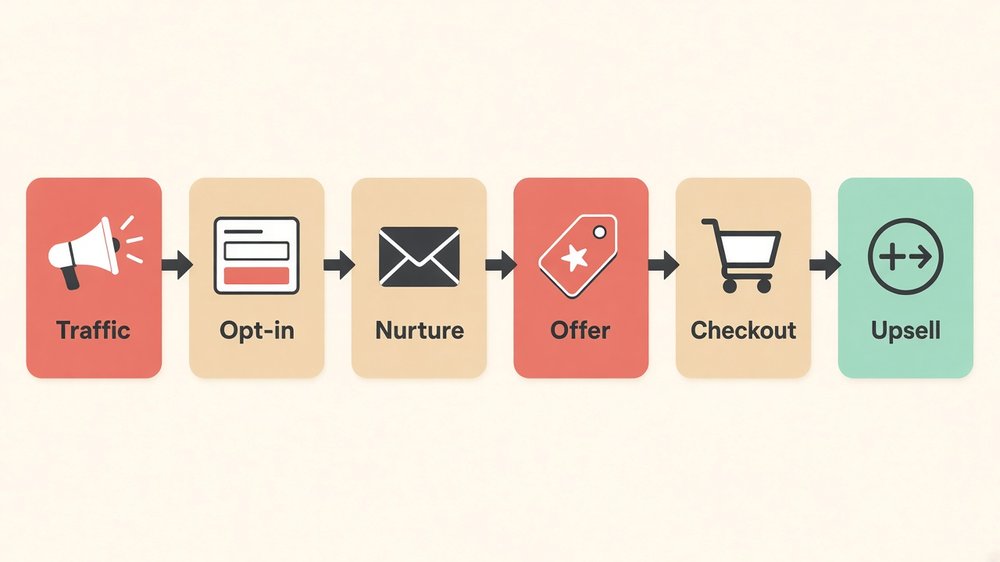
The core sales funnel flow: traffic, opt-in, nurture, offer, checkout and upsell. Retention keeps customers coming back after the sale.
Here are the seven stages I use when planning a funnel. Every stage has one job and one main metric.
- 1. Awareness: people discover you through search, social media, ads, podcasts or referrals.
- 2. Lead magnet and opt-in: you offer something useful for free in exchange for an email address.
- 3. Nurture emails: a short automated sequence that delivers value, tells your story and builds trust.
- 4. Offer: a sales page that presents your product or service clearly, with proof and a guarantee.
- 5. Checkout: a simple, trustworthy payment page with as few fields as possible.
- 6. Upsell: a relevant extra offered right after purchase, such as an order bump or upgrade.
- 7. Retention: onboarding, check-ins and offers that turn buyers into repeat customers and fans.
How to build a sales funnel step by step
Define your customer and your offer
Write one sentence: “I help [who] get [result] with [offer].” Your funnel should lead to a single core offer. If you sell five things, start with the one most people buy first.
Choose one traffic source
Pick the channel where your customers already spend time and you can show up consistently: SEO blog posts, YouTube, LinkedIn, Instagram, Pinterest or paid ads. One channel done well beats four done badly.
Create a lead magnet
Offer a quick win related to your paid offer: a checklist, template, mini-course, calculator or free consultation. My guide on how to create a lead magnet covers formats and examples.
Build the opt-in page
Use a short headline that names the result, three bullet points, an image of the freebie and a form asking only for first name and email. For UK and EU visitors, explain what emails they will receive and link to your privacy policy.
Write a 5-email nurture sequence
Deliver the freebie, share your story, give your best tip, show a customer result and then make a soft offer. See my welcome email sequence template for a ready-made structure.
Build the sales page and checkout
Lead with the problem and the result, then show what is included, proof, price, guarantee and FAQs. Keep checkout simple, show the total including VAT where required and offer common payment options.
Add an upsell and a follow-up
Offer one relevant add-on after purchase, then send onboarding emails that help customers succeed. Happy customers buy again and refer others.
Launch, measure and improve
Send real traffic, wait for enough data and fix the weakest stage first. Small changes to headlines and offers often double results.
💡 Start with the bottom
If you are not sure where to begin, build the offer and checkout first. A funnel full of leads is useless if the final step does not convert.
Worked example: a funnel for a freelance designer
Let us make this concrete. Imagine Maya, a freelance brand designer in Manchester who sells a $490 brand starter kit to new small businesses in the UK, US and Europe.
- Awareness: Maya publishes two Pinterest pins and one blog post a week on branding tips for small businesses.
- Lead magnet: a free “Brand Basics Checklist” PDF with 12 checks before you launch.
- Nurture: five emails over 10 days: checklist delivery, her story, the three most common logo mistakes, a before-and-after case study and an invitation to the starter kit.
- Offer: a $490 brand starter kit (logo, colours, fonts and social templates) with a 14-day revision guarantee.
- Checkout: one page, card and PayPal, VAT handled for UK and EU buyers.
- Upsell: a $150 business card and letterhead pack offered on the thank-you page.
- Retention: a 30-day check-in email and a discount on website design six months later.
Here is what the numbers might look like after one month:
| Stage | People | Conversion | Notes |
|---|---|---|---|
| Visitors to blog and pins | 4,000 | – | From Pinterest and Google |
| Opt-in page visitors | 1,200 | 30% click-through | Checklist promoted in every post |
| Email subscribers | 420 | 35% opt-in rate | Healthy for a focused freebie |
| Sales page visitors | 150 | 36% of subscribers | Clicks from emails 4 and 5 |
| Customers | 9 | 6% of sales page visitors | 9 x $490 = $4,410 |
| Upsell buyers | 3 | 33% take rate | 3 x $150 = $450 |
Total revenue: $4,860 from 4,000 visitors, or about $1.22 per visitor. Now Maya knows exactly what a visitor is worth and can decide what she can afford to spend on ads or content. If she lifts the sales page conversion from 6% to 8%, revenue rises by about a third without any extra traffic.
📌 These numbers are illustrative
Conversion rates vary widely by industry, price and traffic quality. Use your own data after a few weeks rather than chasing benchmarks.
Writing the nurture email sequence
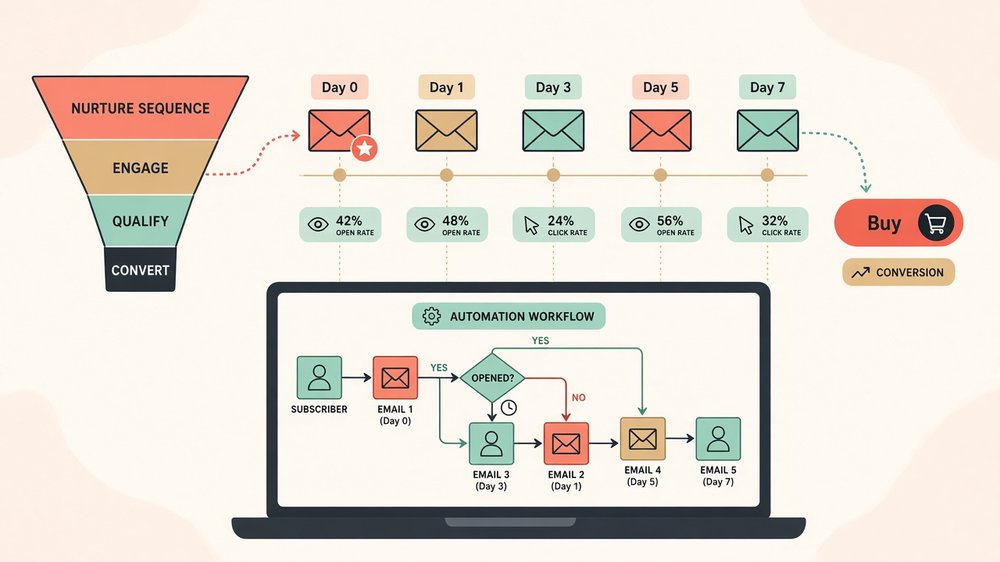
A nurture email sequence delivers the lead magnet, builds trust over several days and then makes a clear offer.
The nurture stage is where most of the trust is built. Keep emails short, personal and focused on one idea each:
- Email 1 (instant): deliver the lead magnet and say what to expect next.
- Email 2 (day 1): your story and why you do this work.
- Email 3 (day 3): your single most useful tip or framework.
- Email 4 (day 5): a customer result or case study.
- Email 5 (day 7): introduce your offer with a clear link and a deadline or bonus if genuine.
After the sequence, move subscribers into your regular newsletter so they keep hearing from you. My guide to email marketing for small business covers list building and newsletters in more detail.
⚠️ GDPR and consent
If you market to people in the UK or EU, you need clear, freely given consent for marketing emails. Do not pre-tick boxes, say what you will send and make unsubscribing easy. Keep records of when and how each person signed up.
Tools to build your funnel
You can build a funnel by stitching together a website builder, an email tool and a payment processor, but each extra tool adds cost and things that can break. An all-in-one funnel builder is usually simpler for a small business.
I recommend starting with Systeme.io because it combines landing pages, email automation, checkout, upsells, courses and affiliate management in one place. When I checked its pricing page on 28 October 2026, the free plan included up to 2,000 contacts and 3 sales funnels, and paid plans started at $17 per month (Startup), with Webinar at $47 and Unlimited at $97 per month. That is enough to build and test the entire funnel in this guide before paying anything.
| Tool | Starting price | Best for |
|---|---|---|
| Systeme.io | Free plan; paid from $17/month | Beginners who want pages, email and checkout in one tool |
| ClickFunnels | Check current pricing | Advanced funnels and a large template library |
| WordPress + email tool + Stripe | Varies | People who already run a WordPress site |
| Kit, MailerLite | Free plans available | Email-first funnels with simple landing pages |
If you want more options, compare them in my list of the best free funnel builders or read my detailed Systeme.io vs ClickFunnels comparison. ClickFunnels is a strong choice for more advanced marketers who want split testing and a big template library, but it costs more, so check its current pricing first.
⚠️ Check prices before you buy
Prices are listed in USD and can change. EU and UK buyers may also pay VAT. Always confirm on the official pricing page.
Sales funnel metrics to track
Measure each stage separately. Then you can fix the weakest link instead of guessing.
| Metric | How to calculate | What it tells you |
|---|---|---|
| Opt-in rate | Subscribers / opt-in page visitors | Whether your lead magnet and page are compelling |
| Email open and click rate | Opens or clicks / emails delivered | Whether subscribers trust and engage with you |
| Sales page conversion | Buyers / sales page visitors | Whether your offer, price and proof convince people |
| Checkout completion | Completed orders / checkouts started | Whether payment friction is costing you sales |
| Upsell take rate | Upsell buyers / customers | Whether the add-on is relevant and well timed |
| Average order value (AOV) | Revenue / number of orders | How much each customer spends per order |
| Customer lifetime value (LTV) | Average revenue per customer over time | How much you can afford to spend to get a customer |
| Cost per acquisition (CPA) | Marketing spend / new customers | Whether the funnel is profitable |
Review these monthly. Change one thing at a time, such as a headline, the lead magnet or the price, and give each change enough traffic to judge. For retention ideas after the sale, see my post on customer retention strategies.
Common sales funnel mistakes
- Building everything before testing anything: launch a basic version, then improve.
- A lead magnet unrelated to the offer: a free recipe ebook will not sell accounting services.
- Too many steps: every extra page or form field loses people.
- Pitching too early or never: give value first, but do make a clear offer.
- No follow-up after purchase: repeat customers are cheaper than new ones.
- Ignoring mobile: most visitors will see your pages on a phone first.
Frequently Asked Questions
How do I build a sales funnel for free?
Use a tool with a free plan, such as Systeme.io, to create an opt-in page, a short email sequence and a sales page with checkout. Drive traffic with free channels like SEO blog posts, Pinterest or LinkedIn, then upgrade only when you outgrow the limits.
What are the stages of a sales funnel?
A simple sales funnel has seven stages: awareness, lead magnet and opt-in, nurture emails, offer, checkout, upsell and retention. Many people group them into top, middle and bottom of the funnel.
How long does it take to build a sales funnel?
A basic funnel with one landing page, five emails, a sales page and checkout can be built in a weekend. Improving it with real data usually takes a few months of testing.
What is a good sales funnel conversion rate?
It depends on your industry, price and traffic. As a rough guide, many opt-in pages convert 20% to 40% of visitors, and many sales pages convert 1% to 5% of visitors. Compare against your own past results rather than general benchmarks.
Do I need a website to build a sales funnel?
No. Funnel builders host your landing pages, sales pages and checkout for you. A website helps with SEO and credibility, but you can start with funnel pages alone.
Is a sales funnel GDPR compliant?
It can be. Collect clear opt-in consent, explain what emails people will receive, link to a privacy policy, store consent records and make unsubscribing easy. Choose tools that offer a data processing agreement.
Final thoughts
Now you know how to build a sales funnel from start to finish: attract the right people, offer a useful freebie, nurture them by email, make a clear offer, keep checkout simple, add a relevant upsell and look after customers once they buy. Start with the simplest version that works, measure every stage and improve the weakest step each month.
Your next step: write your one-sentence offer, pick one lead magnet idea and build the opt-in page this week.
Build your first sales funnel for free
Systeme.io gives you landing pages, email automation, checkout and upsells in one place, with a free plan to get started.
Affiliate link. I may earn a commission at no extra cost to you.
Affiliate disclosure: some links in this post are affiliate links, so I may earn a commission at no extra cost to you. I only recommend tools I’d use myself.