
Knowing how to write a marketing plan is what separates businesses that market on purpose from those that post when they remember and hope something sticks. A good marketing plan does not need to be a 40-page document. For most small businesses, freelancers and online creators, it is a few clear pages that answer who you are selling to, what you want to achieve, which channels you will use, how much you will spend and how you will know it is working.
✔ Key takeaways
- A marketing plan turns business goals into specific actions, channels, budgets and deadlines.
- Start with your customer and your numbers, not with a list of social networks.
- Set two or three SMART goals for the next 90 days instead of ten vague ones.
- Choose fewer channels and do them well. Most small businesses need two or three, not seven.
- Track a small set of metrics monthly and adjust the plan every quarter.
- A one-page plan you actually use beats a long plan that sits in a folder.
📋 In this guide
- What is a marketing plan?
- Why a small business needs one
- The 8 sections of a simple marketing plan
- How to write a marketing plan, step by step
- Setting a realistic marketing budget
- Choosing channels and building a calendar
- Measuring results and adjusting
- A one-page marketing plan template
- Common marketing plan mistakes
- Frequently Asked Questions
- Final thoughts
What is a marketing plan?
A marketing plan is a written roadmap for how you will attract and keep customers over a set period, usually the next 3 to 12 months. It sits underneath your business plan: the business plan explains what the company does and how it makes money, while the marketing plan explains how you will reach the right people and turn them into paying customers.
Think of it as the bridge between a goal such as “grow revenue this year” and the weekly work of writing emails, publishing content, running ads or calling leads.
Why a small business needs one
Without a plan, marketing tends to become reactive. You copy what competitors are doing, jump on every new platform and spend money on boosts or ads without knowing what they returned. A plan helps you:
- Focus your limited time and budget on the activities most likely to work.
- Stay consistent, which matters more than brilliance in most marketing.
- Measure what is working so you can do more of it and drop the rest.
- Delegate clearly, because a freelancer or new hire can follow a written plan.
📌 Plans change, and that is fine
A marketing plan is a living document. The point is not to predict the future perfectly but to make deliberate choices you can review and improve.
The 8 sections of a simple marketing plan
Most small business marketing plans can be built from these eight sections:
| Section | What it answers |
|---|---|
| 1. Business summary | What you sell, to whom, and what makes you different |
| 2. Goals | What you want marketing to achieve in the next 90 days or 12 months |
| 3. Target audience | Who your ideal customer is, their problems and where they spend time |
| 4. Competitor and market review | Who else they could buy from, and the gap you fill |
| 5. Positioning and message | Your core promise and the few key messages you repeat |
| 6. Channels and tactics | Where and how you will reach people |
| 7. Budget | What you will spend on tools, ads, content and help |
| 8. Metrics and review | How you will measure success and when you will review |
How to write a marketing plan, step by step
Review where you are now
Look at the last 6 to 12 months: where did customers come from, what did you spend, which posts, emails or ads brought enquiries? Even rough answers are useful. A quick SWOT (strengths, weaknesses, opportunities, threats) helps here.
Set SMART goals
Make each goal specific, measurable, achievable, relevant and time-bound. For example: grow the email list from 400 to 1,000 subscribers by the end of March, or book eight discovery calls a month by June. Two or three goals is plenty.
Define your target audience
Write a short customer profile: their role or situation, the problem that makes them look for you, what they have already tried, and where they hang out online and offline.
Study your competitors
Pick three to five competitors. Note their offers, prices, messages and main channels, and where customers complain about them in reviews. That is often where your opportunity sits.
Sharpen your positioning
Finish the sentence: we help [who] get [result] without [pain], unlike [alternative]. Use it to shape your website headline, social bios and sales conversations.
Pick channels and tactics
Choose two or three channels that match where your audience is and what you can sustain, then list the specific tactics for each one.
Set the budget
Allocate money and time to each channel, including tools and any freelance help.
Choose metrics and a review rhythm
Decide the handful of numbers you will track and put a monthly check and a quarterly review in your calendar.

Know your ideal customer and your competitors before choosing channels in your marketing plan.
Steps 3 and 4 are where most of the value is. If you know exactly who you serve and why they would choose you over the alternatives, the rest of the plan becomes much easier to write. Your pricing should support that positioning too, so revisit how you price your product or service while you are here.
Setting a realistic marketing budget
There is no single correct marketing budget. Some businesses set it as a percentage of revenue, others start from the goal and work backwards to what it should cost to win a customer. For a small business, the most useful approach is usually a mix of both: decide what you can afford to spend without risking cash flow, then split it across the channels in your plan.
| Budget item | Examples | Tip |
|---|---|---|
| Tools | Email platform, website hosting, design tool, scheduling tool | Start on free plans and upgrade only when you hit limits |
| Content | Blog posts, videos, photos, lead magnets | Reuse one strong piece across several channels |
| Paid ads | Search, social or marketplace ads | Test with a small, fixed monthly amount before scaling |
| People | Freelance writer, designer, ads specialist | Write a clear brief from your plan before hiring |
| Buffer | New tests and opportunities | Keep a small slice unallocated for experiments |
💡 Count your time too
If you are doing the marketing yourself, put hours per week into the budget. A plan that needs 20 hours a week from a solo founder who has 5 will not survive the first month.
Choosing channels and building a calendar
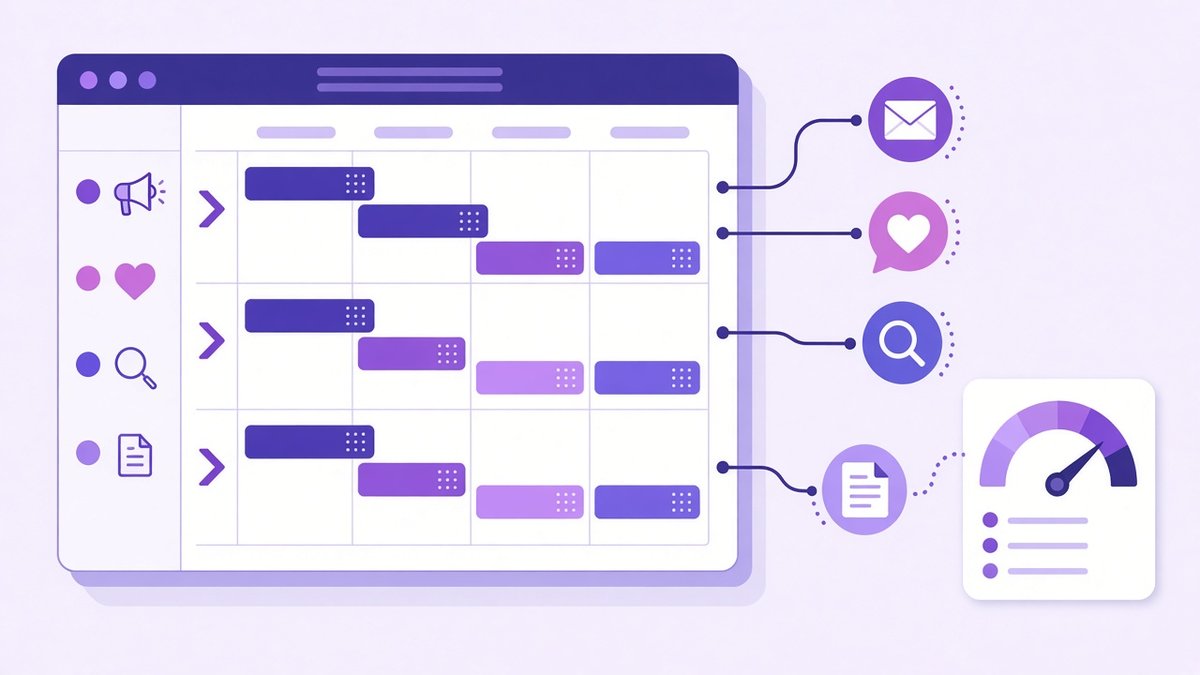
A simple marketing calendar maps each campaign to its channel and the metric you will watch.
Pick channels based on where your audience already looks for help and on what you can keep doing every week. Common choices for small businesses:
- Email marketing: the channel you own, with no algorithm in the way. My guide to email marketing for small business covers the basics, and tools such as Kit make it easy to start with a free plan if you are a creator or newsletter writer.
- Search and content: blog posts and guides that answer the questions your customers type into Google. Slow to start, but they keep working for years.
- Social media: best for visibility and trust when you choose one or two platforms your audience actually uses. Strong visuals help, as covered in these visual marketing strategy tips.
- Partnerships and referrals: other businesses that serve the same customers, plus happy clients who recommend you.
- Paid ads: useful for speed and testing offers, once you know your numbers.
If you sell online, a simple sales funnel ties these channels together: a free lead magnet, an email sequence and an offer page. An all-in-one tool such as Systeme.io lets you build that funnel, the email list and the checkout in one place, and I compare more options in my list of the best free funnel builders.
Then turn your channel choices into a calendar. A spreadsheet with weeks across the top and channels down the side is enough. Plan one main campaign per month or quarter, such as a product launch, a seasonal offer or a webinar, and fill in the supporting posts and emails around it.
Measuring results and adjusting
Each goal in your plan needs at least one number you can check. Keep the list short:
| Goal | Metric to track | Check |
|---|---|---|
| More leads | New email subscribers, enquiries, booked calls | Weekly |
| More sales | Conversion rate, number of new customers, revenue from marketing | Monthly |
| Lower cost | Cost per lead and cost per customer by channel | Monthly |
| Better retention | Repeat purchase rate, churn, referrals | Quarterly |
For a fuller list of numbers worth watching across the business, see my guide to small business KPIs. Keeping customers is usually cheaper than finding new ones, so give your customer retention strategies a place in the plan too.
⚠️ Watch out for vanity metrics
Likes, followers and page views feel good, but they only matter if they lead to leads and sales. Track them, but do not set your goals around them.
A one-page marketing plan template
If you want to start today, copy this structure into a document and fill in one or two lines per heading:
| Heading | Your answer |
|---|---|
| Who we help | Ideal customer in one sentence |
| Main promise | We help [who] get [result] without [pain] |
| 90-day goals | Two or three SMART goals |
| Channels | Two or three, with weekly activity for each |
| Main campaign | The one big push this quarter |
| Budget | Money and hours per month, per channel |
| Metrics | Three to five numbers, with who checks them and when |
| Review date | The date you will review and update the plan |
Common marketing plan mistakes
- Too many goals: if everything is a priority, nothing is.
- No clear audience: “everyone” is not a target market.
- Channel overload: being average on six platforms rarely beats being excellent on two.
- No budget for time: plans fail when nobody has the hours to carry them out.
- Never reviewing: a plan you never look at again is just a wish list.
- Ignoring privacy rules: if you market to people in the UK or EU, collect clear consent for email marketing under GDPR and the UK and EU e-privacy rules.
Frequently Asked Questions
What should a small business marketing plan include?
A business summary, goals, target audience, competitor review, positioning and key messages, channels and tactics, a budget, and the metrics and review dates you will use to measure progress.
How long should a marketing plan be?
For most small businesses, one to five pages is enough. A one-page plan you use every week is more valuable than a long document nobody opens.
How often should I update my marketing plan?
Check your key metrics monthly and review the full plan every quarter. Update it whenever your offer, audience or budget changes significantly.
What is the difference between a marketing plan and a marketing strategy?
The strategy is your big-picture approach: who you target and how you position yourself. The marketing plan turns that strategy into specific goals, channels, budgets, tasks and deadlines.
How much should a small business spend on marketing?
It depends on your margins, goals and stage. Start with an amount you can sustain without hurting cash flow, test it on a few channels and increase spend on what brings customers at a profitable cost.
Final thoughts
Learning how to write a marketing plan is really about making a few clear decisions: who you serve, what you want to achieve, where you will show up and how you will measure it. Start with the one-page template above, commit to two or three channels for the next 90 days and put your first review date in the calendar. You can refine everything else as the results come in.
Building the plan alongside a clear business plan keeps your marketing tied to the numbers that matter.
Put your marketing plan into action
Build your email list, sales funnel and checkout in one place with Systeme.io, which has a free plan to get started.
Affiliate link. I may earn a commission at no extra cost to you.
Affiliate disclosure: some links in this post are affiliate links, so I may earn a commission at no extra cost to you. I only recommend tools I’d use myself.