A marketing strategy is the difference between a business that grows on purpose and one that hopes the next post, ad or discount will finally work. Without one, small teams jump from tactic to tactic, spend money in too many places and never learn what actually brings in customers. With one, every campaign has a clear audience, a clear message and a clear goal. In this guide I explain what a marketing strategy is, why you need one, and how to build yours in seven practical steps, whether you sell in the US, the UK, Europe or online worldwide.
🔍 Checked on 7 Nov 2026: tool plans and free tiers from the official Systeme.io, Kit and SE Ranking websites. Prices are in US dollars, before VAT or sales tax, and can change.
✔ Key takeaways
⏱ About 10 min read · the short version is right here
- A marketing strategy is your long-term plan for who you serve, why they should choose you and how you will reach them.
- Strategy comes first; the marketing plan, campaigns and tactics come after it.
- Build it in seven steps: goals, ideal customer, positioning, offer and price, channels, funnel and budget, then measurement.
- Pick one or two channels you can do well instead of five you do badly.
- Track a few numbers monthly, such as leads, conversion rate and cost per customer, and review the strategy every quarter.
📋 In this guide
- What is a marketing strategy?
- Why every small business needs one
- The core parts of a marketing strategy
- How to create a marketing strategy in 7 steps
- Marketing strategy examples
- How to measure your marketing strategy
- Common mistakes to avoid
- Tools that make it easier
- A book worth reading
- Frequently Asked Questions
What is a marketing strategy?
A marketing strategy is a long-term plan that explains how your business will attract and keep the right customers. It answers five questions: who you serve, what problem you solve for them, why they should choose you over the alternatives, where you will reach them, and how you will know it is working.
People often mix up strategy, plans and tactics. The simplest way to separate them is by time and detail. Strategy is the direction you hold for a year or more. The plan turns that direction into campaigns for the next quarter. Tactics are the individual actions, like a newsletter, a landing page or a LinkedIn post.
| Level | Question it answers | Time frame | Example |
|---|---|---|---|
| Marketing strategy | Who, why and where? | 1 to 3 years | Become the go-to bookkeeping service for freelance designers in the UK |
| Marketing plan | What, when and how much? | 1 quarter to 1 year | Q1: launch a free tax checklist, run a webinar, budget £600 |
| Tactics | What do we do today? | Days to weeks | Write three blog posts and send two emails this week |
Once your strategy is clear, writing the detailed plan becomes much easier. I cover that part in my guide on how to write a marketing plan.
Why every small business needs a marketing strategy
Big brands can afford to test everything. Small businesses cannot. A clear strategy protects your time and budget by telling you what to ignore. It also keeps your message consistent, so a prospect who sees your website, your emails and your social posts gets the same promise every time, which builds trust faster.
A strategy also makes growth measurable. When you know your goal, your ideal customer and your main channel, you can see which efforts move the numbers and which only feel busy. That is how a one-person business competes with larger rivals: by being focused, not by being everywhere.
📌 Strategy beats more effort
If you are posting every day but sales are flat, the problem is rarely effort. It is usually an unclear audience, a weak offer or the wrong channel. Fix the strategy and the same effort starts to pay.
The core parts of a marketing strategy
Every good marketing strategy, from a local café to a SaaS start-up, has the same building blocks. The classic 4 Ps (product, price, place and promotion) still work as a checklist, but in 2026 (see current small business marketing trends) you also need clear positioning and a way to measure results.
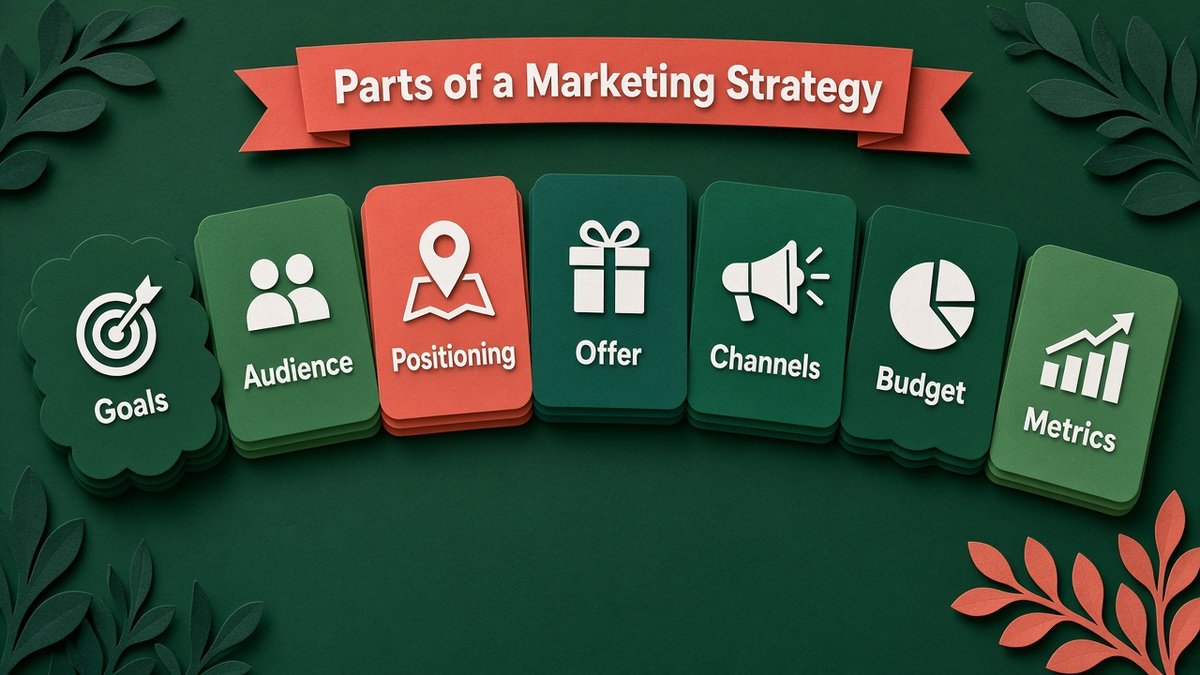
| Part | What it covers | Ask yourself |
|---|---|---|
| Goals | The business result marketing must deliver | How many new customers or how much revenue do I need this year? |
| Target customer | A specific, reachable group of buyers | Who needs this most and can afford it? |
| Positioning | Why you, not a competitor | What do we do better or differently? |
| Product and price | The offer and how you charge for it | Is the offer clear and priced for the value it gives? |
| Place and channels | Where buyers find and buy from you | Where does my customer already spend attention? |
| Promotion and funnel | The path from stranger to customer | What happens after someone first finds me? |
| Metrics | The numbers you track | How will I know in 90 days if this is working? |
How to create a marketing strategy in 7 steps
You do not need a 40-page document. A clear two-page marketing strategy that you actually use is worth more than a long one that sits in a folder. Work through these seven steps in order and write a short answer for each.
Set one or two clear goals
Start with the business result, not the marketing activity. For example: 40 new clients this year, or €5,000 a month in online course sales. Make goals specific and time-bound so you can check progress every month.
Define your ideal customer
Describe one main customer group in detail: their job or situation, their biggest problem, what they have already tried and where they look for help. Talk to five real customers if you can; their words will become your best marketing copy.
Study competitors and position yourself
List three competitors and note their promise, price and weak spots. Then write one sentence that says who you help, what result you deliver and why you are different. My guide to competitor analysis for small business gives you a simple template.
Shape your offer and price
Make sure the offer matches the problem you identified. Package it clearly, show the result, and price for value rather than hours. A simple entry offer, such as a starter package or a low-cost product, can make the first purchase easier.
Choose one or two main channels
Pick channels your customers already use and you can keep up with: search content, email, LinkedIn, local partnerships or paid ads. For many small businesses, search plus an email list is the most reliable long-term mix. If search is one of your channels, a tool like SE Ranking helps you find keywords and track rankings.
Map your funnel and set a budget
Plan the path from first visit to sale: a lead magnet, a landing page, a short welcome email sequence and a clear offer. An all-in-one tool such as Systeme.io lets you build that funnel on a free plan before you spend on ads. See how to build a sales funnel for the full process, then set a monthly budget you can keep for at least three months.
Decide what you will measure
Choose three to five numbers that link to your goal, set a monthly review date and agree what you will change if a channel underperforms for two months in a row.
💡 Quick test for your strategy
Read your answers to a friend who knows nothing about your business. If they can explain back who you serve and why they would choose you, the strategy is clear enough to act on.
Marketing strategy examples
Here are three short, realistic examples to show how the same framework fits very different businesses.
- Local bakery in Lisbon: goal of 25% more weekday sales; target office workers within one kilometre; positioning as the fastest fresh lunch nearby; channels are Google Business Profile, a loyalty card and a weekly WhatsApp or email offer.
- B2B consultant in Germany: goal of eight new retainer clients; target operations managers at 20 to 100 person firms; positioning around one specialist outcome; channels are LinkedIn articles, a monthly webinar and a newsletter.
- Online course creator in the US: goal of $60,000 in course sales; target beginners in one niche; positioning as the most practical, step-by-step course; channels are YouTube and search content feeding a free mini-course and an email sequence.
Notice that each example uses email in some form. An owned list is the one channel no algorithm can take away. If you are starting from zero, my guide to email marketing for small business shows how to build one, and Kit is a strong choice if newsletters and creator-style email are central to your strategy.
How to measure your marketing strategy
A strategy without numbers is just an opinion. Keep measurement simple: a few metrics, checked on the same day each month, in a spreadsheet or dashboard you actually open.
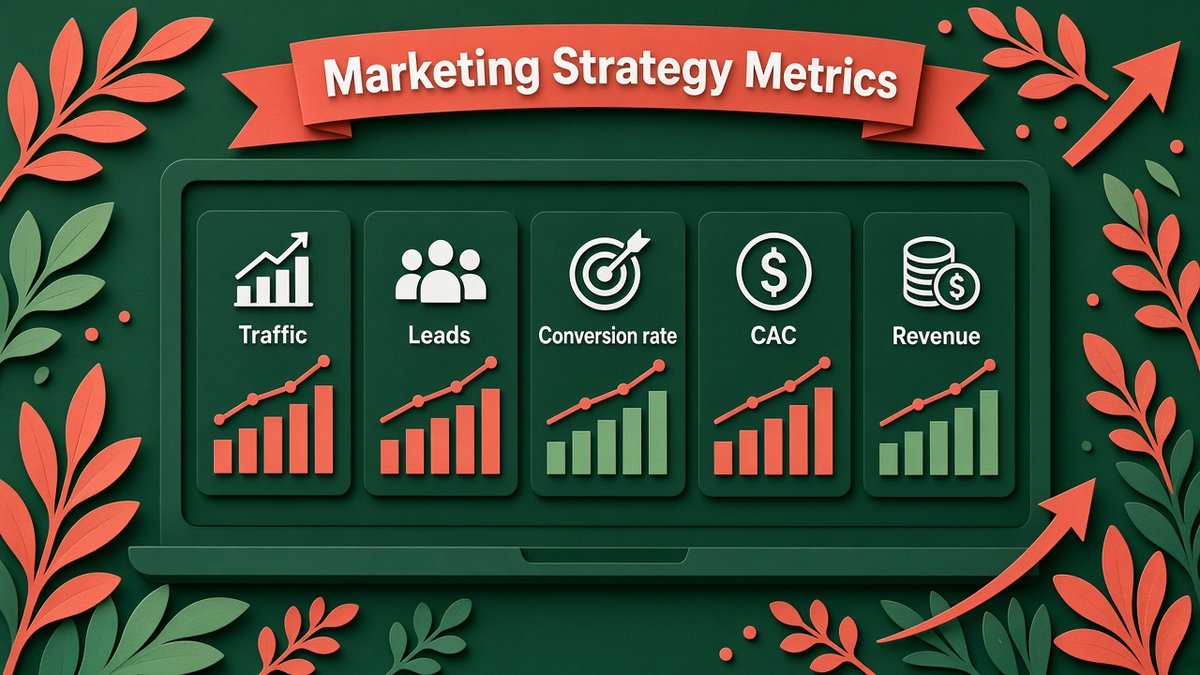
| Metric | What it tells you | Review |
|---|---|---|
| Leads per month | Whether your channels attract enough interest | Monthly |
| Conversion rate | How well your offer and funnel turn leads into buyers | Monthly |
| Customer acquisition cost | How much you spend to win one customer | Monthly |
| Customer lifetime value | How much a customer is worth over time | Quarterly |
| Revenue from marketing | Whether marketing hits the business goal | Quarterly |
If you want a ready list of numbers, my guide to small business KPIs explains which ones matter at each stage of growth.
Common marketing strategy mistakes to avoid
- Targeting everyone. A message for everyone persuades no one. Narrow the audience first; you can widen it later.
- Copying big brands. Large companies buy awareness. Small businesses need direct response: a clear offer and a clear next step.
- Too many channels. Five half-used channels lose to one channel done consistently.
- No follow-up. Most buyers do not purchase on the first visit. Without email or retargeting, you lose them.
- Never reviewing. Markets, prices and platforms change. A strategy that is never revisited slowly goes out of date.
⚠️ Avoid this trap
Do not change your whole strategy after two weeks of weak results. Most channels need at least 90 days of steady work before the numbers mean anything.
Tools that make your marketing strategy easier
You can start with free tools and add paid ones only when a channel proves itself. Here is a simple stack that works for most small businesses.
| Tool | Cost | Best for |
|---|---|---|
| Google Analytics | Free | Seeing where visitors come from and what they do |
| Google Search Console | Free | Search queries, clicks and indexing |
| Systeme.io | Free plan, paid from $17/month | Landing pages, funnels, email and checkout in one place |
| Kit | Free plan, paid plans by list size | Newsletters and email automation for creators and service businesses |
| SE Ranking | Paid, free trial | Keyword research and rank tracking for your SEO channel |
Looking for more tools to support your strategy? Browse my Reviews hub for hands-on tool reviews. Prices and tools checked on 7 Nov 2026; always confirm current pricing on the official sites.
Ready to put your marketing strategy to work?
Build your first lead magnet, landing page and email sequence on Systeme.io’s free plan, then upgrade only when your funnel starts to sell.
Affiliate link. I may earn a commission at no extra cost to you.
A book worth reading
If you read one book on marketing strategy, make it This Is Marketing by Seth Godin. It explains how to choose the smallest viable audience, position your offer and build trust instead of chasing attention, which is exactly the thinking behind steps 2 and 3 above (Amazon US | Amazon UK).
Frequently Asked Questions
What is a marketing strategy in simple words?
A marketing strategy is your long-term game plan for winning customers. It says who you serve, what problem you solve, why you are a better choice than the alternatives, which channels you will use to reach people and how you will measure success.
What is the difference between a marketing strategy and a marketing plan?
The strategy is the why and the what: your audience, positioning, goals and main channels. The marketing plan is the how and the when: the specific campaigns, budget, calendar and owners that put the strategy into action over the next few months.
What are the 4 Ps of a marketing strategy?
The 4 Ps are product, price, place and promotion. They are a simple checklist to make sure your offer, pricing, distribution and communication all support the same positioning and the same target customer.
How often should a small business review its marketing strategy?
Review your numbers monthly and the strategy itself every quarter. Rewrite it fully once a year, or sooner if you launch a new offer, enter a new market or see a big change in costs or competition.
Do I need a big budget for a marketing strategy?
No. Many small businesses start with one or two low-cost channels, such as search content and an email list, and reinvest as results come in. A clear strategy usually saves money because it stops you spreading a small budget across too many channels.
Final thoughts
A marketing strategy does not have to be complicated. Set a clear goal, choose one customer group, explain why you are different, pick one or two channels and measure a few numbers every month. That focus is what turns random marketing activity into steady, predictable growth.
Start this week: write your one-sentence positioning, choose your main channel and set your first 90-day goal. Then review, learn and improve every quarter.
Affiliate disclosure: some links above are affiliate links. If you buy through them, I may earn a commission at no extra cost to you. I only recommend tools I would use myself.