The entrepreneurial mindset is the way successful business owners think: they look for problems worth solving, take small calculated risks, learn fast from what goes wrong and take ownership of results. The good news is that it is not a personality type you are born with. It is a set of habits you can practise. In this guide you will learn the 8 core traits, how they differ from an employee mindset, a 7-step way to build them and a simple 30-day plan you can start this week, whether you run a side hustle, a freelance business or a growing small company.
✔ Key takeaways
⏱ About 8 min read · the short version is right here
- An entrepreneurial mindset means seeing problems as opportunities, acting before everything is perfect and owning the outcome.
- The 8 core traits are vision, calculated risk, resilience, customer focus, resourcefulness, bias for action, learning from failure and ownership.
- You build it through small, repeated experiments, not by waiting for confidence to arrive first.
- Talking to real customers is the fastest way to replace guesses with facts.
- A 30-day plan (spot problems, test small, talk to customers, review) turns the ideas in this post into habits.
- Watch out for perfectionism, fear of judgement and confusing being busy with making progress.
📋 In this guide
- What is an entrepreneurial mindset?
- 8 traits of the entrepreneurial mindset
- Employee mindset vs entrepreneurial mindset
- How to develop an entrepreneurial mindset in 7 steps
- A 30-day entrepreneurial mindset plan
- Mindset traps that hold new business owners back
- Simple tools and books that help
- Frequently Asked Questions
- Final thoughts
What is an entrepreneurial mindset?
An entrepreneurial mindset is a set of attitudes and habits that help you spot opportunities, make decisions with incomplete information and keep moving when things go wrong. People with this mindset ask “how could this work?” before they ask “what could go wrong?”. They still think about risk, but they deal with it by testing ideas cheaply rather than avoiding them.
You do not need to own a company to have it. Many employees, freelancers and team leaders think this way, and it usually makes them more valuable at work. But if you run your own business, it matters even more, because nobody else will set your direction, find your customers or fix your mistakes for you.
💡 In one sentence
The entrepreneurial mindset is the habit of turning problems into small experiments, learning from the results and taking responsibility for what happens next.
8 traits of the entrepreneurial mindset
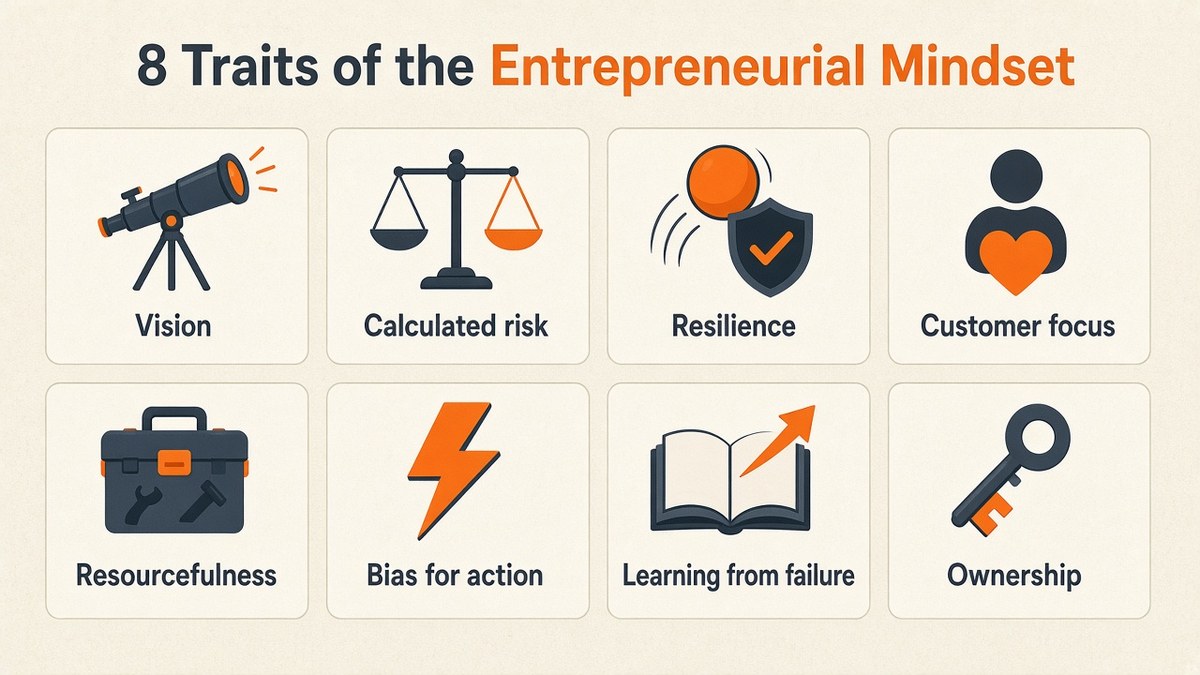
The eight core traits of the entrepreneurial mindset.
- Vision: You can describe where you want the business to be in one to three years and why it matters to your customers. Vision gives you a filter for saying no to distractions.
- Calculated risk: You take risks, but you size them. Instead of quitting your job to launch an untested idea, you test it on evenings and weekends first, or you pre-sell before you build.
- Resilience: Rejections, slow months and failed launches are normal. Resilient owners treat them as information, take a short break if needed and get back to work.
- Customer focus: You start with the customer's problem, not your product. The clearest way to show this is a strong value proposition; my guide on how to write a value proposition shows how.
- Resourcefulness: You make progress with what you have: free tools, borrowed skills, partnerships and simple workarounds, instead of waiting for a big budget.
- Bias for action: You prefer a quick, imperfect first version over a perfect plan that never ships. Action creates feedback; planning alone does not.
- Learning from failure: When something fails, you ask what it taught you and change one thing for the next attempt. Failure is expensive only when you learn nothing from it.
- Ownership: You take responsibility for results, including the ones you did not expect. Owners do not blame the market, the algorithm or their team first; they look for what they can control.
Employee mindset vs entrepreneurial mindset
Neither way of thinking is “bad”. Most people move between the two. But when you start a business, a few default habits need to change:
| Situation | Employee mindset | Entrepreneurial mindset |
|---|---|---|
| A problem appears | Report it and wait for instructions | Look for the cause and test a fix |
| Income | A fixed salary for time | Income linked to value created for customers |
| Risk | Avoid it where possible | Take small, measured risks to learn |
| Failure | Something to hide | Data for the next attempt |
| Learning | Training when the company offers it | Self-directed and continuous |
| Time | Work the hours on the contract | Protect time for the few tasks that grow the business |
How to develop an entrepreneurial mindset in 7 steps
Keep a problem journal
For two weeks, write down every frustration you notice: at work, as a customer, in your industry. Problems people complain about repeatedly are the raw material of good businesses.
Turn one problem into a small test
Pick one problem and design the cheapest test you can: a one-page offer, a short survey or a pre-order. A free landing page and email tool such as Systeme.io lets you put an offer in front of people in an afternoon without paying for software.
Talk to five real customers
Ask people who have the problem how they solve it today, what it costs them and what they have tried. Listen more than you pitch. Five honest conversations beat weeks of guessing.
Set a “risk budget”
Decide in advance how much time and money you are willing to lose on a test (for example, 10 hours and $100). This makes risk feel smaller and stops you over-investing in an idea that is not working.
Review every week
Spend 20 minutes each Friday on three questions: what worked, what did not and what will I change next week? This simple habit is how resilience and learning from failure become automatic.
Learn one business skill at a time
Pick the skill that is holding you back most right now, such as selling, pricing, marketing or managing cash, and focus on it for a month. If you are starting from zero, my guide on how to write a business plan is a good first step.
Surround yourself with builders
Join a local business group, an online community or a mastermind with people slightly ahead of you. Mindset is contagious, so spend time with people who take action.
A 30-day entrepreneurial mindset plan
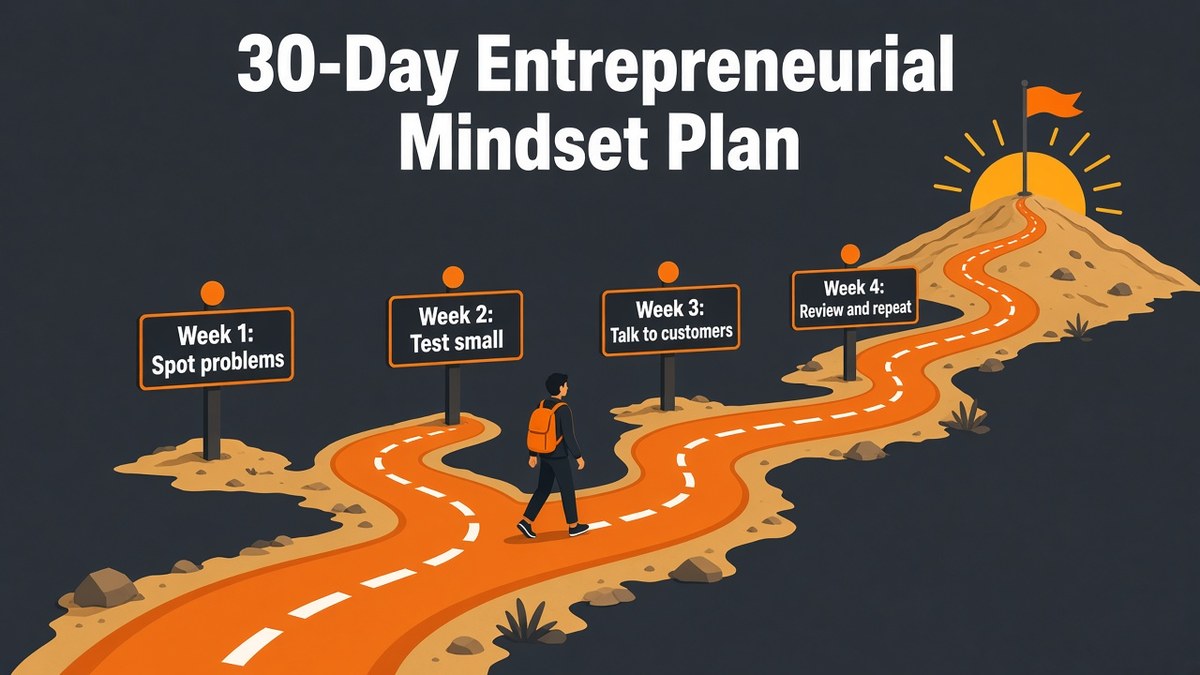
A four-week plan to practise the entrepreneurial mindset.
✅ Small wins count
The goal of the first 30 days is not to build a big business. It is to prove to yourself that you can spot a problem, test a solution and learn from real people. That proof is what builds confidence.
Mindset traps that hold new business owners back
- Perfectionism: polishing a logo or website for months before talking to one customer. Ship a simple version first.
- Fear of judgement: worrying what friends or former colleagues will think. Most people are too busy to notice, and the ones who matter will respect you for trying.
- Busy, not productive: answering emails and tweaking social profiles instead of doing the few tasks that bring revenue.
- Copying instead of solving: launching the same product as everyone else without a clear reason to choose you. Study how startups disrupt industries by solving an old problem in a new way.
- Fixed mindset: believing skills are set in stone. If this sounds familiar, read my guide on how to build a growth mindset.
Simple tools and books that help
You do not need expensive software to practise an entrepreneurial mindset. A notebook, a calendar for your weekly review and a spreadsheet to track tests are enough to start. When you are ready to put an offer online, Systeme.io has a free plan that covers landing pages, email and a simple checkout, which makes it easy to run the small tests described above. Prices and plan limits change, so check the current details on its site.
For reading, The Lean Startup by Eric Ries is one of the best books on turning ideas into quick experiments and learning from customers (Amazon US | Amazon UK). It is written for startups, but the build, measure and learn loop works for any small business.
Ready to test your first idea?
Build a free landing page and email list in an afternoon, then see if real people want what you offer.
Frequently Asked Questions
What is the entrepreneurial mindset in simple words?
It is a way of thinking that looks for problems worth solving, tests ideas with small, measured risks, learns quickly from mistakes and takes ownership of results.
Can you learn an entrepreneurial mindset?
Yes. It is built through habits such as keeping a problem journal, running small tests, talking to customers and reviewing results every week. Most successful owners developed it over time.
What are the main traits of an entrepreneurial mindset?
The core traits are vision, calculated risk-taking, resilience, customer focus, resourcefulness, a bias for action, learning from failure and ownership of results.
Do employees need an entrepreneurial mindset?
It helps. Employees who spot problems, suggest fixes and take ownership tend to get more responsibility and are better prepared if they start a business later.
How long does it take to build an entrepreneurial mindset?
You can notice a change within a month of deliberate practice, such as the 30-day plan above. Making it automatic usually takes several months of repeated testing and reviewing.
What is the difference between a growth mindset and an entrepreneurial mindset?
A growth mindset is the belief that abilities can improve with effort. An entrepreneurial mindset builds on that belief and adds action: spotting opportunities, testing ideas and owning business results.
Final thoughts
The entrepreneurial mindset is not about being fearless or having a brilliant idea on day one. It is about small, repeated actions: noticing problems, testing solutions cheaply, listening to customers and learning from every result. Start with the 30-day plan, keep your tests small and review honestly each week. A few months from now, you will think and act much more like the business owner you want to become.
Affiliate disclosure: some links above are affiliate links. I may earn a commission at no extra cost to you.