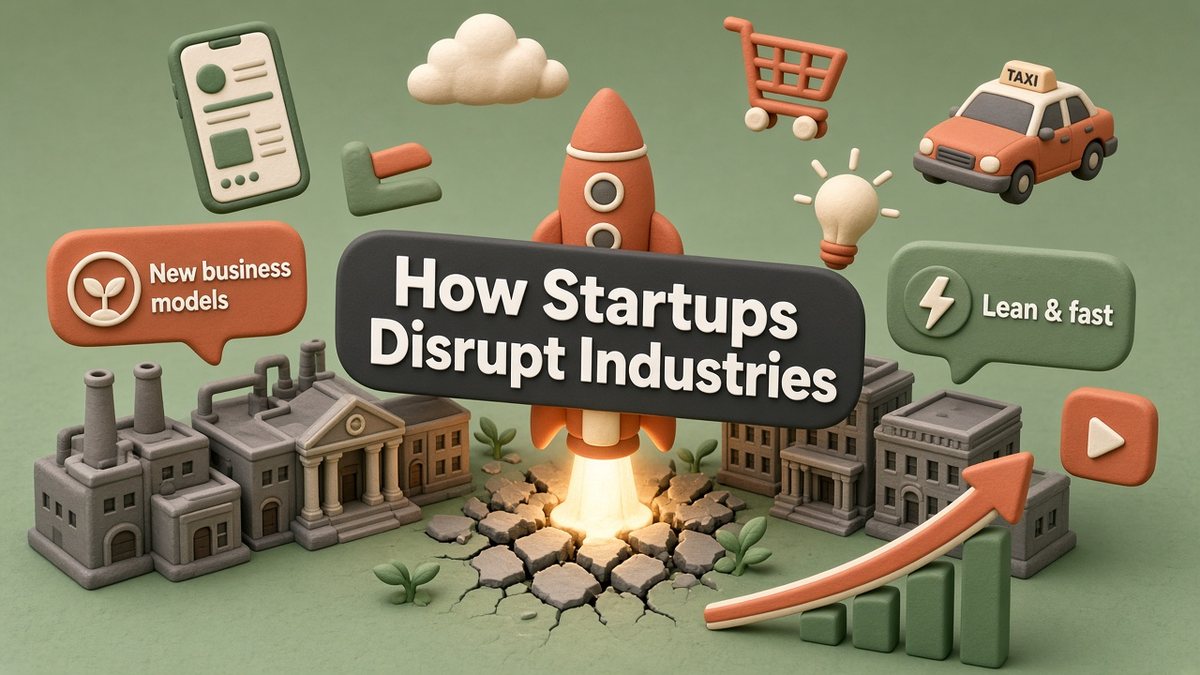
Understanding how startups disrupt industries is one of the most useful lessons any founder or business owner can learn. Netflix pushed Blockbuster out of the video rental business, Airbnb changed how millions of people book travel, and digital banks such as Revolut and Monzo forced traditional banks in the UK and Europe to rethink fees and mobile apps. None of these companies started with the biggest budget. They started with a sharper view of what customers actually wanted and a cheaper, simpler way to deliver it. In this 2026 guide you will learn what startup disruption really means, the business models disruptors use, six real case studies, and a practical 6-step plan to disrupt your own market without burning cash.
✔ Key takeaways
⏱ About 10 min read · the short version is right here
- Startup disruption means a newcomer wins customers by offering something simpler, cheaper or more convenient than the market leaders, often starting with customers the leaders ignore.
- Most disruptors use one of five models: platform, subscription, direct-to-consumer, freemium or on-demand.
- Incumbents are slow to react because the new idea looks small, low-margin or risky at first.
- The safest way to disrupt is to test small: validate the pain, launch a lean offer, price simply and win one niche before scaling.
- Disruption is not only for tech companies. A local service business can disrupt its market with better pricing, speed or convenience.
- Track a few clear numbers (customer acquisition cost, retention, margin) so growth does not hide a broken business model.
📅 Last checked on 3 Nov 2026
📋 In this guide
- What is startup disruption?
- Why startups can beat big incumbents
- 5 disruptive business models startups use
- Disruptor case studies: 6 real examples
- Pros and cons of being the disruptor
- How to disrupt your market in 6 steps
- How established businesses can respond
- Mistakes that kill would-be disruptors
- Frequently Asked Questions
- Final thoughts
What is startup disruption?
In everyday business talk, “disruption” is used for almost any new idea. The original meaning is more precise. Harvard professor Clayton Christensen described disruptive innovation as a process where a smaller company with fewer resources successfully challenges established businesses. It usually happens in one of two ways:
- Low-end disruption. The newcomer targets customers who are over-served by expensive, feature-heavy products and offers a “good enough” version at a much lower price. Budget airlines and low-cost index funds are classic examples.
- New-market disruption. The newcomer creates a product for people who were not customers at all because the old option was too expensive, too complicated or too hard to reach. Canva turned millions of non-designers into people who create their own graphics.
Over time the disruptor improves its product, moves up-market and starts taking the leaders’ best customers. By the time the incumbent notices, the newcomer already has the cost structure, the brand and the habits of a whole generation of users.
📚 Want the original theory?
Christensen’s book The Innovator’s Dilemma is still the best explanation of why great companies miss disruptive threats. Get it on Amazon UK or Amazon US.
Not every successful startup is disruptive in this strict sense. Uber, for example, mostly offered a better experience to people who already used taxis, which Christensen himself called a sustaining innovation. For a founder, the label matters less than the lesson: find a group of customers the market is serving badly, and serve them in a simpler, cheaper or more convenient way.
Why startups can beat big incumbents
Large companies have more money, more staff and more customers. So why do they so often lose to tiny startups? A few reasons come up again and again:
- The new market looks too small. A company earning billions has little reason to chase a niche worth a few million dollars. That small niche is exactly where the startup learns and grows.
- Margins look worse at first. A cheaper product can eat into profitable lines, so managers protect the existing business instead.
- Legacy systems slow them down. Old IT, branch networks, dealer contracts and union agreements make fast change expensive.
- Startups can move faster. A five-person team can test a new price, landing page or feature in a week. A large company may need months of approvals.
- Startups use cheap modern tools. Cloud software, no-code builders and freelancers mean a new business can launch for a few hundred dollars or euros, and access global talent through the gig economy instead of hiring a full department.
5 disruptive business models startups use
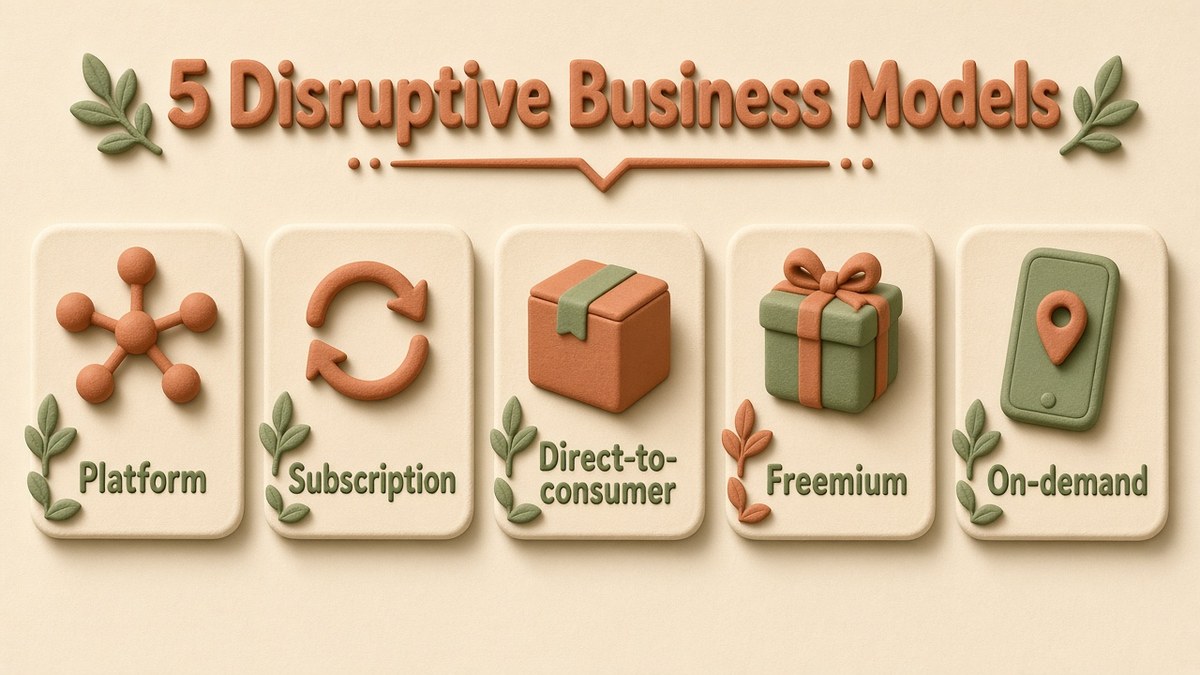
Five business models behind most startup disruption: platform, subscription, direct-to-consumer, freemium and on-demand.
Most startup disruption comes from changing how value is delivered and paid for, not just from new technology. These five models appear again and again:
| Model | How it works | Example disruptors | Who got disrupted |
|---|---|---|---|
| Platform / marketplace | Connects buyers and sellers and takes a fee | Airbnb, Etsy | Hotels, traditional retailers |
| Subscription | Recurring monthly or yearly payment instead of one-off sales | Netflix, Spotify | Video rental, CD and DVD sales |
| Direct-to-consumer (DTC) | Sells online straight to customers, cutting out middlemen | Dollar Shave Club, Warby Parker | Big razor and eyewear brands |
| Freemium | Free core product, paid upgrades for power users | Canva, Zoom | Expensive design and conferencing software |
| On-demand | Instant service booked through an app | Uber, Deliveroo | Taxi firms, restaurant delivery |
Tip: on mobile, swipe the table sideways to see all columns.
Many disruptors combine models. Spotify is freemium plus subscription. Amazon Prime mixes subscription with on-demand delivery. The common thread is lower friction for the customer: fewer steps, clearer pricing and faster results.
Disruptor case studies: 6 real examples
Short stories make the pattern easy to see. Each card shows what the startup disrupted, how it did it and the lesson you can borrow.
Netflix
Subscription
Disrupted: Video rental stores like Blockbuster.
How: Started with DVDs by mail and no late fees in 1997, then moved to streaming in 2007 when broadband was ready.
Lesson: Remove the most hated part of the old experience first.
Airbnb
Platform
Disrupted: Hotels and short-stay rentals.
How: Let ordinary people rent spare rooms and homes, using reviews and secure payments to build trust between strangers.
Lesson: Trust systems can unlock supply that already exists.
Revolut & Monzo
Digital banking
Disrupted: High-street banks in the UK and Europe.
How: App-first accounts, instant notifications and low foreign exchange fees for travellers and younger customers.
Lesson: Win a frustrated segment, then add products.
Dollar Shave Club
Direct-to-consumer
Disrupted: Big razor brands sold through retailers.
How: Cheap razors by monthly subscription, launched with a viral low-budget video in 2012. Unilever bought it in 2016.
Lesson: Clear pricing plus a memorable message beats a big ad budget.
Canva
Freemium
Disrupted: Expensive professional design software.
How: A simple browser tool with templates and a free plan, aimed at people who are not designers.
Lesson: Serve non-customers the old product was too hard for.
Wise
Fintech
Disrupted: Bank fees on international transfers.
How: Showed the real exchange rate and a clear, low fee up front, when banks hid costs in the rate.
Lesson: Transparency can be the whole product.
Pros and cons of being the disruptor
👍 Pros
- ✓ Huge upside if you reshape a large market
- ✓ Lower costs thanks to modern tools and no legacy systems
- ✓ Early customers often become loyal fans and promoters
- ✓ Clear story for investors, press and partners
⚠️ Cons
- ✗ Customers must change habits, which takes time and money
- ✗ Regulators and incumbents may push back hard
- ✗ Thin margins early on can drain cash fast
- ✗ Copycats arrive once you prove the idea works
The cons are why most disruptive ideas fail quietly. The answer is not to avoid bold ideas, but to test them cheaply before you commit serious money.
How to disrupt your market in 6 steps
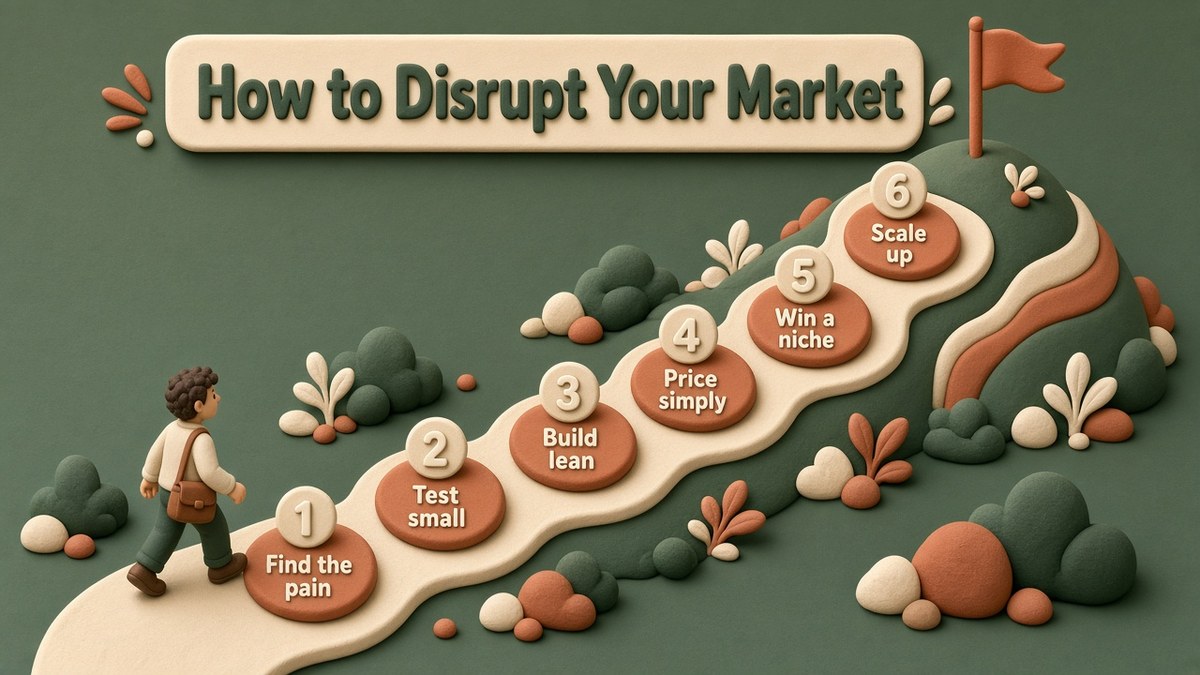
A lean six-step path to disrupt your market: find the pain, test small, build lean, price simply, win a niche, then scale.
You do not need venture capital to apply these ideas. The same steps work for a SaaS founder in Berlin, a coaching business in Texas or a local cleaning company in Manchester.
Find the pain
List the biggest frustrations in your industry: hidden fees, slow service, confusing contracts, too many features, poor mobile experience. Read reviews of the market leaders, especially the one- and two-star ones. The best disruptive ideas start from a complaint many people share.
Test small before you build
Describe your simpler or cheaper offer on a one-page site and see if people sign up, book a call or pre-order. A tool like Systeme.io lets you build the landing page, collect emails and take payments on a free plan, so a test costs time, not thousands of dollars. Eric Ries calls this a minimum viable product in The Lean Startup (Amazon UK | Amazon US).
Build lean
Only build what early customers actually use. Use existing software, freelancers and manual work behind the scenes until demand is proven. Many famous startups ran key processes by hand for months.
Price simply
Disruptors often win on pricing clarity as much as on price. Flat monthly plans, no setup fees and honest comparisons build trust fast. If you are unsure where to start, see how to price your product or service.
Win one niche
Pick one customer group, city or use case and become the obvious choice there. A narrow win gives you referrals, testimonials and data you can use to expand.
Scale what works
Once a niche is profitable and customers stay, add new segments, features or regions. Track a small set of numbers, such as customer acquisition cost, monthly churn and gross margin. Our guide to small business KPIs shows which ones matter most.
💡 Disruption works for service businesses too
A plumber who offers fixed online quotes and same-day booking, or an accountant who charges a flat monthly fee instead of hourly billing, is disrupting a local market. You do not need an app to change the rules.
How established businesses can respond
If you run an established company, startup disruption is a threat but also a signal. Smart incumbents respond in a few ways:
- Listen to the low end. Do not dismiss small, price-sensitive customers. They often show where the market is heading.
- Create a separate team. Christensen’s research suggests a small, independent unit with its own targets can chase a new model without being blocked by the core business.
- Partner or acquire. Unilever buying Dollar Shave Club is one example of buying the disruptor instead of fighting it.
- Fix your own friction. Many banks launched better mobile apps and removed fees only after digital banks proved customers wanted it. Doing it earlier is cheaper.
Mistakes that kill would-be disruptors
- Confusing a cool idea with a real pain. If customers are not frustrated with the current option, they will not switch.
- Scaling before the model works. Spending heavily on ads while customers churn just burns cash faster.
- Ignoring regulation. Finance, health, transport and housing all have rules in the US, UK and EU. Plan for them early.
- Competing only on price. A price war with a large incumbent is hard to win. Combine lower price with better convenience or clarity.
- Building too much. Months of development before talking to customers is the most common startup mistake of all.
Frequently Asked Questions
How do startups disrupt industries?
Startups disrupt industries by serving customers the market leaders ignore or over-charge, using a simpler, cheaper or more convenient product and a new business model such as subscription, platform or freemium. They then improve over time and move up-market.
What is an example of a disruptive startup?
Netflix is a classic example. It started with DVD rentals by mail with no late fees, then moved to streaming and helped push Blockbuster out of business.
What is the difference between disruptive and sustaining innovation?
Sustaining innovation makes existing products better for current customers. Disruptive innovation starts with a simpler or cheaper offer for overlooked or new customers and gradually takes over the mainstream market.
Can a small business be disruptive without technology?
Yes. Clear fixed pricing, faster service, better convenience or a new delivery model can disrupt a local market even without an app or new technology.
Why do big companies fail to respond to disruption?
The new market looks small and low-margin at first, so managers focus on profitable existing customers. By the time the threat is clear, the startup has a cost and brand advantage.
How much does it cost to test a disruptive idea?
It can cost very little. A landing page, a simple offer and a small ad or outreach test can often be run for under $100 or EUR 100 before building anything bigger.
Final thoughts
Learning how startups disrupt industries is really about learning to see a market through the customer’s eyes. Find the frustration everyone accepts, offer a simpler way, prove it on a small scale and grow from there. Whether you are launching a new startup or defending an established business, the companies that win are the ones that keep removing friction for their customers before someone else does.
Your next step: write down the three biggest complaints customers have about your industry, and pick one you could test a solution for this month.
Test your disruptive idea for free
Systeme.io gives you a landing page, email list, sales funnel and payments in one place, with a free plan, so you can validate an offer before you build it.
Affiliate link. I may earn a commission at no extra cost to you.
The Systeme.io and Amazon links in this post are affiliate links. As an Amazon Associate I earn from qualifying purchases.