
The right gig economy tips can turn freelance work from a stressful hustle into a stable, well-paid career, and they can help business owners get specialist help without the cost of full-time hires. Millions of people across the US, the UK and Europe now earn some or all of their income from freelance projects, and companies of every size rely on contractors for design, writing, development, marketing and admin. In this 2026 guide you will learn how the gig economy works, practical tips for freelancers, a 6-step process for businesses that hire freelancers, and the simple tools that keep both sides organised.
✔ Key takeaways
⏱ About 10 min read · the short version is right here
- The gig economy is a labour market built on short-term, project-based and freelance work instead of permanent jobs.
- Freelancers win by choosing a clear niche, pricing for value, using written contracts and saving for taxes and quiet months.
- Businesses get the best results from freelancers with a clear brief, a small paid test, fair contracts and proper onboarding.
- Irregular income is the biggest risk for freelancers, so build a buffer of three to six months of expenses.
- Simple tools for invoicing, a portfolio page, file backup and communication save hours every week.
- Treat freelance relationships as long-term partnerships. Repeat clients and reliable contractors are worth far more than one-off gigs.
📋 In this guide
What is the gig economy?
The gig economy is the part of the labour market where people work on individual tasks or projects, often called gigs, rather than in a permanent salaried role. A gig can be a one-week logo design, a three-month software build, a monthly bookkeeping retainer or a single delivery booked through an app. The worker is usually self-employed, sets their own schedule and works for several clients at once.
Two broad groups make up the gig economy. The first is app-based gig work, such as ride-hailing, food delivery and task apps, where a platform sets most of the rules and prices. The second is skilled freelance work, such as writing, design, programming, consulting, marketing and virtual assistance, where the freelancer finds clients directly or through marketplaces and negotiates their own rates. This guide focuses mainly on the second group, because that is where freelancers have the most control over their income and growth.
📌 Freelancer or solopreneur?
Many people use the words interchangeably, but there is a difference. A freelancer sells their time and skills to clients, while a solopreneur builds a business that can grow beyond their own hours. Read solopreneur vs freelancer to see which path fits you.
Why the gig economy keeps growing
Several trends keep pushing more work into the gig model:
- Remote work is normal. Video calls, shared documents and cloud storage mean a business in London can hire a designer in Lisbon or a developer in Texas as easily as someone down the road.
- Businesses want flexibility. Hiring full-time staff in the US or EU brings salaries, benefits, payroll taxes and long notice periods. Freelancers let companies scale up for a launch and scale down afterwards.
- Workers want control. Many professionals choose freelancing for flexible hours, location freedom and the chance to pick projects they enjoy.
- AI and automation create new niches. Companies need help with automation, AI content workflows, data and no-code tools, and they often prefer specialists on a project basis.
Growth also brings competition. Freelance marketplaces are crowded, rates can be pushed down and clients have more choice than ever. That is why a deliberate plan matters more than raw talent.
Gig economy tips for freelancers
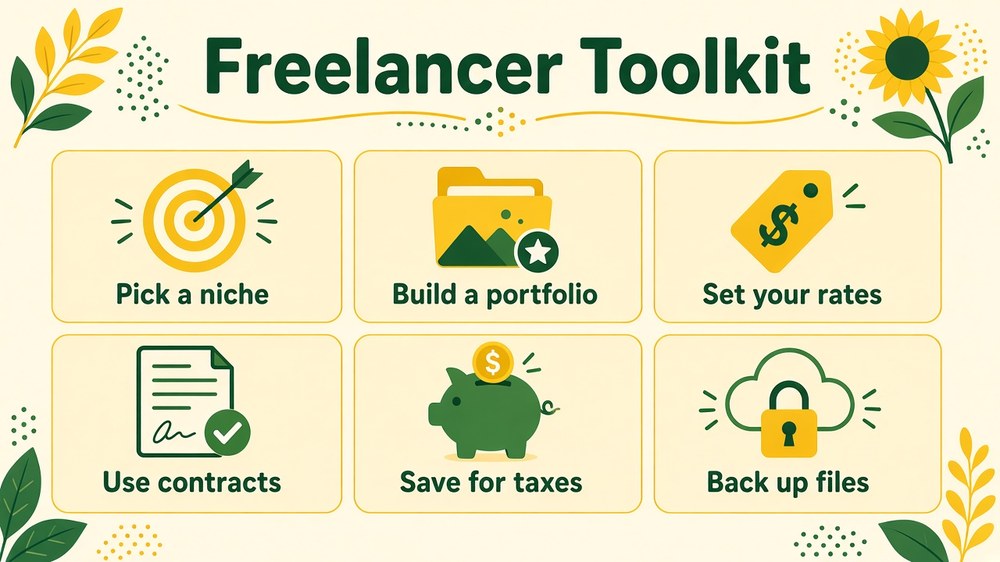
A simple freelancer toolkit: niche, portfolio, rates, contracts, tax savings and file backup.
1. Pick a clear niche
“Freelance writer” competes with millions of people. “Email copywriter for SaaS companies” or “Shopify developer for fashion brands” competes with far fewer and can charge more. A niche makes your marketing easier because you know exactly who you are talking to and what problems they have.
2. Build a portfolio that sells
Clients buy proof, not promises. Show three to five strong samples with a short story for each: the problem, what you did and the result. If you are new, create sample projects or do one discounted project for a real business in exchange for a testimonial. A simple one-page site with your services, samples and a booking form beats a scattered marketplace profile. Tools such as Systeme.io let you build that page, collect leads and send follow-up emails on a free plan.
3. Price for value, not hours
Hourly rates cap your income and punish you for getting faster. Where you can, quote per project or per outcome and include a clear scope. Check what others in your niche charge, then position yourself in the middle or above if your portfolio supports it. Raise rates for new clients at least once a year.
💡 Quick tip
Offer three packages, such as Basic, Standard and Premium. Most clients pick the middle option, and the top option makes it look like great value.
4. Always use a written contract
A short agreement protects both sides. Cover scope, deliverables, deadlines, number of revisions, payment terms, late-payment fees, who owns the finished work and how either side can end the project. Ask for a deposit, often 30 to 50 percent, before you start.
5. Manage irregular income
Freelance income goes up and down. Pay yourself a fixed monthly “salary” from your business account, build a buffer of three to six months of expenses and set aside money for tax on every payment. In the US, self-employed people usually pay estimated tax quarterly; in the UK and most EU countries you register as self-employed and file your own return. A local accountant is worth the fee in your first year.
⚠️ Watch out
Do not count on a single big client. If one client pays more than half of your income, you are effectively an employee without the job security. Keep marketing even when you are busy.
6. Protect your files and your reputation
Losing a client project to a dead laptop is a nightmare. Keep client files in organised folders and back them up to the cloud automatically. Many freelancers use pCloud Business for encrypted storage and easy file sharing with clients. Read how to back up business data for a simple routine.
7. Turn one-off gigs into repeat clients
Finding new clients is expensive. Deliver on time, communicate early when something changes and suggest the next project before the current one ends. A smooth client onboarding process and a polite request for customer testimonials turn happy clients into referrals.
Freelancer vs business: challenges compared
Both sides of the gig economy face problems. Here is how the main challenges and fixes line up.
| Area | Freelancer challenge | Business challenge | Fix that works |
|---|---|---|---|
| Finding work or talent | Crowded marketplaces, low-ball offers | Too many applicants, uneven quality | Niche positioning, referrals, small paid tests |
| Money | Irregular income, late payments, tax | Budget overruns, unclear scope | Deposits, fixed-price scopes, written contracts |
| Communication | Vague briefs, changing requests | Missed deadlines, silence | Clear brief, weekly check-ins, one shared channel |
| Legal and compliance | Self-employment tax, contracts | Misclassification, IP ownership, GDPR | Contracts, local advice, data processing terms |
| Files and security | Lost work, version chaos | Data leaks, lost access when a gig ends | Shared cloud folders, backups, access reviews |
How businesses can hire freelancers in 6 steps
For business owners, freelancers are a way to get expert help fast. The difference between a great experience and a wasted budget is usually the process, not the person. Follow these steps.
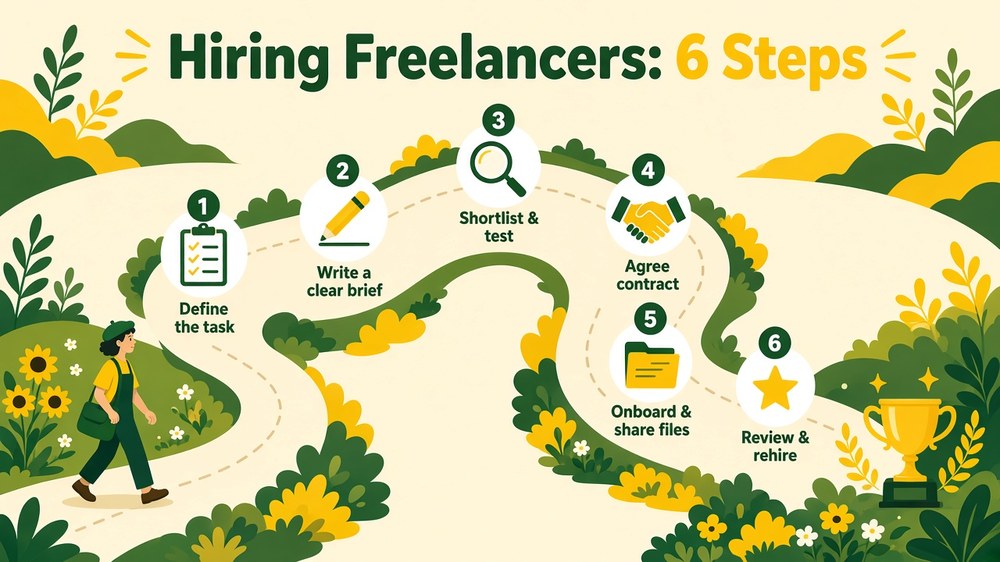
Six steps to hire and work with freelancers in the gig economy.
Define the task
Write down the outcome you want, the deadline and your budget range. “A 5-page website that books discovery calls by March 31, budget $2,000 to $3,000” is far easier to hire for than “help with the website”.
Write a clear brief
Share background on your business, your audience, examples you like, the tools you use and what “done” looks like. A good brief attracts better freelancers and reduces revisions.
Shortlist and test
Review portfolios and reviews, then give two or three candidates a small paid test. Pay fairly for the test; good freelancers rarely do free spec work.
Agree a contract
Confirm scope, milestones, payment schedule, IP ownership, confidentiality and, if you handle EU or UK customer data, GDPR terms. Check local rules so you do not misclassify someone who should legally be an employee.
Onboard and share files
Give access to the right tools only, share brand guidelines and files in one organised cloud folder, and set a weekly check-in. Tips from how to manage a remote team apply to freelancers too.
Review and rehire
At the end, review the work, pay promptly and give feedback. Keep a short list of reliable freelancers so the next project starts in days, not weeks. Remove their access to systems once the gig ends.
💡 Business tip
Pay freelancers on time, every time. In a competitive market, the best freelancers choose clients who respect deadlines on both sides.
Tools that make gig work easier
You do not need an expensive tech stack. A handful of simple tools covers most needs for freelancers and the businesses that hire them:
- Website, funnel and email. Systeme.io combines a portfolio or sales page, opt-in forms, email marketing and payments, with a free plan to start. It is handy for freelancers who also sell templates, courses or packaged services.
- Cloud storage and backup. pCloud offers encrypted storage, file requests and shared links, with lifetime plans that avoid another monthly bill. Compare options in pCloud vs Google Drive vs Dropbox.
- Invoicing and accounting. Use a simple invoicing app that tracks unpaid invoices and sends automatic reminders.
- Contracts and e-signatures. Reusable contract templates plus an e-signature tool make every new project faster and safer.
- Communication and project tracking. One chat channel and one task board per client keeps requests out of scattered email threads.
Mistakes to avoid
- Racing to the bottom on price. Competing only on price attracts the hardest clients and burns you out.
- Starting without a deposit or contract. This is the most common cause of unpaid work.
- Saying yes to every project. Scope creep and poor-fit clients eat the time you need for marketing and rest.
- Ignoring tax and savings. A surprise tax bill can wipe out months of profit.
- For businesses: hiring on price alone. The cheapest bid often costs more after rework and missed deadlines.
- For businesses: vague briefs. Unclear instructions are the number one reason freelance projects fail.
Frequently Asked Questions
What is the gig economy in simple words?
The gig economy is a way of working where people earn money from short-term jobs, projects or tasks for different clients instead of having one permanent employer.
Is the gig economy good for freelancers?
It can be. Freelancers gain flexibility, choice of clients and often higher rates for specialist skills. The trade-offs are irregular income, no paid leave and handling your own taxes, so planning and savings are essential.
How do freelancers find clients in the gig economy?
The most reliable sources are referrals from past clients, a clear niche, a simple portfolio website, networking in your industry, helpful content on LinkedIn or a blog, and selected freelance marketplaces.
How much should a freelancer save for taxes?
It depends on your country and income, but many freelancers set aside 25 to 30 percent of each payment for income tax and social contributions. Check with a local accountant for exact figures.
What should a freelance contract include?
Scope of work, deliverables, deadlines, number of revisions, fees and payment schedule, deposit, late-payment terms, ownership of the finished work, confidentiality and how either side can end the contract.
How can a small business manage freelancers well?
Give a clear brief, start with a small paid test, use a written contract, share files in one organised place, hold short regular check-ins and pay on time.
Final thoughts
The gig economy rewards people who treat freelancing like a real business and companies that treat freelancers like real partners. If you freelance, choose a niche, price for value, use contracts, save for taxes and protect your files. If you hire, write clear briefs, test before you commit and pay on time. Put these gig economy tips into practice and both sides get what they came for: flexible, high-quality work that pays.
Your next step: pick one tip from this guide, whether it is a contract template, a portfolio page or a tax savings account, and set it up this week.
Build your freelance portfolio and lead page for free
Systeme.io gives freelancers a portfolio or sales page, opt-in forms, email follow-up and payments in one place, with a free plan to get started.
Affiliate link. I may earn a commission at no extra cost to you.
Affiliate disclosure: the Systeme.io and pCloud links in this post are affiliate links. If you sign up through them, I may earn a commission at no extra cost to you.