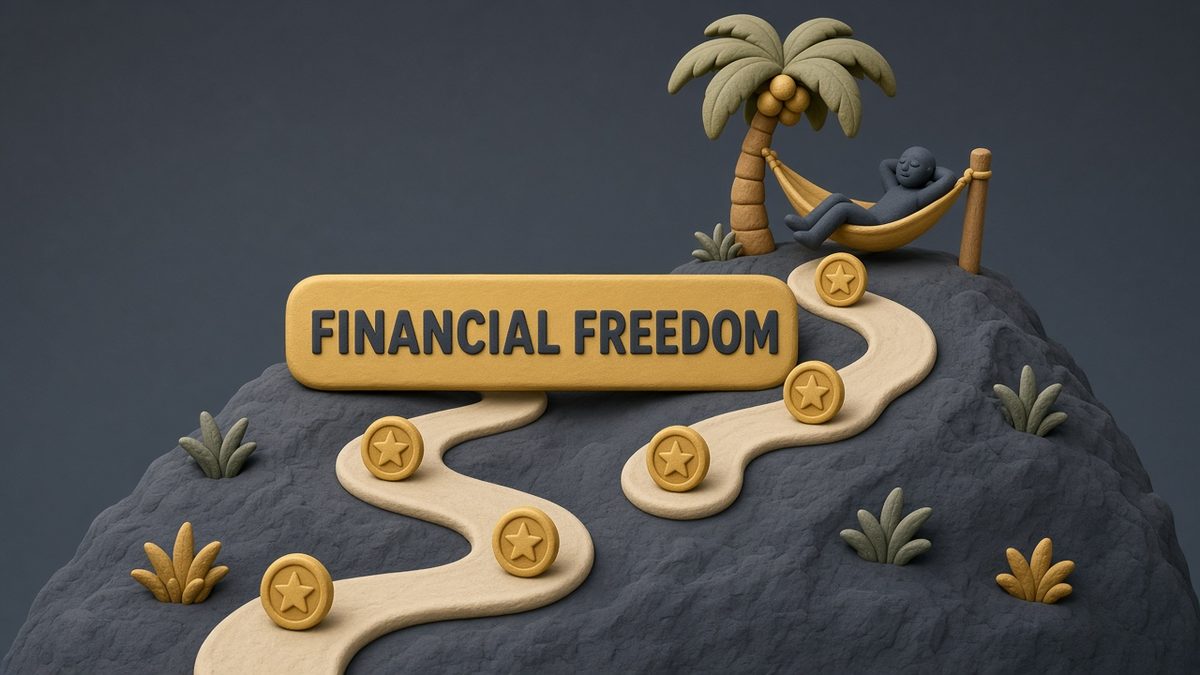
Learning how to achieve financial freedom is less about a lucky break and more about following a clear roadmap. Financial freedom means your money works for you: your savings, investments and income streams cover your living costs, so you can make choices based on what you want rather than what you must do. It sounds distant for most people, but it is built in stages, and each stage brings real relief. In this guide I lay out a practical roadmap to financial independence, the numbers that matter and the habits that keep you on track.
✔ Key takeaways
⏱ About 8 min read · the short version is right here
- Financial freedom means your savings, investments and passive income cover your living costs, so work becomes a choice rather than a necessity.
- The roadmap has clear stages: stability, debt freedom, security, growth and independence.
- Your savings rate, not just your income, is the biggest lever on how fast you get there.
- A rough target many people use is 25 to 30 times your yearly expenses invested, but treat it as a guide, not a guarantee.
- Protect the plan with insurance, diversification and a yearly review.
ℹ️ Please note
This article is general education, not personal financial advice. Investments can fall as well as rise. Consider speaking to a regulated financial adviser about your own circumstances.
What is financial freedom?
Financial freedom is having enough wealth and reliable income that you are no longer dependent on one job to pay for your life. It does not necessarily mean being rich or quitting work forever. It means having options: changing careers, starting a business, working fewer hours, supporting family or retiring early without fear.
A useful way to think about it is the difference between your expenses and your “freedom income”: the money your assets can produce without you trading hours for it. When freedom income covers your essential expenses, you are financially secure. When it covers your full lifestyle, you are financially independent.

Find your financial freedom number
You cannot reach a goal you have not defined. Start with your yearly expenses, because they matter more than your income.
Add up your yearly spending
Track your spending for a few months and multiply to get a yearly figure. Include irregular costs such as insurance, travel, gifts and repairs.
Multiply by 25 to 30
The “25x rule” comes from US research on safe withdrawal rates, which suggested withdrawing about 4 per cent a year from a balanced portfolio could last around 30 years. If you expect a longer retirement or higher inflation, using 30x or more adds a margin of safety.
Subtract other reliable income
If you expect a pension, rental income or other steady income, your portfolio needs to cover only the gap.
📊 Example
If your household spends the equivalent of 6 lakh rupees a year, 25x gives a target of 1.5 crore and 30x gives 1.8 crore. If you spend $40,000 a year, the range is $1 million to $1.2 million. The exact figure matters less than having a clear target to work towards.
The 5-stage roadmap to financial independence
| Stage | Goal | Key actions |
|---|---|---|
| 1. Stability | Stop living paycheque to paycheque | Budget, track spending, small emergency fund |
| 2. Debt freedom | Clear expensive debt | Pay off credit cards and personal loans, avoid new bad debt |
| 3. Security | Handle life’s shocks | Full emergency fund, health and life insurance |
| 4. Growth | Build wealth | Invest a large share of income in diversified, low-cost funds |
| 5. Independence | Assets cover your lifestyle | Reach your number, plan withdrawals, keep reviewing |
Stage 1: Build stability
Create a simple budget, track where your money goes and start a small emergency fund. Automate a transfer to savings every payday so saving happens before spending. My guide on how to save money has a step-by-step system and 20 ways to cut costs.
Stage 2: Become free of expensive debt
High-interest debt is the biggest obstacle to financial freedom because it works against you as powerfully as compounding works for you. List every debt, keep paying the minimums and throw extra money at the highest-interest balance first. Not all debt is bad, and my explainer on good debt vs bad debt helps you prioritise.
Stage 3: Create real security
Grow your emergency fund to three to six months of essential costs. Make sure you have adequate health insurance and, if anyone depends on your income, term life insurance. Write a basic will and nominate beneficiaries on accounts. These steps protect your plan from the unexpected.
Stage 4: Grow your wealth
This is the long middle stage. Invest regularly in diversified, low-cost funds and use tax-advantaged retirement accounts available in your country. Increase your contributions every time your income rises. If investing is new to you, start with my guide on the basics of investing.
Stage 5: Reach independence
When your investments approach your freedom number, plan how you will draw income: which accounts to use first, how much cash to keep for two or three years of expenses, and how to adjust withdrawals in bad market years. Many people choose to keep some part-time or passion work at this stage, which makes the plan far more resilient.
The three levers that decide how fast you get there
1. Your savings rate
Your savings rate, the percentage of income you save and invest, is the single biggest factor you control. A higher savings rate both grows your investments faster and lowers the amount you need, because you are living on less.
| Savings rate | Approximate years to independence* |
|---|---|
| 10% | About 50 years |
| 20% | About 37 years |
| 30% | About 28 years |
| 50% | About 17 years |
| 70% | About 8–9 years |
*Illustration assuming you start from zero, earn about 5 per cent a year after inflation and withdraw 4 per cent a year in retirement. Real results will differ.
2. Your income
Cutting costs has a limit; growing income does not. Ask for raises, build in-demand skills, change jobs strategically or add a side income stream. Many people start a small online business alongside their job, and my guide on how to start an online business covers the simplest models.
3. Your investment returns and costs
You cannot control the market, but you can control fees, diversification and your own behaviour. Low-cost index funds, regular investing and staying invested through downturns typically beat chasing hot tips.

Build multiple income streams
Relying on one income is the biggest risk most people face. Over time, aim to add other streams:
- Investment income: dividends, interest and gains from a diversified portfolio.
- Side business or freelance work: skills you can sell online or locally.
- Digital products or content: courses, templates or a newsletter that can earn without trading hours.
- Rental income: property, though it needs capital and management.
What about FIRE and early retirement?
FIRE stands for Financial Independence, Retire Early. It is a movement of people who save very high percentages of their income, often 40 to 70 per cent, to reach independence in their 30s or 40s. There are several flavours:
- Lean FIRE: independence on a frugal budget, with a smaller target number.
- Fat FIRE: a larger target that supports a comfortable lifestyle.
- Barista or Coast FIRE: investing enough early that growth alone will cover retirement, then working part-time or in lower-stress jobs to cover current costs.
You do not have to retire early to benefit from FIRE ideas. Living below your means, investing the difference and knowing your number give you more choices at any age.
Set specific, written goals for each stage, with amounts and dates. My guide on how to set financial goals shows how to break big targets into monthly actions. And if you are tempted by fast-growing assets, read my cryptocurrency guide for beginners first: speculation can play a small part, but it should never be the core of a freedom plan.
Mistakes that delay financial freedom
- Lifestyle creep: spending every pay rise instead of saving most of it.
- Waiting to start investing: every year of delay costs compounding.
- Being uninsured: one medical emergency can wipe out years of savings.
- Chasing get-rich-quick schemes: speculation and scams set people back far more often than they help.
- No written plan: without a target and a review date, it is easy to drift.
Simple habits that keep you on track
- Review your budget monthly and your investments once or twice a year.
- Raise your savings rate by 1 to 2 per cent every time your income rises.
- Keep a one-page financial plan with your number, current net worth and next steps.
- Learn something about money every month, from books, regulator websites or reputable podcasts.
Frequently Asked Questions
What does financial freedom actually mean?
Financial freedom means having enough savings, investments and reliable income that you can cover your living costs without depending on a single paycheque. For some people it means retiring early; for others it means choosing work they enjoy, taking a career break or simply never worrying about bills.
How much money do I need to be financially free?
A common rule of thumb is to have about 25 times your annual expenses invested, based on research suggesting a 4 per cent yearly withdrawal could last around 30 years. Many people, especially in countries with higher inflation or for longer retirements, aim for 30 times or more to add a safety margin. Your number depends on your costs, lifestyle and location.
How long does it take to achieve financial freedom?
It depends mainly on your savings rate and investment returns. Someone saving 10 per cent of income may need 40 years or more, while someone saving 50 per cent might get there in under 20 years. Increasing income and keeping costs steady speeds things up dramatically.
Can I achieve financial freedom on an average salary?
Yes, although it usually takes longer. Keeping fixed costs low, avoiding high-interest debt, investing consistently in low-cost funds and growing your income over time can make financial independence achievable without a high salary.
What is the difference between financial freedom and financial independence?
The terms are often used interchangeably. Financial independence usually refers to the specific point where investments can cover your expenses. Financial freedom is broader and includes the peace of mind and choices that come from having your money under control, even before full independence.
Is passive income necessary for financial freedom?
Not strictly. Many people reach independence through a large, diversified investment portfolio that they draw from carefully. Passive or semi-passive income, such as rent, dividends or a small online business, can reduce how much you need to withdraw and add security.
Final thoughts
Financial freedom is a journey with clear milestones: stability, debt freedom, security, growth and finally independence. Define your number, raise your savings rate, grow your income, invest simply and protect yourself along the way. You do not need to be perfect, only consistent. Every step you take reduces stress today and brings real freedom closer.