Are you a freelancer or a solopreneur? Both work alone, so the labels sound the same. However, the solopreneur vs freelancer difference is not about job titles. It is about how you think. A freelancer waits for the next gig. A solopreneur plans a business, owns a small niche and builds systems that keep earning. This guide covers the key differences, a quick comparison table and a 6-step plan to make the switch.
✔ Key takeaways
- A freelancer sells a skill project by project, while a solopreneur runs a one-person business with a niche, packaged offers, systems and assets.
- The difference is mindset, not job title, and you can make the switch without quitting your current clients.
- Specialists in a micro-niche can charge more because they solve a known problem with less risk.
- Fixed packages priced on value, plus products and retainers, mean your income is no longer capped by your hours.
- Follow the 6-step plan: a 12-month plan, a micro-niche, a package, value pricing, systems, then products and an email list.
📋 In this guide
- What Is a Freelancer?
- What Is a Solopreneur?
- Solopreneur vs Freelancer: The Key Differences
- Why the Solopreneur Mindset Pays Off
- How to Make the Switch: A 6-Step Plan
- Freelancer or Solopreneur: Which Fits You Right Now?
- Examples: What the Switch Looks Like in Practice
- Your First 30 Days: A Switch Checklist
- Common Mistakes When Moving From Freelancer to Solopreneur
- Frequently Asked Questions
What Is a Freelancer?
A freelancer sells a skill to clients, project by project. Writers, designers, developers and editors often start this way. The work is real and it pays the bills. In addition, it is a great way to learn what clients need.
The problem is the model behind it. Most freelancers react to demand. They answer briefs, bid on job boards and quote by the hour. As a result, income rises and falls with the number of hours they can sell. When work dries up, they start hunting again from zero.
What Is a Solopreneur?
A solopreneur is a one-person business owner. The skills may be exactly the same as a freelancer’s. The difference is that a solopreneur treats the work as a company with a plan, a market and assets.
For example, a freelance designer might take any logo job that appears. A solopreneur designer, by contrast, might focus only on brand kits for independent coffee shops. She sells a fixed package, publishes helpful guides for that audience and sells a template pack on the side. Same skill, different business.
Still unsure about working solo? Read my guide on why now is the best time to be a solopreneur.
Solopreneur vs Freelancer: The Key Differences
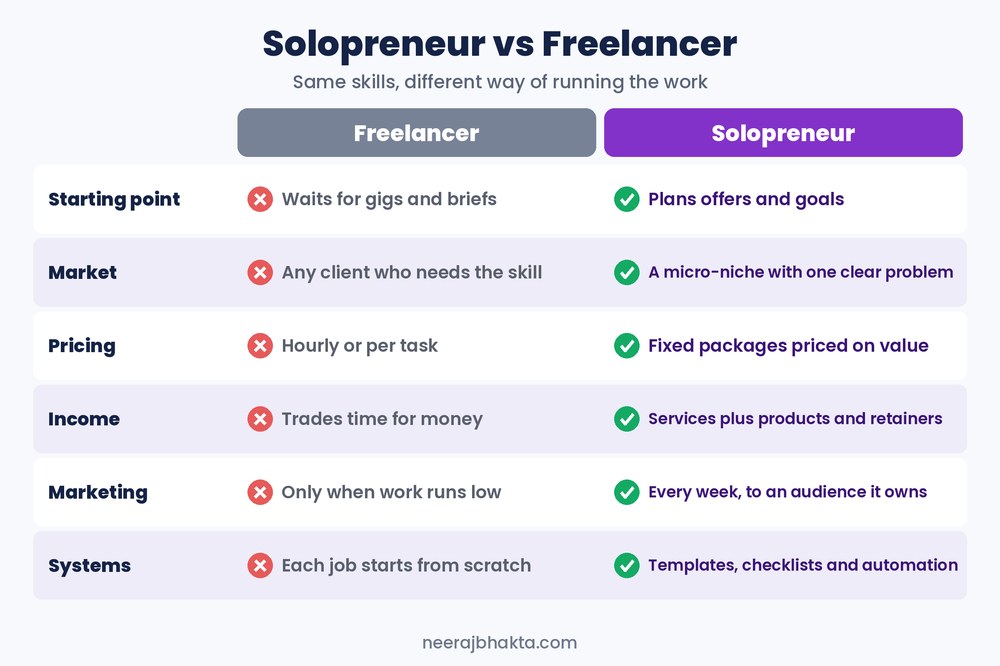
The table below sums up the solopreneur vs freelancer differences. Notice that none of them need a team or a big budget. Instead, they need a change in how you plan and sell.
| Area | Freelancer | Solopreneur |
|---|---|---|
| Starting point | Waits for gigs and briefs | Plans offers and goals |
| Market | Any client who needs the skill | A micro-niche with one clear problem |
| Pricing | Hourly or per task | Fixed packages priced on value |
| Income | Trades time for money | Services plus products and retainers |
| Marketing | Only when work runs low | Every week, to an audience it owns |
| Systems | Each job starts from scratch | Templates, checklists and automation |
💡 Same skill, different business
None of these differences need a team or a big budget. They need a change in how you plan and sell.
Why the Solopreneur Mindset Pays Off
Thinking like a solopreneur does not mean you stop doing client work. Rather, it means you run that work like a business owner. Here is why that shift matters.
You control your pipeline
A freelancer often depends on one platform or a few clients. If one of them leaves, income can drop overnight. A solopreneur, on the other hand, builds steady demand through content, referrals and an email list. Therefore, new leads keep arriving even during busy months.
You can charge premium prices
Specialists earn more than generalists because they solve a known problem with less risk. When you serve one niche, you understand its language and its pain. Consequently, clients see you as the expert, not as one of fifty bids. You can learn more in my guide on how to price your product or service.
Your income is not capped by your hours
There are only so many hours in a week. A solopreneur adds income that does not need more hours, such as a template, a short course or a monthly retainer. Over time, these assets make your business calmer and more predictable.
You build something you can grow or sell
A freelancer’s value walks out of the door at the end of each day. A solopreneur, however, builds a brand, an audience, documented processes and products. Those assets have value of their own. Later, they make it easier to raise prices, hire help or even sell the business.
How to Make the Switch: A 6-Step Plan
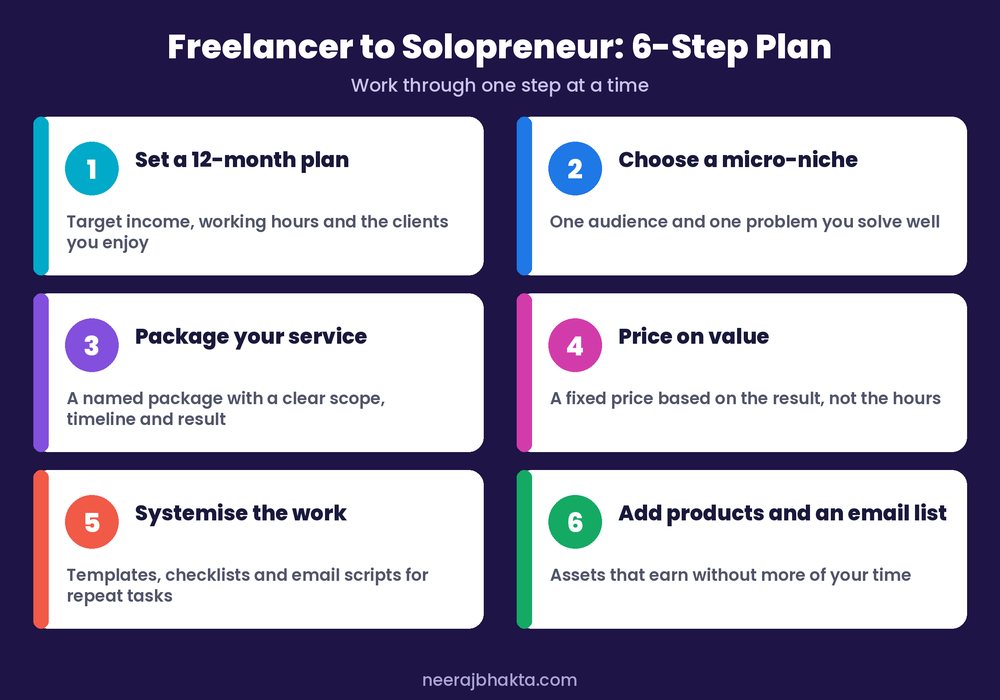
You do not need to quit your current clients to start. Instead, work through these steps one at a time over the next few months.
Step 1: Set a 12-month plan
First, write down what you want from the business in one year. Include your target income, working hours and the kind of clients you enjoy. A one-page plan is enough to start. If you want more detail, follow my guide on how to write a business plan.
Step 2: Choose a micro-niche
Next, pick one audience and one problem you solve well. Look at your past projects. Which clients paid well, valued your work and were easy to help? Combine that audience with your strongest skill. For instance, “copywriting for physiotherapy clinics” is far easier to market than “copywriting”.
Step 3: Package your service
Then turn your service into a named package with a clear scope, timeline and result. A package is easier to sell than an open-ended hourly deal. It also stops scope creep, because the client knows exactly what is included.
Step 4: Price on value
After that, set a fixed price based on the result the client gets, not the hours you spend. Ask what the problem costs the client today. A fair share of that value is a fair price. Finally, offer two or three tiers so clients compare your options, not your rivals.
Step 5: Systemise the work
Now look for tasks you repeat with every client. Turn them into templates, checklists and email scripts. A free workspace such as Notion works well for storing them. As a result, each new project takes less time, and the quality stays the same.
Step 6: Add products and an email list
Lastly, start building assets that earn without your time. Offer a free guide to grow an email list, then sell a small product to that list. Systeme.io covers landing pages, email and courses in one place. Its free plan allows up to 2,000 contacts. The Startup plan costs $17 a month (official pricing, checked October 2026). I cover it in detail in my Systeme.io review. For more ideas, see my guide to email marketing for small business.
If you run done-for-you services, such as booking, follow-up or marketing for local clients, a CRM with automation can help. GoHighLevel is built for that model. Its Starter plan is $97 a month with a 14-day free trial.
Freelancer or Solopreneur: Which Fits You Right Now?
Freelancing is not a failure, and it is often the best way to start. It teaches you what clients need, how to deliver and how to get paid. The question is whether it still fits where you want to go. Use these signs as a quick self-check.
Freelancing may still suit you if:
- You are still testing which skill and type of client you enjoy most.
- You like variety and do not want to focus on one niche yet.
- You want flexible, short-term work around another job, studies or family.
It is time to think like a solopreneur if:
- Your income rises and falls with the number of hours you can sell.
- Most of your work comes from one platform or one or two clients.
- You keep explaining the same process and rebuilding the same documents for every project.
- You notice the same problems again and again among a certain type of client.
If most of the second list sounds familiar, you already have what you need to start. You know a market, you know its problems and you have delivered results. Now you need to package that knowledge.
Examples: What the Switch Looks Like in Practice
The same skill can become a very different business. These examples show how the six steps change the offer, not the talent behind it.
| Skill | Freelancer offer | Solopreneur offer |
|---|---|---|
| Copywriting | Writes any copy, quoted per word or per hour | A fixed website copy package for physiotherapy clinics, plus a template pack for clinic emails |
| Design | Takes any logo job that appears | Brand kits for independent coffee shops, sold as a named package with a side product |
| Bookkeeping | Hourly help with whatever the client needs | A monthly retainer for one type of business, with a clear checklist of what is included |
| Web development | Bids on job boards for one-off builds | A website care plan for local service businesses, with a short guide to grow an email list |
For freelancers in the US, UK and EU, the move usually starts in the same way. You pick a market you can reach directly, through local networks, industry groups, content or referrals, rather than competing with everyone on a global marketplace. Rules for registering and taxing a one-person business differ by country, so check what applies to you with your tax authority or an accountant before you change how you trade.
Your First 30 Days: A Switch Checklist
You do not need to do everything at once. In the first month, aim to finish these small, concrete tasks:
- Write a one-page, 12-month plan with your target income, hours and ideal clients.
- Review your past projects and choose one audience and one problem.
- Name one package with a clear scope, timeline and result.
- Set a fixed price for it, with two or three tiers.
- Turn your most repeated task into a template or checklist.
- Create a simple free guide for your niche and a page where people can join your email list.
- Offer the new package to two or three past clients who were a great fit.
Common Mistakes When Moving From Freelancer to Solopreneur
- Keeping a vague niche. “Small businesses” is not a niche. Pick a specific group you can name and reach.
- Raising prices without changing the offer. Higher prices need a clearer result, a better process and proof such as case studies.
- Building products too early. First learn your market through client work. Then create products that solve the problems you see most often.
- Relying on one platform. Marketplaces such as Upwork can bring early clients. Still, move good clients to direct relationships and your own list over time.
- Doing everything alone. Solo does not mean isolated. Outsource small tasks and share ideas with other business owners on LinkedIn.
⚠️ Do not rely on one platform
Marketplaces can bring early clients, but move good clients to direct relationships and your own email list over time.
Frequently Asked Questions
Is a solopreneur the same as a freelancer?
No. Both work alone, but a freelancer sells time on a project basis. A solopreneur runs a one-person business with a niche, packaged offers, systems and often products.
Can I be a freelancer and a solopreneur at the same time?
Yes. Many solopreneurs still do client work. The difference is that they plan their business, choose a niche, use fixed packages and build assets alongside their services.
Do solopreneurs earn more than freelancers?
Not automatically. Income depends on your niche, offer and pricing. However, value-based packages and products are not limited by your hours, so they give you more room to grow.
What is the first step to becoming a solopreneur?
Start with a simple 12-month plan and a clear micro-niche. Once you know who you serve and what problem you solve, packaging and pricing your offer becomes much easier.
How do I know if I am ready to move from freelancer to solopreneur?
You are probably ready if your income depends on the hours you sell, most work comes from one platform or a few clients, and you see the same problems again and again in one type of client. Those patterns show you a niche you can package.
Do I need to quit freelance platforms to become a solopreneur?
No. Platforms can still bring early clients. Over time, though, move your best clients to direct relationships and build your own email list, so one platform no longer controls your income.
Final Thoughts
The solopreneur vs freelancer choice comes down to one question: are you waiting for work, or building a business? You can keep the same skills and clients. Simply start planning, narrow your niche, package your service and add systems and products. Within a year, you will have a business that works for you, not just another job.
Start Your Free Systeme.io Account →
Disclosure: Some links in this post are affiliate links for Systeme.io and GoHighLevel. If you sign up through them, I may earn a commission at no extra cost to you. Prices were checked in October 2026 and may change.