
A clear SEO plan is the difference between publishing pages and hoping, and growing search traffic on purpose. Most small businesses do some SEO: a few blog posts, a plugin, maybe a Google Business Profile. What they rarely have is a written plan that says which keywords to target, which pages to fix first and what to do every week. In this 2026 guide you will get a practical SEO plan for small businesses in the US, UK and Europe: the setup you need, a 7-step process, a month-by-month 90-day timeline, a weekly routine and the numbers that tell you it is working.
✔ Key takeaways
⏱ About 10 min read · the short version is right here
- An SEO plan is a written list of goals, target keywords, priority pages and weekly tasks, so search work stops being random.
- Set up Google Search Console, Google Analytics 4 and a rank tracker before you change anything, so you can measure results.
- Start with keyword research and a quick technical audit, then fix and improve the pages you already have before writing new ones.
- Give the plan 90 days: month 1 fixes the foundations, month 2 improves and publishes content, month 3 builds links and local signals.
- A 2 to 3 hour weekly routine beats a big burst of work once a year.
- Judge success by clicks, rankings for money keywords and leads, not just traffic.
📅 Checked on 4 Nov 2026 (tool features and free trials can change, so confirm on each site)
📋 In this guide
- What is an SEO plan?
- Why small businesses need a written SEO plan
- Before you start: 4 things to set up
- How to build your SEO plan in 7 steps
- Your 90-day SEO plan, month by month
- A simple weekly SEO routine
- Tools for your SEO plan (free and paid)
- How to measure whether your SEO plan works
- Common SEO plan mistakes
- Frequently Asked Questions
- Final thoughts
What is an SEO plan?
An SEO plan is a simple document that turns search engine optimisation into a schedule. It answers five questions: what you want search traffic to achieve, which keywords your customers actually type, which pages on your site should rank for them, what needs fixing, and who does what each week. It does not need to be long. For most small businesses, one page of goals and keywords plus a task list in a spreadsheet is enough.
The plan is different from an SEO strategy. The strategy is the big picture (for example, “win local searches for emergency plumbing in Leeds”). The plan is the practical part: the exact pages, the order of work and the deadlines that make the strategy happen.
Why small businesses need a written SEO plan
Without a plan, SEO tends to happen in bursts. Someone writes three blog posts in January, nothing happens for months, and the business decides “SEO does not work for us”. A written plan fixes that in three ways:
- Focus: you work on the keywords that bring buyers, not just visitors.
- Order: you fix problems that block rankings (slow pages, missing titles, broken links) before spending time on new content.
- Accountability: a weekly routine and a few clear numbers show whether the work is paying off.
💡 Quick reality check
SEO usually takes 3 to 6 months to show clear results for a small site, and longer in competitive markets. A plan will not make that faster overnight, but it stops you wasting those months on the wrong tasks.
Before you start: 4 things to set up
| Set up | Why it matters | Cost |
|---|---|---|
| Google Search Console | Shows the searches you appear for, clicks, indexing problems and manual actions | Free |
| Google Analytics 4 | Shows what visitors do after they land, including enquiries and sales | Free |
| Google Business Profile | Essential if you serve a local area or have a shop or office | Free |
| A rank tracker and site audit tool (for example SE Ranking) | Tracks keyword positions over time and finds technical issues automatically | Paid, free trial available |
Write down your starting numbers on day one: monthly organic clicks, the number of keywords in the top 10 and the leads or sales from organic search. Your plan is only useful if you can compare against this baseline later.
How to build your SEO plan in 7 steps
Set one clear goal
Pick a business goal, not a vanity number. For example: “Get 20 extra enquiries a month from Google within 6 months” or “Rank on page one for our five main service keywords”. Every task in the plan should support this goal.
Research the keywords buyers use
List the products and services you sell, then find the phrases people search for each one. Prioritise keywords with clear buying intent (“accountant for freelancers London”, “best CRM for coaches”) over broad ones (“accounting”). My guide to keyword research for small business walks through this with free tools.
Check what competitors rank for
Search your main keywords and note who appears in the top five. Look at what their pages include that yours do not: pricing, comparison tables, FAQs, reviews, local details. A simple competitor analysis often shows the fastest wins.
Map keywords to pages
Give each important keyword one target page. Your homepage targets your brand and main service, service pages target each service, and blog posts target questions. This prevents two of your own pages competing for the same search.
Run a technical audit
Crawl your site to find broken links, missing titles, duplicate pages, slow loading and pages blocked from Google. A tool such as SE Ranking's website audit lists issues by priority, or you can start with the free Search Console reports. If you run an online shop, also check these common ecommerce SEO mistakes.
Plan content updates and new pages
Improve the pages that already rank in positions 8 to 20 first, because they are closest to page one. Then add new pages for keywords you have no page for yet. Aim for quality and usefulness rather than a fixed number of posts.
Add links and local signals
Earn mentions from suppliers, partners, local directories and industry sites. If you serve a local area, follow the steps in my local SEO guide to strengthen your Google Business Profile and reviews.
Your 90-day SEO plan, month by month
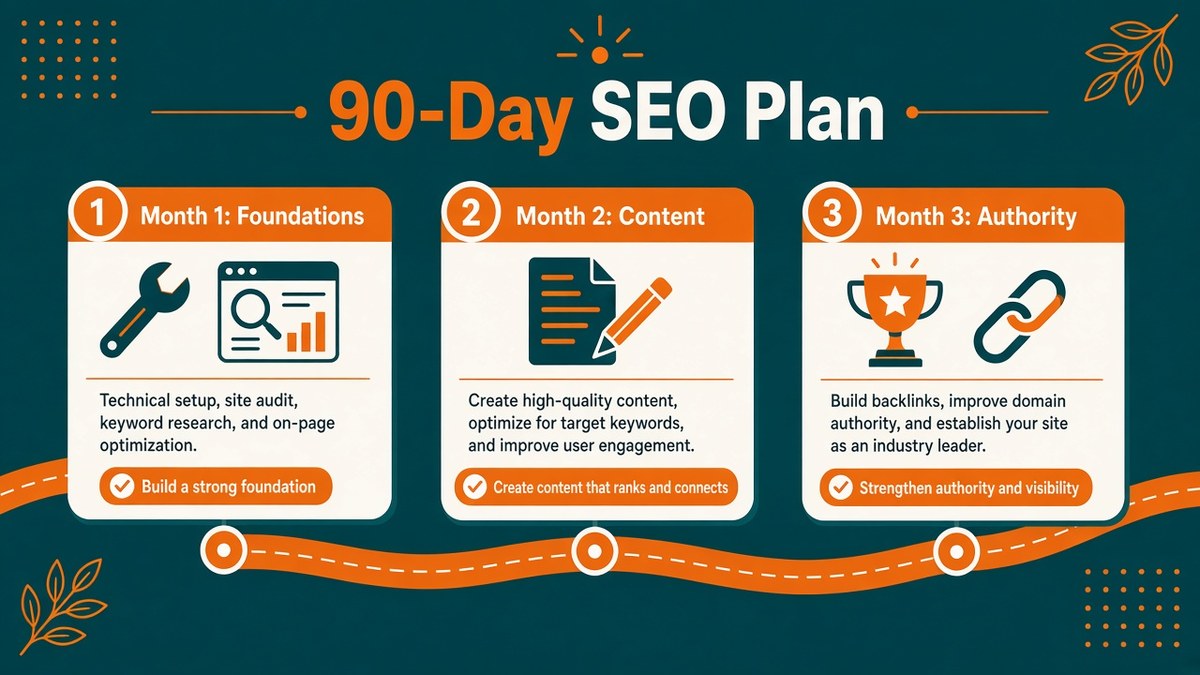
A 90-day SEO plan split into foundations, content and authority phases.
A simple weekly SEO routine
Once the 90-day plan is running, a short weekly routine keeps progress steady. Two to three hours is enough for most small businesses:
| Day | Task | Time |
|---|---|---|
| Monday | Check Search Console for new errors, drops in clicks and new queries | 20 min |
| Tuesday | Update or improve one existing page | 60 min |
| Wednesday | Add 3 to 5 internal links to a priority page | 20 min |
| Thursday | Work on one link or review opportunity | 30 min |
| Friday | Review rank tracker movement and note next week's task | 15 min |
✅ Tip for UK and EU sites
If you use analytics or tracking scripts, make sure your cookie banner and privacy policy follow GDPR and UK GDPR rules. Fast, honest consent banners also help user experience, which supports SEO.
Tools for your SEO plan (free and paid)
You can run a basic SEO plan with free tools only: Google Search Console, Google Analytics 4, Google Business Profile, PageSpeed Insights and a spreadsheet. Paid tools save time once you track more than a handful of keywords. SE Ranking is a good fit for small businesses and freelancers because it combines rank tracking, a site audit, keyword research and competitor research in one dashboard at a lower price than the biggest enterprise suites. Semrush and Ahrefs are powerful too, but often more than a small business needs; see my list of Semrush alternatives for small business and the rest of my tool reviews for side-by-side options.
If you prefer learning from a book, The Art of SEO by Eric Enge, Stephan Spencer and Jessica Stricchiola is one of the most complete references on search optimisation (Amazon US | Amazon UK). It is long, so use it as a reference while you follow your plan rather than reading it cover to cover first.
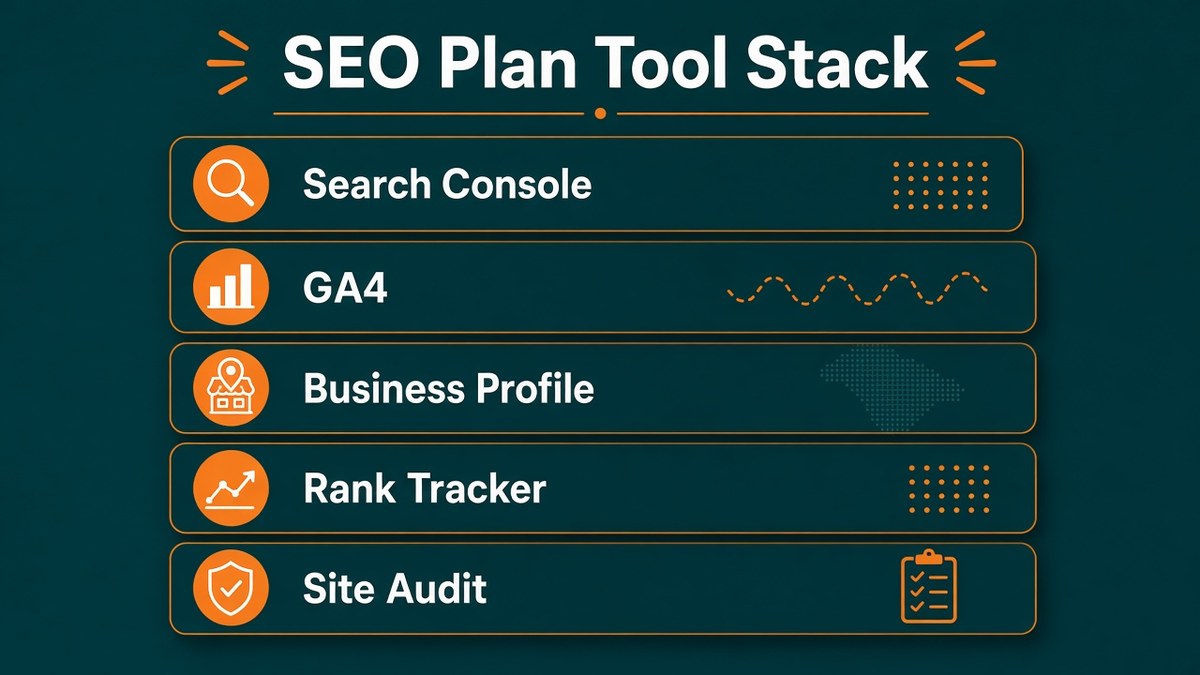
The core tool stack for a small business SEO plan.
How to measure whether your SEO plan works
Track a small set of numbers every month and compare them with your day-one baseline:
- Organic clicks (Search Console): the clearest sign your plan is reaching people.
- Keywords in the top 10 (rank tracker): focus on your money keywords, not every phrase.
- Click-through rate on key pages: low CTR with good rankings means your titles and descriptions need work.
- Leads or sales from organic search (GA4): the number that actually matters to the business.
- Technical health score (audit tool): should rise as you fix issues.
Expect early movement in rankings within 4 to 8 weeks for pages you improve, and clearer changes in leads after 3 to 6 months. If nothing moves after 90 days, go back to step 2: the keywords may be too competitive or the wrong intent.
Common SEO plan mistakes
- Targeting only broad keywords. Big phrases look exciting but rarely bring buyers to a small site.
- Writing new posts before fixing old pages. Improving pages that already rank is usually faster.
- Ignoring search intent. If Google shows comparison pages for a keyword, a sales page will struggle to rank.
- Not tracking a baseline. Without starting numbers you cannot tell what worked.
- Buying cheap links. Spammy links can hurt rankings; earn links from real businesses instead.
- Stopping after a month. SEO compounds; consistency matters more than intensity.
Frequently Asked Questions
What should an SEO plan include?
A good SEO plan includes a business goal, target keywords mapped to specific pages, a list of technical fixes, content updates and new pages, link and local tasks, a weekly routine and the numbers you will track each month.
How long does an SEO plan take to work?
Most small business sites see ranking movement within 4 to 8 weeks of improving pages, and clearer growth in clicks and leads after 3 to 6 months. Competitive industries can take longer.
Can I do SEO myself without an agency?
Yes. With free tools such as Google Search Console and a clear 90-day plan, many small business owners handle the basics themselves in 2 to 3 hours a week. An agency or freelancer helps when you need faster progress or technical work.
How much does SEO cost for a small business?
You can start with free tools only. A paid SEO tool for rank tracking and audits usually costs a modest monthly fee, while agencies in the US, UK and Europe often charge several hundred to a few thousand dollars or euros a month.
How often should I update my SEO plan?
Review it every month and rewrite it every 90 days based on what moved rankings, clicks and leads.
Is local SEO part of an SEO plan?
If you serve customers in a specific area, yes. Your Google Business Profile, reviews and local pages should be a core part of the plan.
Final thoughts
A good SEO plan is simple, written down and followed every week. Set your baseline, research the keywords buyers use, fix the foundations, improve the pages closest to page one and give it 90 days before judging the results. Small, consistent steps beat occasional big pushes every time.
Your next step: open Google Search Console today, note your clicks for the last 3 months, and pick the first five keywords for your plan.
Put your SEO plan on autopilot
SE Ranking tracks your keywords, audits your site and watches competitors in one dashboard, with a free trial so you can test it on your own site first.
Affiliate link. I may earn a commission at no extra cost to you.
The SE Ranking and Amazon links in this post are affiliate links. As an Amazon Associate I earn from qualifying purchases.