Small business marketing trends in 2026 are less about chasing every new platform and more about owning your audience, showing up with useful content and measuring what actually brings in customers. Paid social and rented data are less reliable than they were a few years ago, so the businesses that grow are the ones that combine email, useful video, first-party data, search, simple automation, community and a clear local or personal presence. In this guide I walk through seven trends worth following this year, how to apply them without a huge team, and which tools fit if you sell in the US, the UK, Europe or online worldwide.
🔍 Checked on 8 Nov 2026: plan details from the official Kit and Systeme.io pricing pages. Kit’s free plan covers up to 10,000 subscribers; Creator and Pro prices vary by list size (the 1,000-subscriber annual view showed Creator at $33/month and Pro at $66/month). Systeme.io lists a free plan plus Startup from $17/month, Webinar at $47/month and Unlimited at $97/month. Prices are in US dollars, before VAT or sales tax, and can change.
✔ Key takeaways
⏱ About 12 min read · the short version is right here
- The most useful small business marketing trends in 2026 favour channels you own: email, first-party data and content people actually want.
- Pair one visibility channel (search, short video or local presence) with a simple way to follow up, usually email or a lightweight funnel.
- Collect customer data with clear consent and keep it in a tool you control, rather than relying only on platform targeting.
- Helpful content still wins in search, including answers that AI overviews can cite; thin, keyword-stuffed pages do not.
- Start with one or two trends you can keep up for 90 days. Review a few numbers each month and adjust the mix each quarter.
📋 In this guide
- The 7 small business marketing trends at a glance
- 1. Own your audience with email
- 2. Useful and short-form video
- 3. First-party data and privacy-safe marketing
- 4. Search and helpful content
- 5. Simple automation and funnels
- 6. Newsletters, community and creator-style email
- 7. Local presence and personal brand
- How to put these trends to work
- Common mistakes to avoid
- Tools that make the work easier
- A book worth reading
- Frequently Asked Questions
The 7 small business marketing trends at a glance
These seven trends work together. Email and first-party data give you a durable audience; video, search and local presence help new people find you; automation and community turn that attention into sales. Pick the two closest to how your customers already buy, then add the rest as you get capacity.
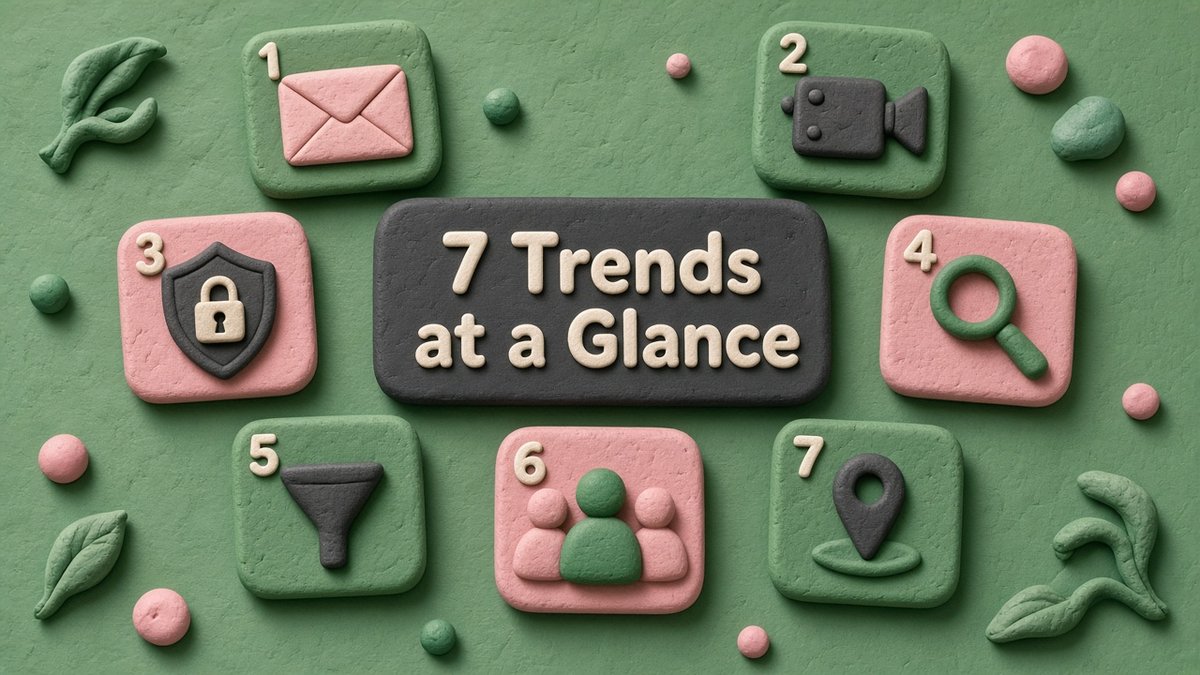
| Trend | What it means | A sensible first step |
|---|---|---|
| Owned email | Reach people who asked to hear from you | Add one clear opt-in and a short welcome sequence |
| Useful video | Show the work, the offer or a quick how-to | Publish one short, helpful clip each week |
| First-party data | Collect emails and preferences with consent | Write down what you collect and why |
| Helpful search | Answer real questions, including in AI search | Update one page that already gets enquiries |
| Simple automation | Follow up without relying on memory | Map the path from first visit to a booked call or checkout |
| Community and newsletters | Stay in touch between purchases | Send a useful email on a schedule you can keep |
| Local and personal brand | Show up where nearby or niche buyers already look | Complete your local profile or publish under your own name |
1. Own your audience with email
If you follow only one of these small business marketing trends, make it email. Social feeds, marketplaces and ad platforms can change the rules overnight. An email list is an asset you control, as long as people gave you permission to write to them. That is why email marketing for small business still sits at the centre of a durable plan, whether you sell consulting in Berlin, a shop in Manchester or a digital product to a US audience.
The bar is higher than collecting addresses and sending discounts. Offer something specific, such as a checklist or short guide, then send a welcome sequence that delivers it, says who you help and makes one clear next step.
You do not need a complex stack to start. A creator-focused platform such as Kit lets you collect subscribers, send broadcasts and, on paid plans, run automated sequences. Coaches comparing options can also look at my round-up of the best email marketing tools for coaches. Whatever tool you pick, keep the list clean, make every email easy to read on a phone and include a one-click unsubscribe.
📌 Permission beats interruption
Ask clearly, say what people will receive and write to them like a person. A smaller list that opens your emails is worth more than a large list you bought or scraped.
2. Useful and short-form video
Video is no longer a “nice extra” reserved for brands with a studio. Short, useful clips help people understand your offer faster than a long block of text, and they travel well on YouTube Shorts, Instagram, TikTok and LinkedIn. The trend that actually helps small businesses is not dancing in front of a logo. It is showing the work: a 45-second answer to a common question, a before-and-after, a walk-through of how you pack an order or a plain explainer of who your service is for.
Film on a phone in good daylight, add captions and treat each clip as an invitation to a page, a call or your email list. One useful weekly video, reused in a newsletter or blog post, is a habit most small teams can keep.
💡 A simple video test
If a stranger watched the clip with the sound off, would they know what you do and what to do next? If not, add on-screen text and a clearer ending.
3. First-party data and privacy-safe marketing
Third-party cookies and lookalike targeting are less dependable than they used to be. Browser privacy changes, app tracking limits and stricter rules in the UK, EU and many US states mean you cannot plan your growth around data you do not own. The practical response is first-party data: information customers give you directly, such as an email address, a preference, a purchase history or an answer to a short form.
Collect only what you need, explain why and store it in a system you control. In the UK or EU, use a clear privacy notice, an unticked marketing opt-in and an easy withdrawal. In the US, follow the rules that apply to your state and honour opt-outs. Start with one form and a few tags. Do not buy lists: those people never gave you permission and they hurt deliverability.
4. Search and helpful content
People still search when they have a problem to solve, and they now also get answers from AI overviews and chat tools. The businesses that show up are the ones that publish clear, specific pages a human would bookmark. That is the same thinking behind a good SEO plan: pick questions your buyers already ask, write complete answers and keep the pages updated.
Helpful content has a point of view, fresh details and proof from your own work, not a rewrite of pages already ranking. Keep the site fast on a phone and indexed in Google Search Console. If search is a main channel, SE Ranking can show which pages are moving, but the writing is the advantage. Thin keyword posts, including old trend round-ups that never get updated, waste the chance to be the page someone trusts.
5. Simple automation and funnels
Automation is a trend only when it saves you from dropping the ball, not when it sends people a dozen robotic emails. A simple funnel is enough for most small businesses: a visitor finds you, they exchange an email for something useful, they receive a short sequence and they get one clear offer. That path is also the core of lead generation for small business done properly.
You can build that path in separate tools or keep pages, email and checkout together. Systeme.io is a practical free starting point: its free plan includes contacts, a handful of funnels and unlimited email sends, with paid plans from $17/month if you outgrow those limits. Write the emails yourself, keep the tone human and stop the sequence when someone buys or asks to talk.
⚠️ Do not automate a messy process
If you cannot describe the steps on one page, automation will only send confusion faster. Sketch the path on paper first: trigger, three follow-up emails, then a manual check-in if someone goes quiet.
6. Newsletters, community and creator-style email
The other side of email is not a sales sequence. It is a regular reason to stay in someone’s inbox: a newsletter, a members’ note or a small community where customers talk to you and to each other. Creator-style email works for more than influencers. A baker, a bookkeeper or a coach can send a short weekly note with one tip, one story and one link. If you are starting from scratch, how to start a newsletter walks through the practical setup.
Kit is built for this style of email: broadcasts, tagging and a newsletter feed, with automations on paid plans. A community can be a reply-friendly newsletter or a monthly Q&A; one conversation you host beats three empty rooms. If you use Kit and want to watch seasonal offers, I keep a page on the Kit Black Friday deal for when those promotions are live.
7. Local presence and personal brand
Not every small business needs to go viral. Many still win by being easy to find in a town, a neighbourhood or a tight niche. That means a complete Google Business Profile, consistent name and address details, recent photos, fast replies to reviews and pages that mention the area you serve without stuffing keywords. I cover the search side of this in local SEO for small business.
Personal brand is the same idea online: people buy from someone they recognise. Use your name and face on the site and in your videos, and share who you help. Online-only businesses can treat “local” as wherever customers already spend time, such as a niche community or a complementary partner, and show up there with help rather than a hard pitch.
How to put these trends to work
A list of trends is only useful if it changes next week’s calendar. Use the steps below to turn the ideas into a 90-day plan. If you also need the bigger picture of who you serve and why they should choose you, start with what a marketing strategy is and then come back to these actions.
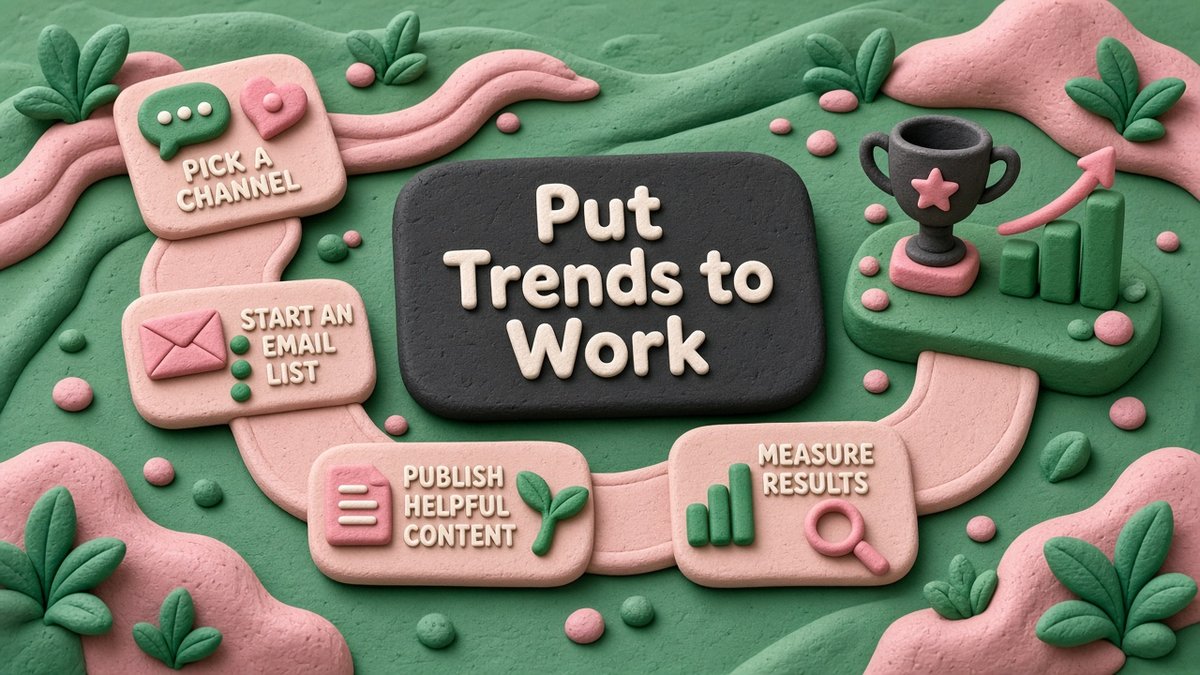
Choose one visibility channel and one follow-up channel
Pick the place new people already look for you (search, short video or local) and pair it with email. Write that choice down so you are not tempted to add three more channels this month.
Make the opt-in obvious
Add one offer and one form to your homepage, your most-visited blog post and your social profile. Say exactly what people will receive and how often you will write.
Publish one helpful asset
Update or write a page that answers a real buyer question, or film a short video that does the same job. End with a next step into your email list or a booking page.
Set up a short welcome path
Three to five emails are enough: deliver the promised resource, share who you help, answer a common objection and invite a call, a trial or a purchase.
Measure a few numbers for 90 days
Track new subscribers, replies or booked calls, and sales or revenue you can tie to the channel. Review the notes on the same day each month before you change the plan.
Common mistakes to avoid
- Copying a trend without a customer in mind. Short video, newsletters and funnels only work if they speak to a specific person with a specific problem.
- Starting five channels at once. A half-used TikTok, a silent newsletter and an unfinished funnel help no one. Finish one loop first.
- Buying data or skipping consent. It damages trust and deliverability, and it sits on the wrong side of UK, EU and many US rules.
- Publishing content you never update. Old statistics and leftover year-in-the-title posts train both readers and search engines not to trust you.
- Automating too early or too much. A bad welcome sequence sent 2,000 times is still a bad welcome sequence.
💡 A 90-day rule of thumb
Give a chosen channel three months of steady work before you judge it. Most marketing looks quiet in week two and clearer by week ten.
Tools that make the work easier
Use free tools until a channel proves itself, then pay for the feature you actually need. Here is a simple stack that covers the seven trends above without locking you into software you will not open.
| Tool | Cost (checked 8 Nov 2026) | Best for |
|---|---|---|
| Google Search Console | Free | Seeing search queries, clicks and indexing issues |
| Google Business Profile | Free | Local visibility, photos, posts and review replies |
| Kit | Free up to 10,000 subscribers; Creator from $33/month on annual billing at 1,000 subscribers | Newsletters, broadcasts and creator-style email; automations on paid plans |
| Systeme.io | Free plan, then paid from $17/month | Landing pages, funnels, email and checkout in one place |
| Your phone plus captions | Free | Short, useful video you can publish weekly |
Looking for more hands-on comparisons? Browse my Reviews hub. Prices and tools checked on 8 Nov 2026; always confirm current pricing on the official sites.
Ready to put these trends into a simple funnel?
Build your first lead magnet, landing page and email sequence on Systeme.io’s free plan, then upgrade only when the funnel starts to bring in customers.
Affiliate link. I may earn a commission at no extra cost to you.
A book worth reading
If you read one book alongside these trends, make it Permission Marketing by Seth Godin. It explains why interrupting people is getting more expensive and why earning the right to follow up, usually by email, is the more durable path. That idea sits underneath trends 1, 3 and 6 in this guide (Amazon US | Amazon UK).
Frequently Asked Questions
What are the most important small business marketing trends in 2026?
The seven that matter most for small teams are an owned email list, useful short-form video, first-party data collected with consent, helpful search content (including AI search), simple automation and funnels, a newsletter or community, and a clear local or personal presence where customers already spend time.
Which marketing trend should a small business start with?
Start with the one you can keep up with for 90 days and that already sits close to how customers find you. For most service businesses that is email plus one visibility channel, such as search, short video or a complete local profile.
Is email marketing still worth it for small businesses in 2026?
Yes. Email is still the channel you own. Platforms can change their rules overnight, but a permission-based list lets you reach people who asked to hear from you. Send useful, mobile-friendly messages and collect addresses with a clear opt-in.
Do I need a big budget to follow these marketing trends?
No. You can start with free tools such as a Google Business Profile, Search Console, phone videos and an email platform with a free plan. Paid ads and extra software help later, once a channel is already bringing in enquiries.
How often should I review my marketing trends and channels?
Check a few numbers every month, such as new subscribers, qualified enquiries and sales from each channel. Review the mix itself every quarter, and replace a weak channel with one clearer bet rather than another pile of tactics.
Final thoughts
You do not need to ride every marketing wave this year. You need a list you own, content that helps, a simple way to follow up and a habit of checking what worked. Those are the small business marketing trends that still make sense in 2026. Pick one visibility channel and one follow-up channel this week, then review the numbers in 90 days.
Affiliate disclosure: some links above are affiliate links. If you buy through them, I may earn a commission at no extra cost to you. I only recommend tools I would use myself. As an Amazon Associate I earn from qualifying purchases.