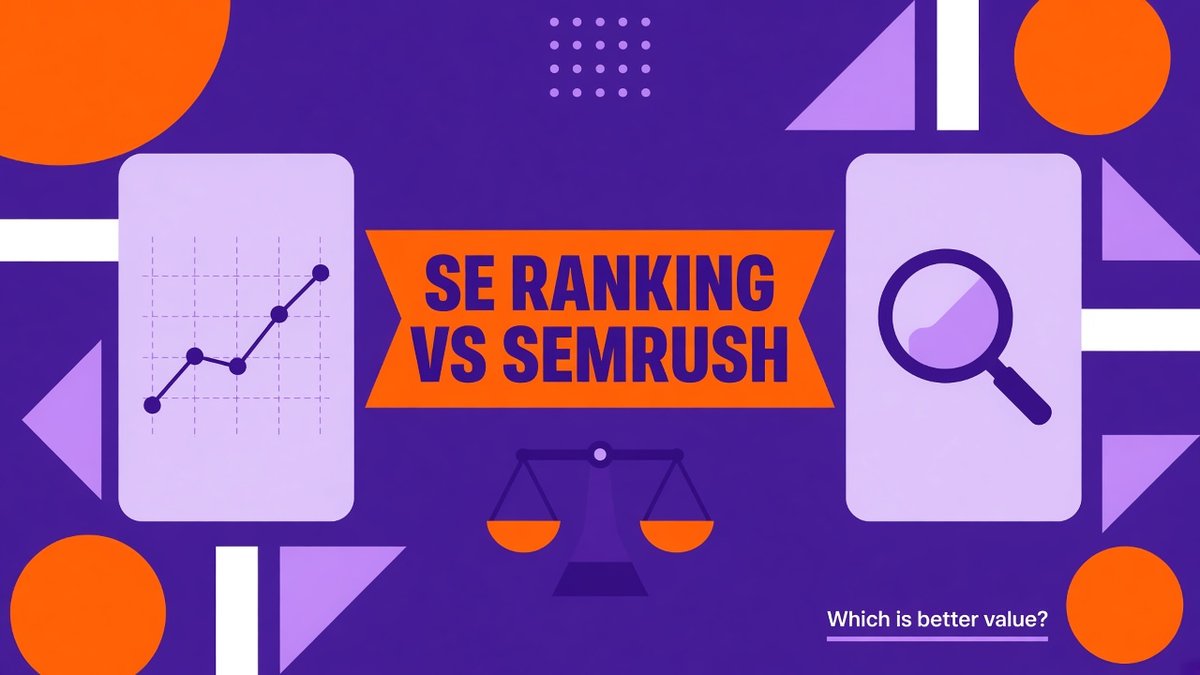
The SE Ranking vs Semrush question comes down to one thing for most small businesses: do you need Semrush’s extra depth, or does SE Ranking give you everything you will actually use for a much lower monthly bill? Both are serious all-in-one SEO platforms with rank tracking, keyword research, backlink analysis and site audits. In this head-to-head I compare features, data accuracy, limits on each plan and real prices shown on both official websites on 16 November 2026, then tell you exactly who should pick which.
✔ Key takeaways
⏱ About 10 min read · the short version is right here
- SE Ranking is the better value for most small businesses, freelancers and small agencies: Core costs $129 a month, or $103.20 billed annually.
- Semrush is the deeper research tool, with stronger competitive and market data, but its paid plans run from $139 to $299 a month for one user.
- On limits, SE Ranking Core tracks 2,000 keywords a day across 10 projects, while Semrush’s SEO and Starter plans track 500 keywords across 5 websites.
- Neither tool’s traffic and keyword volume figures are exact; treat both as estimates and use Google Search Console for your own site’s real data.
- Pick Semrush if competitor research and advertising data drive your growth; pick SE Ranking if you mainly track rankings, audit sites and report to clients.
📋 In this guide
- SE Ranking vs Semrush: the quick verdict
- What each tool is built for
- Features compared side by side
- Pricing and limits per plan (checked today)
- Data accuracy: what to expect from each
- Ease of use and reporting
- AI search tracking and extras
- EU and UK buyers: VAT, GDPR and billing
- Who should pick which tool
- How to test both before you pay
- FAQ
SE Ranking vs Semrush: the quick verdict
For a typical small business or a solo marketer, SE Ranking wins on value. You get more tracked keywords, more projects and a free 14-day trial without a credit card, at a lower price than Semrush’s entry plan. Semrush wins on research depth: if you spend hours studying competitors, keyword gaps and paid search, its data and extra toolkits can justify the higher cost.
My short advice: start with the SE Ranking free trial and only move to Semrush if you hit a research limit that genuinely costs you money.
| Question | SE Ranking | Semrush |
|---|---|---|
| Best for | Small businesses, freelancers, small agencies | In-house teams and agencies doing heavy research |
| Entry price (monthly) | $129 (Core) | $139 (SEO) |
| Entry price (billed annually) | $103.20 a month | $117.33 a month |
| Keywords tracked daily (entry plan) | 2,000 | 500 |
| Projects or websites (entry plan) | 10 | 5 |
| Free option | 14-day free trial, no card | Free plan with limited daily reports |
| Overall | Best value | Most depth |
What each tool is built for
SE Ranking started as a rank tracker and grew into a full SEO platform. Its focus is the day-to-day work of running SEO for one site or a handful of client sites: tracking positions, auditing pages, monitoring backlinks and sending clean reports. I cover it in full in my SE Ranking review.
Semrush is the market heavyweight. Beyond SEO it covers advertising research, content, local, social and AI visibility, many of them as separate toolkits. Its strength is competitive intelligence: seeing what other sites rank and bid for, and where the gaps are. If you already know Semrush is too much, my list of Semrush alternatives for small business covers cheaper options.
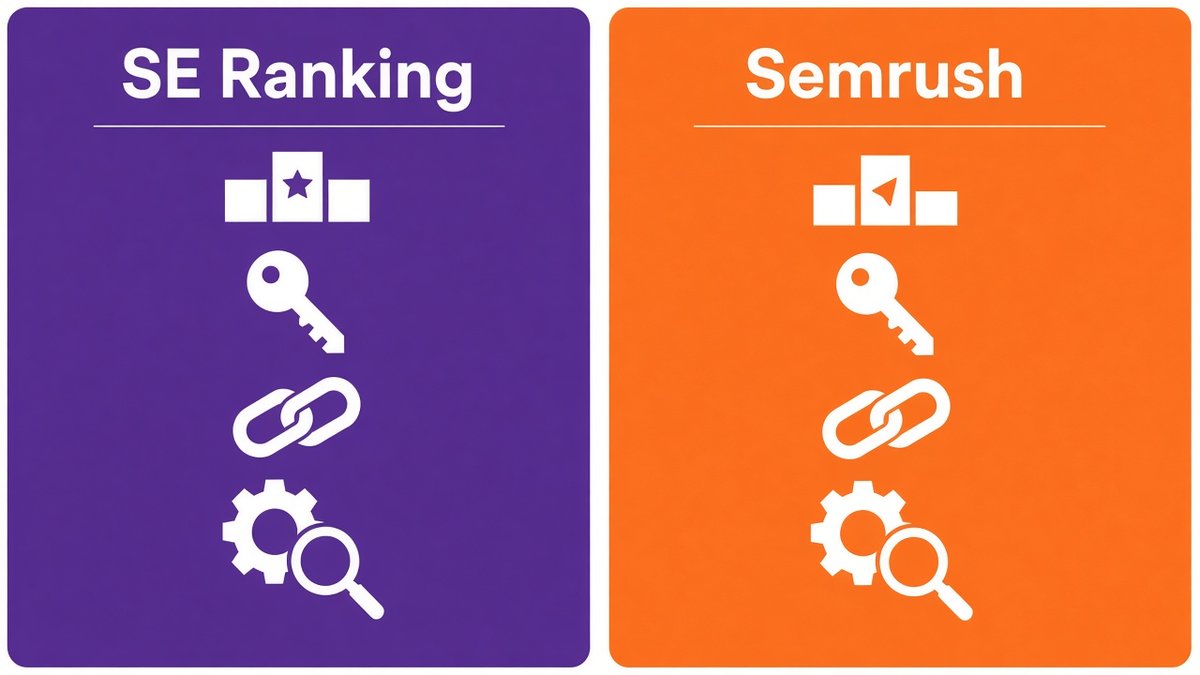
SE Ranking vs Semrush at a glance: core SEO features both tools share, and where each one goes further.
Features compared side by side
Both tools cover the core SEO jobs. The differences are in depth, limits and how much you pay for extras.
| Feature | SE Ranking | Semrush |
|---|---|---|
| Rank tracking | Daily tracking, Google top 100, share of voice, local and map rank tracker | Position Tracking on every plan; multi-location and device tracking from Pro+ |
| Keyword research | Unlimited keyword research on paid plans | Keyword research on all plans; full optimization tools from Starter |
| Competitor research | Unlimited competitor and backlink research | Deepest competitive and market data of the two |
| Backlink analysis | Backlink research and monitoring included | Backlink analytics included |
| Site audit | 250,000 pages a month on Core, 2 million on Growth | Site Audit on all plans; AI-ready Site Audit from Starter |
| Historical data | 6 months on Core, full project history on Growth | Historical SEO data from Pro+ |
| Content tools | 25 articles a month on Core, 50 on Growth | Content optimization from Pro+; more content tools as add-ons |
| Reporting | Report builder; white label in the Agency Pack add-on | Base and Pro Report add-ons |
| Extra users | Extra manager seats from $16 a month | Additional users at extra cost per month |
💡 Count your keywords first
Before comparing plans, list the keywords you really need to track every day. A local business with 200 keywords fits either tool; a consultant tracking 1,500 keywords for several clients will pay far less with SE Ranking.
For a broader view of the market, including free options, see my guide to the best SEO tools for small business.
Pricing and limits per plan (checked today)
These are the prices each official site showed on 16 November 2026, in US dollars and before tax. SE Ranking advertises up to 20% off for annual billing, and Semrush up to 17%.
SE Ranking plans
| Plan | Monthly | Billed annually (per month) | Key limits |
|---|---|---|---|
| Core | $129 | $103.20 | 10 projects, 1 manager seat, 2,000 keywords tracked daily, 250K audit pages a month, 25K API credits |
| Growth | $279 | $223.20 | 30 projects, 3 manager seats, 5,000 keywords tracked daily, 2M audit pages a month, 100K API credits |
| Enterprise | Custom | Custom | Custom limits and full API |
SE Ranking also sells an Agency Pack for white-label reporting at +$69 a month (annual billing only). For every add-on and real-world cost scenario, read my SE Ranking pricing guide.
Semrush plans
| Plan | Monthly | Billed annually (per month) | Key limits |
|---|---|---|---|
| Free | $0 | $0 | 1 demo project, 10 reports a day |
| SEO | $139 | $117.33 | 5 websites, 500 keywords tracked daily, basic keyword and competitor research |
| Starter | $199 | $165.17 | 5 websites, 500 keywords, full keyword and competitor tools, 50 AI prompts a day |
| Pro+ | $299 | $248.17 | 15 websites, 1,500 keywords, historical data, content optimization, 100 AI prompts a day |
| Advanced | Custom | Custom | 40+ websites, 5,000+ keywords, API access |
📌 Checked on 16 November 2026
Neither pricing page showed a Black Friday or Cyber Monday offer on this date. Semrush displayed local-currency prices for my region, which matched its US dollar list above. Prices change often, so confirm the current figures on the SE Ranking pricing page and on semrush.com before you buy.
On pure numbers, SE Ranking Core gives you four times the daily tracked keywords and twice the projects of Semrush’s entry plans, for less money. To match SE Ranking Core’s 2,000 keywords inside Semrush, you would need to look at Pro+ (1,500) or Advanced.
Data accuracy: what to expect from each
No third-party SEO tool sees Google’s real data. Search volumes, traffic estimates and keyword difficulty scores in both SE Ranking and Semrush are modelled estimates built from clickstream data, SERP crawls and their own algorithms. They are useful for comparing opportunities, not for predicting exact visits.
- Rank tracking is the most reliable data in both tools, because it checks real search results for your chosen location and device. Expect small differences from what you see in your own browser, which is personalised.
- Search volume estimates usually agree on which keywords are big and which are small, but the exact numbers can differ, especially for low-volume long-tail terms.
- Traffic estimates for competitors are rough. Use them to compare sites with each other, not as real visitor counts.
- Backlink counts differ because each tool crawls the web on its own schedule. Semrush generally has the broader index for competitive research; SE Ranking is solid for monitoring your own links.
⚠️ Trust your own data first
For your own website, Google Search Console and your analytics tool are the source of truth. Use SE Ranking or Semrush to research competitors and spot opportunities, then confirm results in Search Console.
If you are new to this, my SEO plan guide shows how to turn keyword data into a simple monthly routine.
Ease of use and reporting
SE Ranking is the easier tool to learn. The dashboard is simpler, projects are set up in minutes and the report builder makes client-friendly PDFs without much effort. That matters for small business owners who do their own SEO a few hours a month.
Semrush has a steeper learning curve because it does so much more. Power users love it; occasional users often feel they are paying for dozens of reports they never open. Semrush’s reporting add-ons cover scheduled PDFs and, on the Pro Report, white labelling.

Who should pick which: SE Ranking for value and simple reporting, Semrush for deep competitor and market research.
AI search tracking and extras
Both platforms now track how brands appear in AI answers, not just classic search results. SE Ranking’s paid plans include AI visibility tracking for 25 prompts a day across five AI engines, with a separate SE Visible product for bigger needs. Semrush adds 50 daily prompts on Starter and 100 on Pro+, plus AI visibility reports.
For most small businesses this is a nice extra rather than the reason to buy. Make sure your classic SEO basics, such as technical health, content and local SEO, are in place first.
EU and UK buyers: VAT, GDPR and billing
Both companies price in US dollars, and VAT or other sales tax may be added at checkout depending on where you are. If you are a VAT-registered business in the UK or EU, enter your VAT number at checkout where offered and keep the invoices for your records.
On GDPR, both tools mainly process data about websites and search results rather than your customers. Still, if you connect Google Analytics or Search Console, invite team members or upload contact data, check each provider’s privacy policy and data processing terms and add them to your record of processors.
Who should pick which tool
Choose SE Ranking
Best value for most small businesses
You run SEO for one site or a few client sites, track hundreds to thousands of keywords, want clean reports and a lower monthly bill, and prefer a tool you can learn in an afternoon.
Choose Semrush
Best for research-heavy teams
You live in competitor research, keyword gap analysis and paid search data, run campaigns in several markets, and have the budget and time to use a large toolset.
| Your situation | Better pick |
|---|---|
| Local business owner doing your own SEO | SE Ranking Core |
| Freelance SEO with 5 to 10 clients | SE Ranking Core or Growth |
| Small agency needing white-label reports | SE Ranking Growth + Agency Pack |
| In-house marketer focused on competitor and PPC research | Semrush Starter or Pro+ |
| Content team analysing many markets | Semrush Pro+ |
Still unsure? Most small businesses get further with a cheaper tool they actually open every week than with a powerful one they rarely log into.
How to test both before you pay
List your must-have jobs
Write down the keywords, sites and reports you need each month, so you judge both tools against real work.
Start the SE Ranking trial
Add your site, import keywords and run a site audit. The 14-day trial needs no credit card.
Run the same tasks in Semrush
Use its free plan or trial to check the same keywords and competitors.
Compare what you would act on
Ignore feature counts. Which tool gave you insights you would actually use this month?
Choose and set a review date
Pick one tool, pay monthly first if unsure, and review the choice after three months.
Try SE Ranking free for 14 days
Track rankings, audit your site and research competitors with no credit card needed. See if it covers everything you need before paying for a pricier tool.
Affiliate link. I may earn a commission at no extra cost to you.
Frequently Asked Questions
Is SE Ranking better than Semrush?
For most small businesses, freelancers and small agencies, SE Ranking is the better value because it costs less and includes more tracked keywords and projects. Semrush is better for teams that rely heavily on competitor, market and advertising research.
Is SE Ranking cheaper than Semrush?
Yes. On 16 November 2026 SE Ranking Core cost $129 a month or $103.20 billed annually, while Semrush’s cheapest paid plan, SEO, cost $139 a month or $117.33 billed annually.
Which is more accurate, SE Ranking or Semrush?
Rank tracking is reliable in both. Search volumes, traffic estimates and backlink counts are estimates in any third-party tool, so expect differences between them and confirm your own site’s data in Google Search Console.
Does SE Ranking have a free trial?
Yes. SE Ranking offers a 14-day free trial on its Core and Growth plans, and its pricing page says no credit card is required.
Does Semrush have a free plan?
Yes. Semrush lists a free plan with one demo project and 10 reports a day, which is useful for trying the interface but too limited for ongoing SEO work.
Can an agency use SE Ranking instead of Semrush?
Many small agencies do. SE Ranking Growth supports 30 projects and 3 manager seats, and the Agency Pack add-on adds white-label reporting and client-facing tools.
My final SE Ranking vs Semrush verdict: choose SE Ranking if you want strong everyday SEO and reporting at a fair price, and choose Semrush if deep research is central to how you grow. For more honest comparisons, browse the Reviews section.
Affiliate disclosure: some links in this post are affiliate links, so I may earn a commission at no extra cost to you. I only recommend tools I’d use myself.