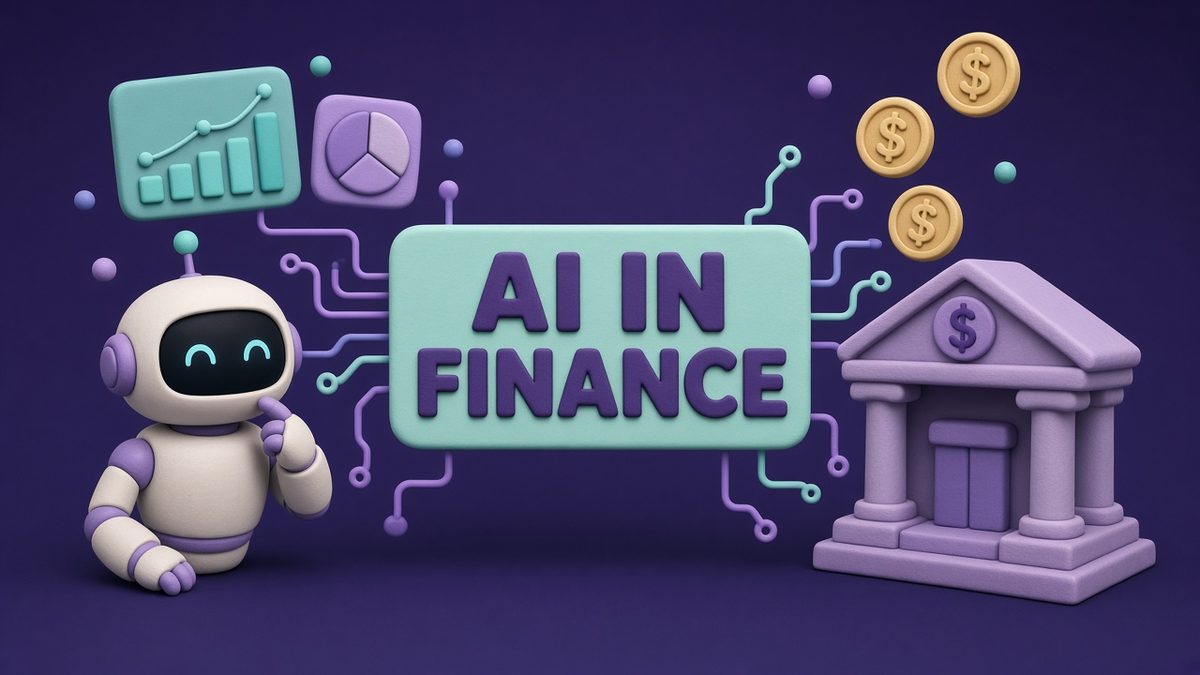
The role of artificial intelligence in the finance industry has grown from a niche experiment to something that touches almost every transaction you make. When your bank flags a suspicious card payment in seconds, when a loan app approves you in minutes or when a chatbot answers your question at midnight, AI is usually working in the background. In this guide I explain how AI is used in finance today, the benefits and risks for customers and businesses, how regulation is changing and how small businesses can use AI tools safely in their own financial work.
✔ Key takeaways
⏱ About 8 min read · the short version is right here
- Artificial intelligence in finance is already used for fraud detection, credit scoring, customer service, trading, risk management and compliance.
- For customers, AI means faster approvals, smarter fraud alerts and 24/7 chat support; for firms, lower costs and better risk control.
- The biggest risks are biased decisions, opaque “black box” models, data privacy, cyber threats and over-reliance on automation.
- Regulators increasingly expect explainability, human oversight and fair treatment when AI makes financial decisions.
- Small businesses can use AI today for bookkeeping, forecasting, invoice processing and cash-flow insights, as long as a human checks the output.
What does AI in finance actually mean?
Artificial intelligence is a broad term for computer systems that perform tasks that normally need human intelligence: recognising patterns, making predictions, understanding language and learning from data. In finance, the main types are:
- Machine learning: models that learn patterns from historical data, for example which transactions tend to be fraudulent.
- Natural language processing: systems that read and write human language, such as chatbots and tools that summarise reports or contracts.
- Generative AI: large language models that draft text, code and analysis on request.
- Robotic process automation: software “robots” that handle repetitive rule-based tasks, often combined with AI for smarter decisions.

8 key uses of AI in the finance industry
1. Fraud detection and prevention
Banks and payment companies analyse millions of transactions in real time. Machine learning models learn your normal behaviour, such as where and how you usually spend, and flag unusual activity instantly. This is one of the oldest and most successful uses of AI in finance.
2. Credit scoring and lending
Lenders use AI to assess creditworthiness faster, sometimes using extra data such as cash-flow history alongside traditional credit reports. This can widen access to credit for people with thin credit files, but it also raises questions about fairness and transparency.
3. Customer service and chatbots
AI assistants handle balance checks, card blocks, payment queries and simple product questions around the clock, passing complex cases to human staff. Generative AI is making these assistants more conversational and helpful.
4. Algorithmic and high-frequency trading
Investment firms use algorithms to analyse market data, news and patterns and execute trades in fractions of a second. AI helps spot opportunities and manage execution, though markets remain unpredictable and models can fail in unusual conditions.
5. Robo-advisers and personalised investing
Robo-advisers build diversified portfolios based on your goals and risk tolerance and rebalance automatically, often at low cost. They have made simple, diversified investing more accessible. If you are new to the concepts behind them, my guide to the basics of investing is a good starting point.
6. Risk management
Banks and insurers use AI to model market, credit and operational risk, run stress tests and spot early warning signs in loan portfolios. Insurers also use it to price policies and assess claims more quickly.
7. Compliance and anti-money laundering
“RegTech” tools use AI to monitor transactions for money laundering, screen customers against sanctions lists and check documents during onboarding. They reduce false alarms that previously swamped compliance teams.
8. Back-office automation and document processing
AI reads invoices, receipts, statements and loan documents, extracts the key data and routes it into accounting systems. This cuts manual work and errors in finance departments of every size.
| Area | What AI does | Benefit | Main risk |
|---|---|---|---|
| Fraud detection | Spots unusual transactions in real time | Fewer losses, faster alerts | False positives blocking real payments |
| Lending | Assesses credit risk quickly | Faster decisions, wider access | Bias against certain groups |
| Customer service | Chatbots and virtual assistants | 24/7 support, lower cost | Frustration if no human route |
| Trading | Analyses data and executes trades | Speed and efficiency | Model failures, market shocks |
| Investing | Robo-advice and portfolio management | Low-cost diversification | One-size-fits-all advice |
| Compliance | Monitors for money laundering | Better detection, less manual review | Missed edge cases |
Benefits of AI for customers and firms
- Speed: instant payments checks, quick loan decisions and real-time support.
- Lower costs: automation reduces operating costs, which can mean lower fees.
- Better security: faster fraud detection protects accounts.
- Personalisation: tailored budgeting insights, product recommendations and alerts.
- Financial inclusion: alternative data and digital onboarding can reach people traditional banks missed.
These changes are part of a wider shift in how banks work, which I cover in the future of banking.

Risks and challenges
- Bias and fairness: models trained on historical data can repeat past discrimination in lending or insurance.
- Lack of explainability: complex models can be hard to explain, which is a problem when customers deserve to know why they were refused credit.
- Data privacy: AI needs large amounts of personal data, raising questions about consent and security.
- Cyber threats and deepfakes: criminals use AI too, for example voice cloning to trick staff or customers.
- Errors at scale: a faulty model can make thousands of wrong decisions before anyone notices.
- Over-reliance: automation without human oversight can miss context and unusual situations.
How regulation is responding
Financial regulators around the world are paying close attention. Common themes include requiring firms to explain automated decisions, test for bias, keep humans in the loop for important decisions, protect customer data and take responsibility for outcomes even when a third-party AI vendor is involved. The European Union’s AI Act treats AI used for credit scoring as high risk, with extra obligations. Expect rules to keep evolving as the technology changes.
How small businesses can use AI in their finances
You do not need to be a bank to benefit. Many accounting and banking tools now include AI features:
Automate bookkeeping
Let your accounting software categorise transactions and match receipts, then review the results weekly. My guide to business record keeping explains what to keep.
Forecast cash flow
Use AI forecasting features or ask an AI assistant to help build a simple 12-week cash-flow model from your own figures.
Speed up invoicing and collections
Automate invoice reminders and use AI to draft polite follow-ups for late payments.
Spot unusual spending
Set alerts for duplicate payments, unexpected subscriptions or out-of-pattern expenses.
Keep a human in charge
AI can be wrong or out of date, especially on tax. Double-check important outputs against official sources, as I explain in my guide to taxation basics.
🔒 Protect your data
Never paste full bank details, passwords, ID numbers or confidential client data into public AI chatbots. Use business tools with clear data protection policies, and turn on two-factor authentication everywhere.
Using AI for your personal finances
Individuals can benefit from AI too, often without realising it. Many banking apps already categorise spending, predict upcoming bills and warn you before your balance runs low. Used carefully, AI can make good money habits easier:
- Budget insights: let your bank app group spending automatically, then review the categories monthly.
- Learning: ask an AI assistant to explain a financial term, compare loan types in general terms or build a simple savings plan template.
- Automation: combine AI insights with automatic transfers to savings and investments.
- Scam awareness: be extra careful with unexpected calls, voice notes or videos asking for money or codes; AI makes impersonation easier.
Pair these tools with solid basics. My personal finance tips cover the habits that matter more than any app.
What AI means for finance careers
Routine roles built around data entry, reconciliation and simple checks are the most exposed to automation. Roles that combine finance knowledge with judgement, communication and technology are growing. Useful skills include data analysis, understanding how models work and where they fail, risk and compliance knowledge, and the ability to explain complex numbers to clients and colleagues. Finance professionals who learn to work alongside AI, rather than compete with it, are likely to be in the strongest position.
What comes next
Expect more AI-powered personal finance assistants, real-time lending decisions, smarter fraud prevention and deeper automation of finance teams. Digital assets and blockchain may also intersect with AI, though that area remains highly speculative; my cryptocurrency guide covers the risks. The winners will be firms that combine AI’s speed with human judgement, transparency and trust.
Frequently Asked Questions
How is artificial intelligence used in finance?
AI is used to detect fraudulent transactions, assess credit risk, automate customer service through chatbots, power algorithmic trading, personalise financial advice, monitor compliance and anti-money-laundering rules, and process documents such as invoices and loan applications.
Will AI replace jobs in banking and finance?
AI is automating many routine tasks such as data entry, document checks and basic customer queries. At the same time, it creates demand for roles in data science, risk, compliance, model oversight and relationship management. Most experts expect roles to change significantly rather than disappear entirely.
Is AI in finance safe?
AI can make finance safer, for example by catching fraud faster, but it also brings risks such as biased models, privacy breaches, cyber attacks and errors at scale. Safety depends on good data, testing, human oversight and regulation.
What is a robo-adviser?
A robo-adviser is an online service that uses algorithms to build and manage a diversified investment portfolio based on your goals and risk tolerance, usually at a lower cost than a traditional adviser. Most handle rebalancing automatically; some offer access to human advisers too.
How can small businesses use AI for finance?
Common uses include automatic bookkeeping and bank reconciliation, reading receipts and invoices, cash-flow forecasting, chasing late payments, spotting unusual spending and drafting financial summaries. Always review AI outputs before relying on them for tax or important decisions.
Can I trust AI-generated financial advice?
Treat general AI chatbots as a starting point for learning, not as personal advice. They can be out of date or confidently wrong. For decisions about your own money, check official sources and speak to a qualified, regulated adviser.
Final thoughts
Artificial intelligence is reshaping the finance industry, from fraud detection and lending to investing and compliance. It brings real benefits in speed, cost and security, along with genuine risks around bias, privacy and accountability. For individuals and small businesses, the smart approach is to use AI tools to save time and spot problems early, while keeping a human, and reliable sources, in charge of important financial decisions.