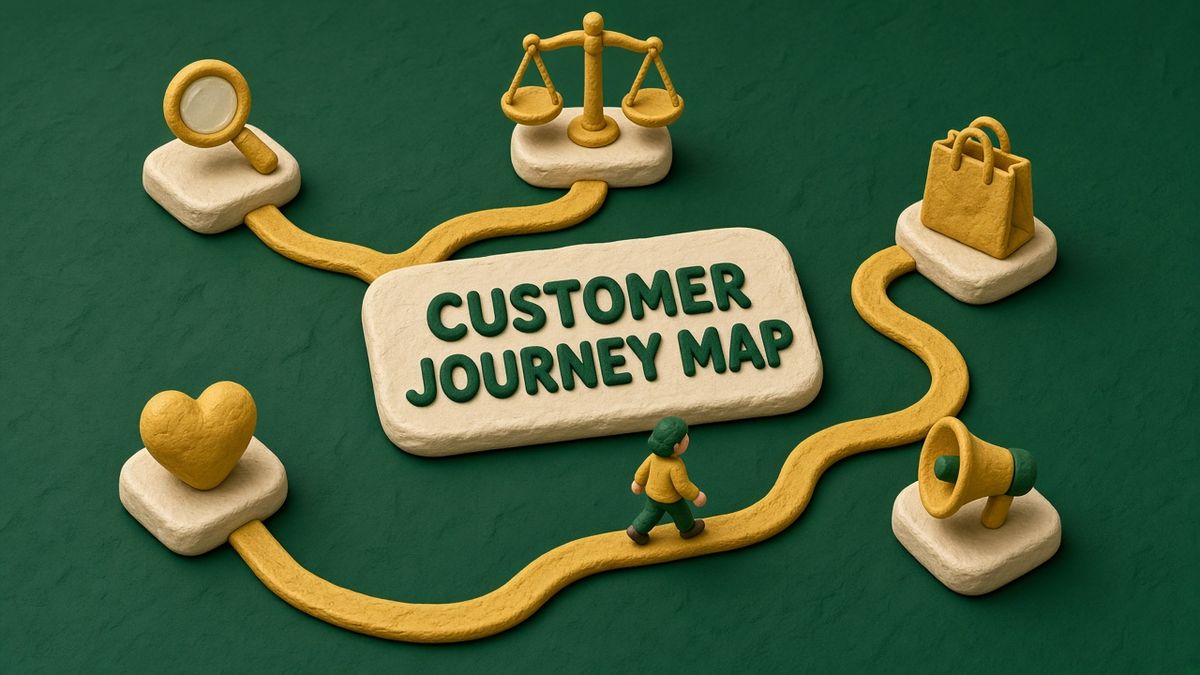
A customer journey map shows every step a customer takes with your business, from the moment they first hear about you to the moment they buy again or recommend you to a friend. Learning how to create a customer journey map helps you spot where people get confused, lose interest or leave, so you can fix the right problems instead of guessing. This guide explains the five customer journey stages, a 7-step process to build your map, a worked example for a small business, the touchpoints to include and a simple template you can copy.
✔ Key takeaways
⏱ About 8 min read · the short version is right here
- A customer journey map is a visual timeline of what customers do, think and feel at each stage of buying from you.
- Most maps use five stages: awareness, consideration, purchase, retention and advocacy.
- Build your map from real data such as interviews, reviews, analytics and support emails, not assumptions.
- Focus on pain points and drop-off moments, then turn each one into a specific fix with an owner.
- Start with one persona and one journey; a simple table is enough for most small businesses.
📋 In this guide
What is a customer journey map?
A customer journey map is a diagram or table that lays out the customer experience step by step. For each stage it records what the customer is trying to do, which touchpoints they use (your website, an ad, an email, a phone call), what they are thinking and feeling, and where things go wrong.
Unlike a sales funnel, which shows your process for turning leads into customers, a customer journey map shows the experience from the customer’s side. The two work best together: your sales funnel describes what you want to happen, and the journey map shows what actually happens.
📌 Start with who, not what
Every journey map is built around one type of customer. If you have not done it yet, first create a buyer persona so you know whose journey you are mapping.
Why small businesses need one
Big companies run journey mapping workshops with whole teams, but the method is just as useful for a five-person business. A clear map helps you:
- Find where you lose customers, such as a confusing pricing page or a slow reply to enquiries.
- Prioritise fixes by impact instead of opinion.
- Align your team so sales, service and marketing see the same customer.
- Improve retention, which is usually cheaper than winning new customers; see these customer retention strategies.
- Raise customer lifetime value by planning the moments after the first purchase, not just before it.
The 5 customer journey stages
Most customer journey maps use five stages. You can rename them to suit your business, but keep the order.
| Stage | Customer goal | Typical touchpoints | Key question for you |
|---|---|---|---|
| Awareness | Realise they have a problem and discover options | Search, social media, ads, word of mouth | Can the right people find us? |
| Consideration | Compare options and judge if you can be trusted | Website, reviews, case studies, pricing page, emails | Do we answer their doubts clearly? |
| Purchase | Buy or sign up with as little friction as possible | Checkout, booking form, proposal, sales call | Is buying easy and reassuring? |
| Retention | Get value and decide whether to stay or buy again | Onboarding, product use, support, follow-up emails | Do they succeed quickly with us? |
| Advocacy | Recommend you and leave reviews | Review requests, referral programme, social posts | Do we make it easy to recommend us? |
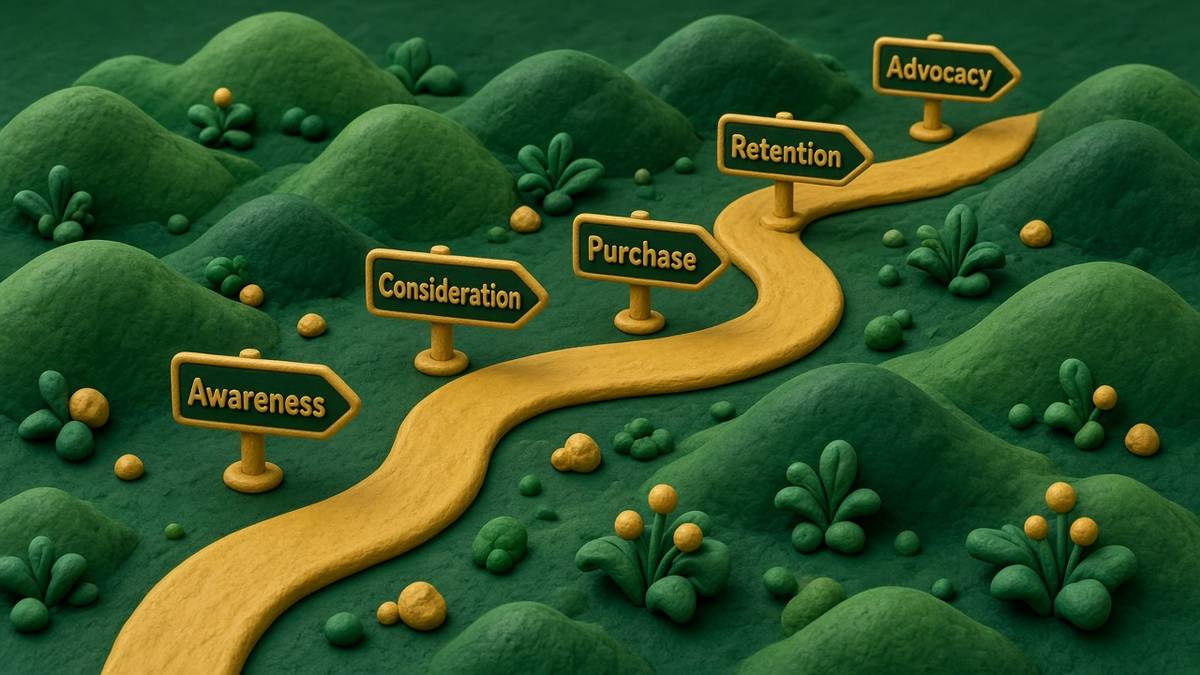
The five customer journey stages from awareness to advocacy.
How to create a customer journey map in 7 steps
Set a clear goal for the map
Decide what you want to improve, for example “increase repeat bookings” or “reduce abandoned checkouts”. A focused goal keeps the map short and practical.
Choose one persona and one scenario
Map a single customer type doing one thing, such as “a freelance designer buying our template pack for the first time”. You can add more journeys later.
Gather real customer data
Use short customer interviews, reviews, support emails, sales call notes, website analytics and survey answers. Five to ten interviews usually reveal the main patterns. Under GDPR, ask permission before recording calls and only keep the data you need.
List every touchpoint
Walk through the journey yourself as if you were the customer: search for your business, read your site, fill in your form, open your emails. Write down every interaction, including ones you do not control, such as review sites.
Add actions, thoughts and feelings
For each stage, write what the customer does, what they are thinking (often a question), and how they feel. Use real quotes from your research where possible.
Mark pain points and drop-offs
Highlight moments of confusion, delay or doubt, and where analytics show people leaving. These are your opportunities.
Turn insights into actions with owners
For each pain point, write one fix, who owns it and when it will be done. Review the map every quarter and update it as you improve.
💡 Use numbers you already have
Your analytics, email reports and small business KPIs show where the biggest drop-offs happen. Fix the stage with the largest loss first.
Customer journey map example
Here is a simplified customer journey map for a small online yoga studio in Europe selling a monthly membership. It shows how the map reveals specific, fixable problems.
| Stage | Customer action | Thinking / feeling | Pain point | Fix |
|---|---|---|---|---|
| Awareness | Sees a friend’s post about a class | “Could I do this from home?” Curious | No clear beginner info on social profile | Pin a “start here for beginners” post |
| Consideration | Visits website and pricing page | “Is it worth the money?” Unsure | Prices hidden behind sign-up | Show prices and a sample class openly |
| Purchase | Signs up for a free trial | “Hope this is easy.” Slightly anxious | Long form with too many fields | Cut form to name, email and payment |
| Retention | Attends two classes in week one | “Am I doing this right?” Motivated but unsure | No contact after sign-up | Send a 3-email welcome series with a beginner plan |
| Advocacy | Enjoys classes for a month | “I should tell my sister.” Happy | No referral option | Add a “bring a friend free” link in emails |
Notice that most of the fixes are small. That is typical: journey maps rarely reveal one huge problem, but several small ones that add up.
Touchpoints and channels to include
Touchpoints are every place a customer meets your business. List them per stage so nothing is missed.
| Stage | Online touchpoints | Offline or human touchpoints |
|---|---|---|
| Awareness | Search results, social posts, ads, podcasts, review sites | Events, referrals, local press, signage |
| Consideration | Website, landing pages, case studies, comparison pages, emails | Sales calls, demos, showroom visits |
| Purchase | Checkout, booking system, invoices, confirmation emails | In-person payment, signed proposal |
| Retention | Onboarding emails, help centre, account area, newsletter | Support calls, check-in meetings, packaging |
| Advocacy | Review requests, referral links, social sharing | Thank-you notes, loyalty perks |
Post-purchase email is often the weakest touchpoint in small businesses. A simple automated welcome and check-in sequence fixes many retention pain points; tools such as Kit make it easy to set one up and to segment customers by where they are in the journey.
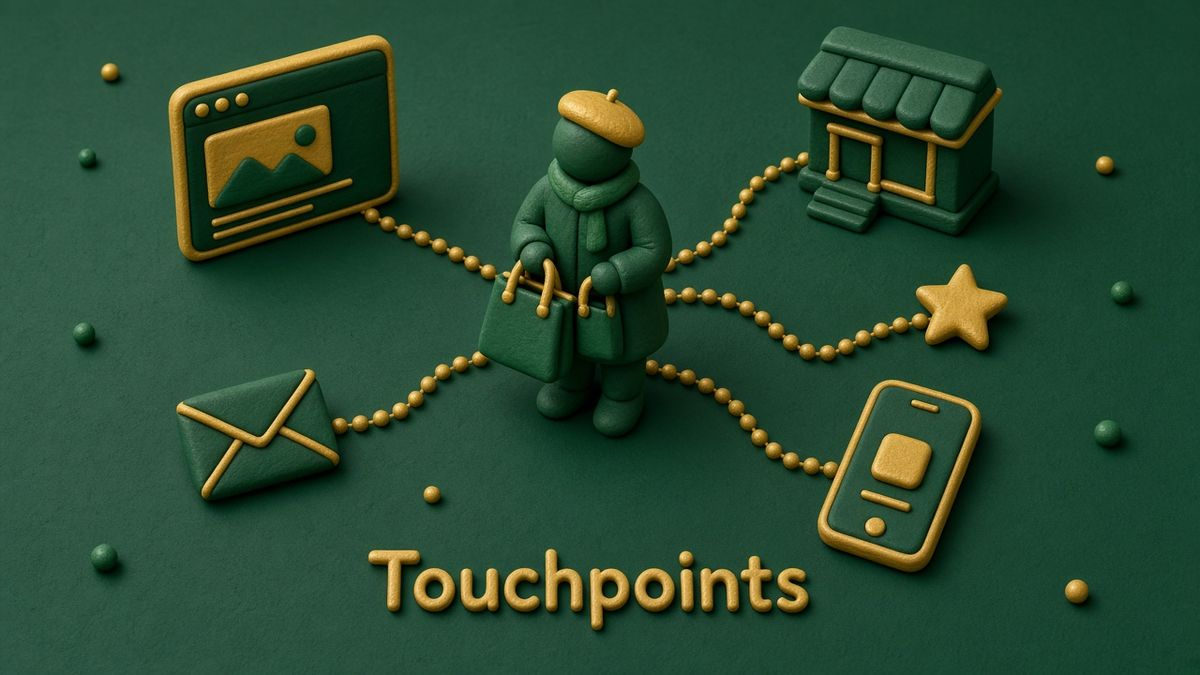
Map online and offline touchpoints at every stage of the customer journey.
📌 Onboarding is part of the journey
For service businesses, the first week after a client signs often decides whether they stay. See this client onboarding process for a step-by-step checklist.
Mistakes that make maps useless
- Mapping the journey you wish customers took. Use evidence, not assumptions from inside the business.
- Trying to map every customer at once. One persona per map keeps it readable.
- Stopping at purchase. Retention and advocacy are where long-term profit comes from.
- Making it too pretty to change. A spreadsheet you update beats a poster you never touch.
- No owners or deadlines. Insights without actions change nothing.
- Ignoring emotions. Doubt, frustration and relief explain why customers act the way they do.
⚠️ Collect feedback lawfully
If you interview or survey customers in the UK or EU, tell them why you are collecting their answers, store them securely and delete what you no longer need. This keeps your research in line with GDPR.
Simple customer journey map template
Copy this customer journey map template into a spreadsheet or doc. Add one column per stage and fill each row from your research.
| Row | Awareness | Consideration | Purchase | Retention | Advocacy |
|---|---|---|---|---|---|
| Customer goal | |||||
| Actions | |||||
| Touchpoints | |||||
| Thoughts / questions | |||||
| Feelings | |||||
| Pain points | |||||
| Fixes and owner |
Once your map is done, feed the fixes into your marketing plan and your content calendar, so content answers the exact questions customers ask at each stage.
Frequently Asked Questions
What is a customer journey map?
A customer journey map is a visual timeline of every step a customer takes with your business, showing their actions, touchpoints, thoughts, feelings and pain points at each stage.
What are the 5 stages of the customer journey?
The most common stages are awareness, consideration, purchase, retention and advocacy. Some businesses add an onboarding stage between purchase and retention.
How do I create a customer journey map for a small business?
Set a goal, pick one persona, gather real customer data, list touchpoints, add actions and feelings, mark pain points, and turn each pain point into a fix with an owner.
What is the difference between a customer journey map and a sales funnel?
A sales funnel shows your process for converting leads from the business’s point of view. A customer journey map shows the full experience from the customer’s point of view, including after the sale.
What tools can I use to make a customer journey map?
A spreadsheet or shared document is enough for most small businesses. Whiteboard tools such as Miro or Canva work well if you prefer a visual map.
How often should I update a customer journey map?
Review it every three to six months, and whenever you change your product, pricing, website or main marketing channels.
A customer journey map turns vague ideas about “customer experience” into a clear list of fixes. Start small with one persona, one journey and real data, fix the biggest drop-off first, and update the map as you learn. Over time it becomes one of the most useful documents in your business, for raising customer lifetime value and keeping customers coming back.
Affiliate disclosure: some links in this post are affiliate links, so I may earn a commission at no extra cost to you. I only recommend tools I’d use myself.