Customer lifetime value (CLV) is the total profit you can expect from one customer over the whole time they buy from you. It is one of the most useful numbers a small business can know, because it tells you how much you can afford to spend to win a customer, which customers deserve the most attention, and whether your growth is actually profitable. This guide shows you how to calculate customer lifetime value with three simple formulas, a worked example in dollars, the CLV to CAC ratio, and practical ways to raise it.
✔ Key takeaways
⏱ About 9 min read · the short version is right here
- Customer lifetime value is the profit (not just revenue) one customer brings in over the entire relationship.
- The simplest formula: average order value × purchases per year × years as a customer × gross margin.
- For subscriptions, use average monthly revenue per customer × gross margin ÷ monthly churn rate.
- A healthy CLV to customer acquisition cost (CAC) ratio is often quoted as about 3:1. Below 1:1 you lose money on every new customer.
- You raise CLV by keeping customers longer, getting them to buy more often, and lifting order value, usually in that order.
📋 In this guide
What is customer lifetime value?
Customer lifetime value, also written as CLV, CLTV or LTV, estimates how much a typical customer is worth to your business from their first purchase to their last. Revenue-based CLV counts what customers spend. Profit-based CLV subtracts the cost of delivering what they bought, which is the version you should use for decisions.
Think of a local coffee shop. A regular who spends $5 a day, four days a week, for three years spends about $3,100. If the shop’s gross margin is 65%, that customer is worth roughly $2,000 in gross profit. Knowing that number changes how much the owner would happily spend on a loyalty card or a free drink to win that regular.
Why CLV matters for a small business
Marketing
Know your ceiling
CLV tells you the maximum you can spend to acquire a customer and still make money.
Retention
Find the leak
A falling CLV is often the first sign that customers are leaving sooner than they used to.
Strategy
Pick your best segments
Comparing CLV by channel or product shows which customers are worth chasing.
Most small businesses obsess over the cost of getting a customer and ignore what happens afterwards. Yet it is usually far cheaper to keep and grow an existing customer than to win a new one. CLV puts a number on that, so retention work stops being a vague nice-to-have and becomes something you can measure. If you already follow a short list of small business KPIs, CLV belongs on it.
3 ways to calculate customer lifetime value
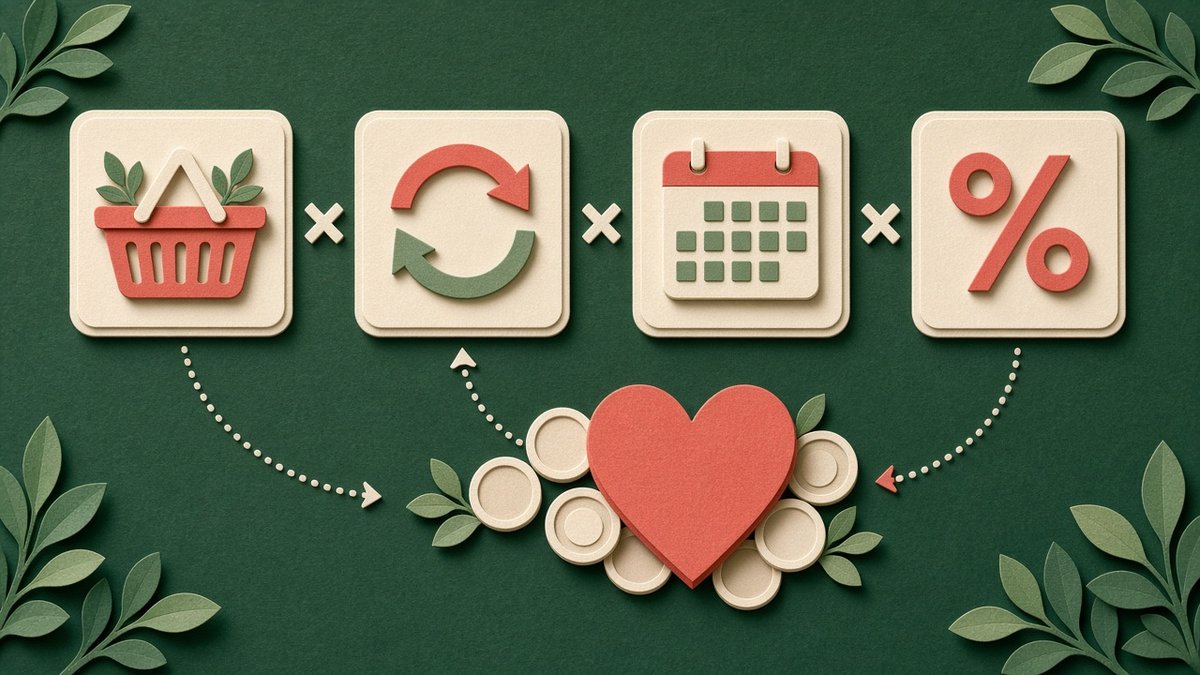
Illustrative breakdown of the customer lifetime value formula: average order value, purchase frequency, customer lifespan and gross margin.
You do not need advanced analytics. Pick the formula that matches how your business earns money.
1. Simple CLV (one-off or repeat purchases)
📌 Formula
CLV = average order value × purchases per year × average customer lifespan in years × gross margin %
Use this for shops, e-commerce stores, restaurants and service businesses where customers buy again from time to time. Average order value is total revenue divided by number of orders. Purchase frequency is orders divided by unique customers over a year. Lifespan is how many years a typical customer keeps buying.
2. Subscription CLV (monthly plans and retainers)
📌 Formula
CLV = average monthly revenue per customer × gross margin % ÷ monthly churn rate
Use this for SaaS, memberships, coaching programmes and agency retainers. Monthly churn is the share of customers who cancel each month. If 5% cancel every month, the average customer stays about 1 ÷ 0.05 = 20 months.
3. Cohort CLV (the most accurate)
Group customers by the month they first bought, then add up the gross profit each group generates over the following months. After 12 to 24 months you can see real lifetime value rather than an estimate. This takes longer, but it shows whether newer customers are worth more or less than older ones, which the averages hide.
| Formula | Best for | Data you need | Accuracy |
|---|---|---|---|
| Simple CLV | Shops, e-commerce, local services | Orders, revenue, customers, margin | Good starting estimate |
| Subscription CLV | SaaS, memberships, retainers | Monthly revenue per customer, churn, margin | Good if churn is stable |
| Cohort CLV | Any business with 1+ year of data | Customer-level purchase history | Most accurate |
A worked example with real numbers
Let us run the simple formula for a small online store selling skincare in the US and EU.
| Input | Value | How it was calculated |
|---|---|---|
| Average order value | $60 | $180,000 revenue ÷ 3,000 orders |
| Purchases per year | 2.5 | 3,000 orders ÷ 1,200 customers |
| Average customer lifespan | 3 years | From repeat-purchase history |
| Gross margin | 55% | After product, packaging and payment fees |
| Customer lifetime value | $247.50 | $60 × 2.5 × 3 × 0.55 |
So each new customer is worth about $247 in gross profit. If the store spends $70 on ads to win a customer, the CLV to CAC ratio is about 3.5:1, which is healthy. If ad costs creep up to $200 per customer, the store is barely breaking even once overheads are added.
Now a subscription example: a coaching membership at €49 a month with an 80% gross margin and 6% monthly churn. CLV = €49 × 0.80 ÷ 0.06 = about €653. Cutting churn from 6% to 4% lifts CLV to €980, a 50% increase without a single new member.
💡 Use conservative numbers
When in doubt, shorten the lifespan and lower the margin. An optimistic CLV leads to overspending on ads, and that is far harder to fix than a cautious budget.
CLV vs CAC: the ratio that matters
Customer acquisition cost (CAC) is everything you spend on sales and marketing in a period divided by the new customers you won in that period. Comparing it with CLV tells you whether growth is profitable.
| CLV : CAC ratio | What it usually means | What to do |
|---|---|---|
| Below 1:1 | You lose money on every new customer | Pause paid acquisition and fix retention or pricing first |
| 1:1 to 2:1 | Thin margins once overheads are counted | Raise order value or retention before scaling spend |
| About 3:1 | Commonly cited healthy target | Keep going and test new channels carefully |
| 5:1 or higher | Very profitable, possibly under-investing | Consider spending more to grow faster |
Also watch the payback period: how many months it takes for a customer’s gross profit to cover what you spent to win them. For a small business with limited cash, a payback under 12 months matters as much as the ratio itself, because long payback periods squeeze cash flow.
How to increase customer lifetime value

Illustrative customer lifetime value growth levers: onboarding, retention emails, upsells, referrals and loyalty over time.
Every CLV formula has the same three levers: how long customers stay, how often they buy, and how much they spend each time. Work on them in this order.
Nail the first 30 days
Most customers who leave do so early. A clear client onboarding process or a helpful first-order follow-up sets expectations and gets people to their first win quickly.
Stay in touch with useful email
A short welcome email sequence plus a regular newsletter keeps you top of mind between purchases. A tool like Kit lets you automate this and tag customers by what they bought.
Offer relevant upgrades
Bundles, add-ons and premium tiers raise order value when they genuinely help the customer. My guide on how to upsell without being pushy covers the approach.
Review your prices
Many small businesses undercharge loyal customers for years. A well-communicated increase can lift CLV straight away; see how to raise prices without losing customers.
Turn happy customers into referrers
Referred customers often stay longer and cost less to acquire, so a simple referral program improves both sides of the CLV to CAC ratio.
For a deeper list of tactics, read my guide to customer retention strategies. Even a small cut in churn has an outsized effect on lifetime value, as the membership example above shows.
Common CLV mistakes to avoid
- Using revenue instead of profit. A $1,000 customer on a 20% margin is worth less than a $500 customer on a 70% margin.
- Averaging everyone together. One big client can make your average CLV look great while most customers are barely profitable. Segment by channel, product or customer type.
- Assuming customers stay forever. Use real repeat-purchase or churn data, and cap lifespan at a sensible number of years.
- Ignoring the cost of serving customers. Heavy support, returns or custom work all reduce real lifetime value.
- Calculating it once. CLV changes as prices, products and competitors change. Recheck it every quarter.
⚠️ Do not over-optimise one number
Chasing a higher CLV with aggressive upsells or hard-to-cancel subscriptions can backfire, and in the UK, EU and US, consumer protection rules increasingly require cancellation to be easy. Raise CLV by delivering more value, not by trapping customers.
How to track CLV without a data team
You can start in a spreadsheet: export orders from your shop, payment processor or invoicing tool, then calculate average order value, purchase frequency and lifespan once a quarter. That is enough for most businesses with fewer than a few thousand customers.
As you grow, a CRM makes it easier, because it keeps every purchase, deal and conversation on the customer record. If you run a service business or agency, GoHighLevel combines CRM pipelines, email, SMS and payments, so you can see revenue per client in one place. I compare options in best CRM for small agencies.
💡 A simple quarterly routine
Every quarter: update the three inputs, recalculate CLV and CAC, compare them with last quarter, and pick one lever (onboarding, email, upsell, price or referrals) to improve next.
Frequently Asked Questions
What is a good customer lifetime value?
There is no universal number. What matters is CLV compared with your customer acquisition cost. A ratio of about 3:1 is a commonly cited healthy target, and a payback period under 12 months is a sensible goal for most small businesses.
What is the simplest way to calculate CLV?
Multiply average order value by purchases per year, then by the average number of years a customer stays, then by your gross margin. For example, $60 × 2.5 × 3 × 55% gives a CLV of about $247.
How do you calculate CLV for a subscription business?
Divide average monthly revenue per customer, multiplied by gross margin, by your monthly churn rate. A €49 plan with an 80% margin and 6% monthly churn has a CLV of about €653.
What is the difference between CLV and LTV?
They mean the same thing. CLV (customer lifetime value), CLTV and LTV (lifetime value) are used interchangeably. Just be clear whether you are measuring revenue or profit.
How often should a small business calculate CLV?
Once a quarter is enough for most small businesses. Recalculate sooner after a price change, a new product launch or a big shift in marketing spend.
What is the fastest way to increase customer lifetime value?
Reduce early churn. Better onboarding and a helpful follow-up in the first 30 days usually raise CLV faster than new upsells, because customers who stay longer also buy more often.
Affiliate disclosure: some links in this post are affiliate links, so I may earn a commission at no extra cost to you. I only recommend tools I’d use myself.


