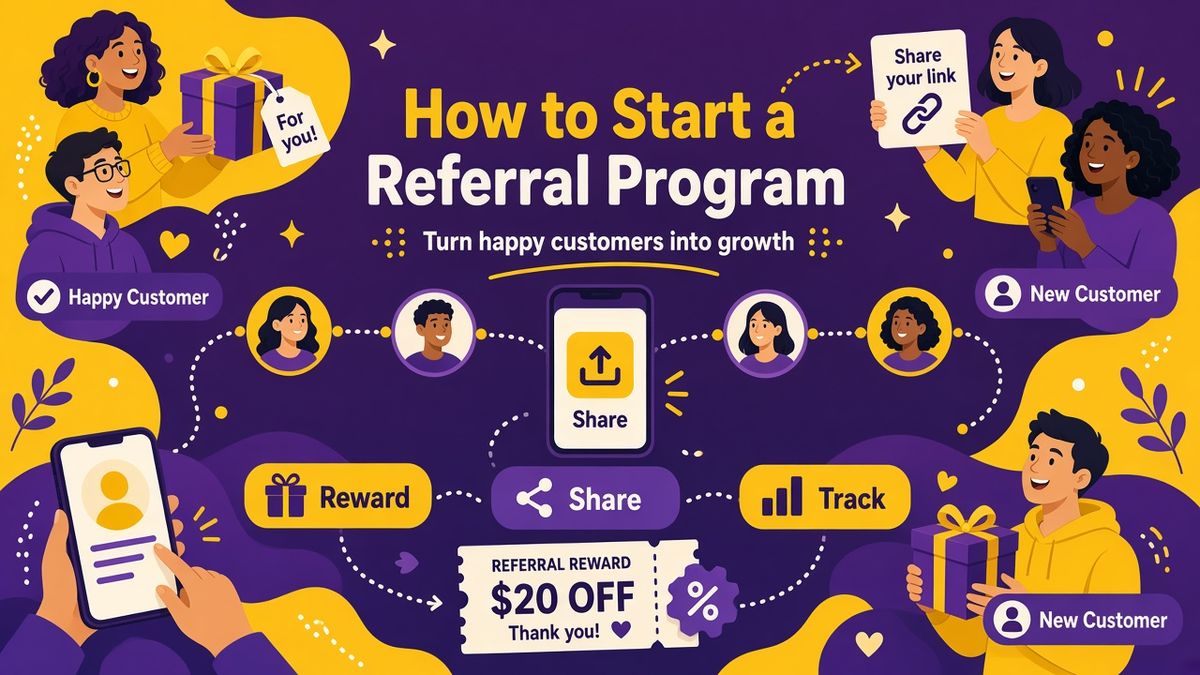
Knowing how to start a referral program is one of the fastest ways for a small business to win new customers without raising its ad budget. People trust recommendations from friends and colleagues far more than ads, and referred customers often stay longer and spend more. In this guide I walk you through how to start a referral program step by step: choosing the right reward, making sharing easy, tracking every referral, and staying on the right side of FTC, UK CMA and GDPR rules when you email customers in the US, UK and Europe.
✔ Key takeaways
⏱ About 9 min read · the short version is right here
- A referral program rewards existing customers for introducing new ones, turning word of mouth into a repeatable system.
- Start with happy customers: ask right after a win, such as a delivered project, a five-star review or a renewal.
- Double-sided rewards (both people get something) usually outperform one-sided rewards.
- Give every referrer a unique link or code so you can track and reward accurately.
- Keep it legal: referrers who post about rewards should disclose them, and referral emails in the UK and EU need a lawful basis such as consent.
- Measure referral rate, conversion rate and cost per referred customer, then improve one thing each month.
📋 In this guide
- What is a referral program?
- Why referral programs work for small businesses
- How to start a referral program in 7 steps
- Referral reward ideas that actually motivate
- Tools to run and track your referral program
- FTC, UK CMA and GDPR rules to know
- How to measure referral program success
- Common referral program mistakes
- Frequently Asked Questions
- Final thoughts
What is a referral program?
A referral program is a structured way of asking your existing customers to recommend you, and rewarding them when that recommendation turns into a new customer. Unlike informal word of mouth, a program has clear rules: who can refer, what counts as a successful referral, what the reward is, and how it is tracked.
It is different from an affiliate program. Referral programs are usually for customers who already love your product, with modest rewards such as a discount or credit. Affiliate programs are for creators and partners who promote you to their audience for a commission. Many small businesses start with referrals and add affiliates later.
Why referral programs work for small businesses
- Trust is built in: a new customer arrives already believing you can deliver.
- Lower acquisition cost: you only pay a reward when a referral converts, unlike ads that cost money whether or not anyone buys.
- Better-fit customers: people tend to refer friends who are like them, so referred customers often match your ideal client.
- Stronger loyalty: customers who refer others feel more invested in your business. Pair your program with solid customer retention strategies and the two reinforce each other.
How to start a referral program in 7 steps
You can launch a simple program in a week. Here is the process I recommend:
Set one clear goal
Decide what a successful referral means for you: a paid order, a booked call or a signed contract. Set a realistic target, such as 10 referred customers in 90 days.
Fix the experience first
Referral programs amplify what customers already feel. If onboarding is clunky, fix it before asking for referrals. My client onboarding process guide helps here.
Choose a reward
Pick a reward that is meaningful to customers and affordable for you. Work out your maximum by looking at your average order value and profit margin.
Write simple rules
Spell out who qualifies, when rewards are paid, any limits, and the expiry date. Keep the terms to a short page that anyone can understand.
Make sharing effortless
Give every customer a unique referral link or code, a ready-to-send message and one-click sharing by email, WhatsApp or social media.
Ask at the right moment
Ask right after a moment of success: a delivered project, a positive review, a renewal or a thank-you email. Add the ask to your welcome email sequence too.
Track, reward and thank quickly
Pay rewards fast and send a personal thank-you. Slow or forgotten rewards kill referral programs.
💡 Use a simple referral message
Write the message for your customers: “I use [business] for [result]. If you sign up with my link, you get [reward] and so do I.” The easier you make it, the more people share.
Referral reward ideas that actually motivate
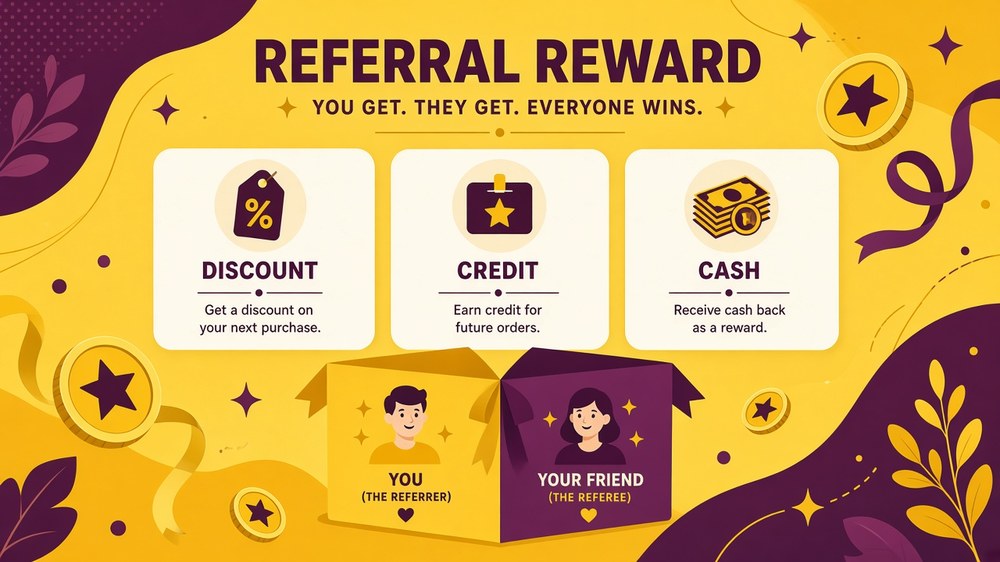
Double-sided rewards give something to both the referrer and the friend.
The right reward depends on your margins and what your customers value. These are the most common options:
| Reward type | Example | Best for | Watch out for |
|---|---|---|---|
| Double-sided discount | Give $20, get $20 | E-commerce, subscriptions | Margin on low-priced items |
| Account credit | One free month | SaaS, memberships, services | Only works if customers stay |
| Cash reward | $50 per signed client | High-value B2B services | Can feel transactional |
| Free upgrade or add-on | Free premium feature or extra session | Agencies, coaches | Delivery cost and time |
| Tiered rewards | Bigger reward after 3 and 5 referrals | Brands with superfans | Complexity |
| Charity donation | $10 donated per referral | Mission-driven brands | Lower personal motivation |
📌 A quick reward formula
If your average customer is worth $600 in profit over their lifetime, spending $60 to $100 per referred customer (split between both people) is usually still very profitable. Work out your pricing and margins before you choose.
Tools to run and track your referral program
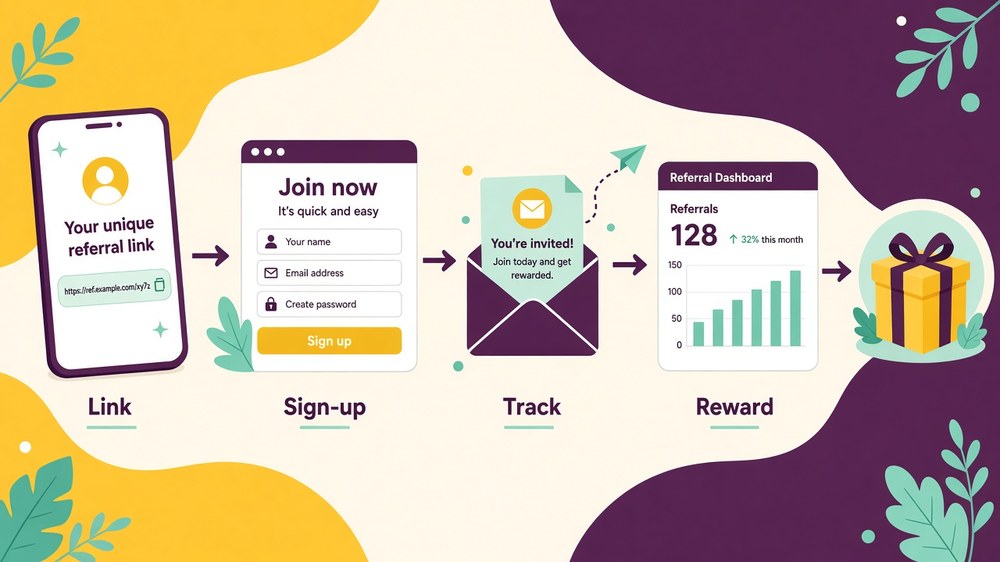
A simple referral tracking flow: unique link, sign-up, tracking dashboard and reward.
A spreadsheet and unique discount codes can work for your first few referrals, but tracking gets messy fast. Software handles unique links, attribution and reward payouts for you.
If you sell courses, digital products or coaching, Systeme.io includes a built-in affiliate program feature, so customers and partners can get their own tracked links and commissions alongside your funnels, email automation and checkout. When I last checked its pricing in late October 2026, the free plan allowed up to 2,000 contacts, with paid plans from $17 a month.
For agencies and local service businesses, GoHighLevel combines a CRM, automated review requests, SMS and email follow-ups, plus an affiliate manager. It is a good fit if you want to ask for a review and a referral in the same automated sequence. Not sure which suits you? Read my Systeme.io vs GoHighLevel comparison.
| Tool | Referral features | Best for |
|---|---|---|
| Systeme.io | Built-in affiliate program, tracked links, commissions, email automation | Course creators, coaches, info products |
| GoHighLevel | CRM, review requests, SMS/email automation, affiliate manager | Agencies, local service businesses |
| Your e-commerce platform | Referral apps and unique discount codes | Online stores |
| Spreadsheet + discount codes | Manual tracking | Testing a program with your first 20 customers |
Referrals work best as one part of a bigger system. Connect them to your sales funnel and the rest of your lead generation for small business channels, so referred leads get the same fast follow-up.
FTC, UK CMA and GDPR rules to know
Referral programs are simple, but a few rules apply when rewards and marketing emails are involved. This is general information, not legal advice.
- US (FTC): the FTC Endorsement Guides treat a reward as a material connection. If customers post about your business to earn a reward, they should clearly disclose it, for example “I get a credit if you sign up”. Give them suggested wording.
- UK (CMA and ASA): the CMA expects incentivised recommendations and reviews to be clearly labelled, and you should never reward customers for posting only positive reviews. Keep reviews and referral rewards separate.
- UK and EU (GDPR and PECR/ePrivacy): sending marketing emails to a friend’s address that a customer gave you is risky. The safest approach is to let your customer share their own link directly. If you email referred contacts, you need a lawful basis, which for marketing usually means their consent.
- US (CAN-SPAM): referral emails you send still need a clear sender, a postal address and a working unsubscribe link.
- Clear terms: publish your rules, reward limits and end date so nobody feels misled.
⚠️ Do not buy or harvest contacts
Never upload address books or bought lists into a referral campaign. It damages your email deliverability and, in the UK and EU, it usually breaks data protection rules.
How to measure referral program success
| Metric | How to calculate | Healthy sign |
|---|---|---|
| Participation rate | Customers who share divided by customers invited | Rising month over month |
| Referral conversion rate | Referred customers divided by referred leads | Higher than your other channels |
| Cost per referred customer | Total rewards and tool costs divided by referred customers | Below your normal acquisition cost |
| Referred customer retention | Referred customers still active after 6 to 12 months | Equal to or better than average |
| Share of new revenue | Revenue from referrals divided by total new revenue | Growing steadily |
Review these numbers monthly and change one thing at a time: the reward, the ask timing or the message.
Common referral program mistakes
- Launching and forgetting: a single announcement email is not a program. Remind customers at key moments.
- Rewards that are too small or too complicated: if customers have to read the terms twice, they will not share.
- Slow payouts: pay rewards within days, not months.
- Asking unhappy customers: check satisfaction first, for example with a quick survey or a net promoter score question.
- No tracking: without unique links or codes you cannot reward fairly or know what works.
- Ignoring disclosure rules: make it easy for customers to disclose rewards when they post publicly.
Frequently Asked Questions
How do I start a referral program for my small business?
Set a clear goal, choose a reward, write simple rules, give every customer a unique link or code, ask at moments of success, and track and pay rewards quickly. You can start with a spreadsheet and move to software as referrals grow.
What is a good referral reward?
A double-sided reward, where both the referrer and the new customer get something, works well for most businesses. Common examples are a $20 discount each, a free month or account credit.
What is the difference between a referral program and an affiliate program?
Referral programs reward existing customers for recommending you, usually with discounts or credit. Affiliate programs pay partners and creators a commission for promoting you to their audience.
Do customers need to disclose referral rewards?
Yes, if they post publicly. In the US the FTC expects people to disclose a material connection such as a reward, and in the UK the CMA expects incentivised recommendations to be clearly labelled.
Can I email people my customers refer?
In the UK and EU you generally need a lawful basis, usually consent, before sending marketing emails. The safest option is for customers to share their own referral link directly with friends.
Which software is best for a referral program?
Systeme.io suits creators and coaches who want a built-in affiliate program alongside funnels and email. GoHighLevel suits agencies and service businesses that want CRM, review requests and automation together.
Final thoughts
Learning how to start a referral program is really about turning your happiest customers into a repeatable growth channel. Fix the customer experience, choose a reward that makes sense for your margins, make sharing effortless, track every referral and stay transparent about rewards. Start small with your best customers this month, measure the results, and improve one piece at a time.
Your next step: list your 20 happiest customers and draft a short, friendly referral ask you can send this week.
Launch your referral program for free
Systeme.io gives you a built-in affiliate program, funnels, email automation and checkout in one place, with a free plan to get started.
Affiliate link. I may earn a commission at no extra cost to you.
Affiliate disclosure: some links in this post are affiliate links, so I may earn a commission at no extra cost to you. I only recommend tools I’d use myself.