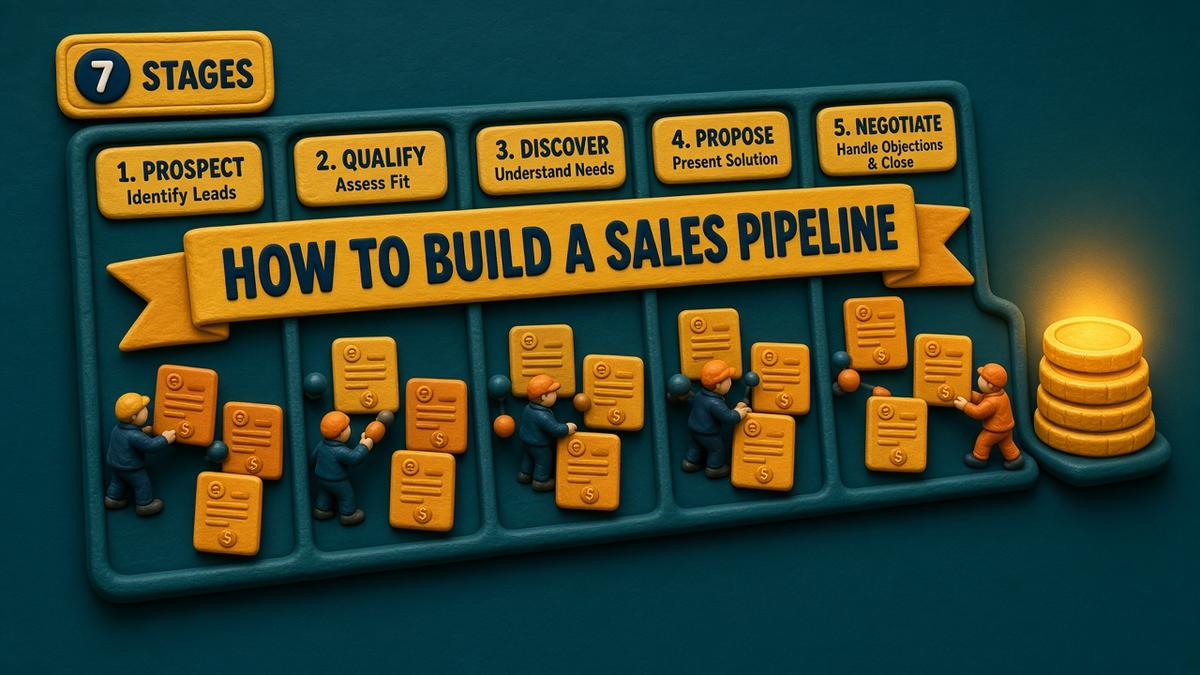
A sales pipeline is the simplest way to see every deal you are working on, where it is stuck, and how much revenue is likely to close this month. If you run a small business, agency or consultancy, building a sales pipeline turns sales from a guessing game into a weekly routine: you know which leads to call today, which proposals need a nudge, and whether next quarter looks healthy or thin. This guide shows you how to build a sales pipeline step by step, with stages, conversion maths, a worked example and the metrics that matter.
✔ Key takeaways
⏱ About 10 min read · the short version is right here
- A sales pipeline is a visual list of open deals, grouped by stage, from first contact to closed won or lost.
- Most small businesses need only 5 to 7 stages, each defined by a clear buyer action, not by how you feel about the deal.
- Work backwards from your revenue goal: target revenue, average deal size and stage conversion rates tell you how many leads you need.
- Track four numbers every week: deals in each stage, pipeline value, win rate and average sales cycle length.
- Start in a spreadsheet if you have fewer than 30 open deals; move to a CRM once follow-ups start slipping.
📋 In this guide
- What is a sales pipeline?
- The 7 sales pipeline stages for a small business
- Sales pipeline vs sales funnel
- How to build a sales pipeline in 7 steps
- Sales pipeline maths: how many leads you need
- Sales pipeline example: a 3-person agency
- Sales pipeline metrics to track
- Tools: spreadsheet or CRM?
- Common sales pipeline mistakes
- FAQ
What is a sales pipeline?
A sales pipeline is a structured view of all the potential deals you are currently working on, organised by the stage each one has reached. Every deal moves from left to right: from a new lead, to a qualified conversation, to a proposal, to a decision. At any moment you can see how many deals sit in each stage and what they are worth.
It is different from a lead list. A lead list is just names. A pipeline adds two things that make it useful: a defined next step for every deal and an estimated value, so you can forecast revenue. That is why sales teams at companies of every size, from a freelance designer in Manchester to a 20-person SaaS team in Austin, rely on one.
📌 Pipeline in one sentence
If you can answer ‘which deals are open, what stage are they in, what is the next step and what are they worth?’ in under a minute, you have a working sales pipeline.
The 7 sales pipeline stages for a small business
Your stages should mirror how your customers actually buy. For most service businesses and B2B sellers, these seven stages work well. Each one has an exit rule: a specific buyer action that moves the deal forward.
| Stage | What it means | Exit rule (moves forward when…) | Typical conversion to next stage |
|---|---|---|---|
| 1. New lead | Someone has shown interest: form, referral, inbound email, event contact | You have made first contact | 50 to 70% |
| 2. Contacted | You have reached out and they replied | They agree to a discovery call | 40 to 60% |
| 3. Qualified | Real need, budget, timing and decision maker confirmed | You agree the scope of a proposal | 50 to 70% |
| 4. Proposal sent | Quote or proposal delivered | They review it with you or ask questions | 60 to 80% |
| 5. Negotiation | Discussing price, scope, terms | Verbal yes or final terms agreed | 60 to 80% |
| 6. Closed won | Signed contract or paid invoice | Hand over to onboarding | n/a |
| 7. Closed lost | They chose someone else or not now | Log the reason, set a follow-up date | n/a |
The conversion ranges are rough benchmarks for small B2B and service businesses, not rules. Your own numbers after three months will be far more useful. Use stage names that match your language; a coach might use ‘Enquiry, Discovery call, Offer made, Enrolled’, while an agency might add a ‘Scoping’ stage.
💡 Define stages by buyer actions
‘Proposal sent’ is a fact. ‘Very interested’ is a feeling. Pipelines built on facts forecast accurately; pipelines built on feelings are always too optimistic.
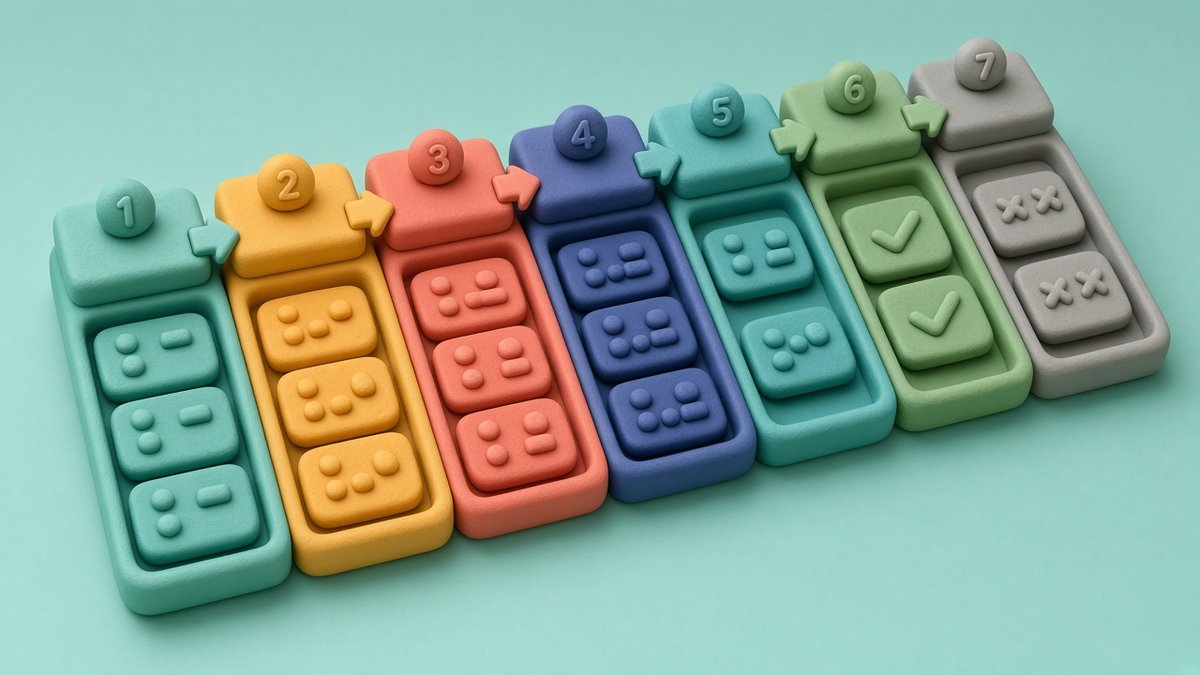
The seven sales pipeline stages, from new lead to closed won or lost, with an exit rule at each step.
Sales pipeline vs sales funnel
People often use the two terms interchangeably, but they look at sales from different angles. A sales funnel shows the buyer’s journey in aggregate: how many visitors become leads and how many leads become customers. A sales pipeline shows your individual deals and the actions you need to take on each one.
| Sales pipeline | Sales funnel | |
|---|---|---|
| Focus | Individual deals and next actions | Conversion rates across the whole journey |
| Main question | What do I do next on each deal? | Where are we losing people? |
| Best for | Service businesses, B2B, high-ticket offers | Online offers, e-commerce, low-ticket products |
| Typical tool | CRM or spreadsheet board | Analytics and funnel builder |
Most growing businesses need both. The funnel fills the top of the pipeline; the pipeline makes sure no qualified lead is forgotten.
How to build a sales pipeline in 7 steps
Write down your ideal customer
Describe who buys from you and why: industry, size, location, the problem they want solved and the budget range. In the US or UK this might be ‘local trades businesses with 5 to 20 staff’; in the EU, add language and country if that limits who you can serve. This stops you filling the pipeline with leads that never close.
Map how customers actually buy
Look at your last 10 customers. How did they first find you, how many conversations happened, who signed off and how long did it take? Your stages come from this real path, not from a template.
Set 5 to 7 stages with exit rules
Use the table above as a starting point. Give every stage a single exit rule, so two people would put the same deal in the same column.
Add every open deal
List each opportunity with company, contact, value, stage, last contact date and next step with a date. Be honest: if nobody has replied in 60 days, move it to closed lost with a follow-up reminder.
Fill the top consistently
A pipeline is only as good as its inflow. Pick two or three lead sources you can run every week, such as referrals, content, partnerships or compliant cold email outreach, and give each a weekly target.
Create a follow-up rhythm
Most deals are lost through silence, not rejection. Set a rule such as ‘no deal without a next step dated within 7 days’, and use templates for the follow-ups you send most often.
Review the pipeline every week
Block 30 minutes each Monday. Update stages, remove dead deals, check where deals pile up and choose the three actions that will move the most money forward this week.
⚠️ Data protection still applies
A pipeline is a database of personal data. If you sell to people in the UK or EU, GDPR applies: keep only the details you need, record where each lead came from and delete contacts you no longer have a reason to hold.
Sales pipeline maths: how many leads you need
This is where a pipeline becomes a planning tool. Work backwards from your revenue goal to the number of leads you need each month.
Say you want $20,000 in new monthly revenue and your average deal is $2,500. You need 8 closed deals. If 25% of qualified leads become customers, you need 32 qualified leads. If half of your new leads qualify, you need 64 new leads a month, roughly 15 a week. Suddenly ‘get more clients’ becomes ‘add 15 new leads every week’.
| Input | Example value | Your number |
|---|---|---|
| Monthly revenue goal | $20,000 | |
| Average deal size | $2,500 | |
| Deals needed (goal / deal size) | 8 | |
| Qualified-to-won rate | 25% | |
| Qualified leads needed | 32 | |
| New-lead-to-qualified rate | 50% | |
| New leads needed per month | 64 |
Improving any one ratio has a big effect. Raising your win rate from 25% to 33% cuts the leads you need by about a quarter. Better qualification, faster follow-up and stronger proposals, such as those in my guide on how to write a business proposal, often move the needle more than more leads.
Sales pipeline example: a 3-person agency
Here is how a small marketing agency with three people in Bristol might set up its pipeline. It sells monthly retainers averaging £1,800 (about $2,300) and wants four new clients a month.
- Stages: Enquiry, Discovery call booked, Qualified, Proposal sent, Negotiation, Won, Lost.
- Lead sources: referrals from existing clients, a monthly webinar and LinkedIn content. Target: 20 enquiries a month.
- Rules: proposals go out within 48 hours of a discovery call; every proposal gets a follow-up on day 3 and day 7.
- Weekly review: Monday 9:00, 30 minutes, owner plus account lead.
- Result after one quarter: they noticed deals stalled at Proposal sent, so they added a short video walkthrough to every proposal and their proposal-to-won rate rose from 30% to 42%.
The point is not the exact numbers. It is that the pipeline showed them where deals were stuck, so they fixed the right stage instead of just chasing more leads.
Sales pipeline metrics to track

Four sales pipeline metrics worth checking every week: pipeline value, win rate, sales cycle length and deals per stage.
You do not need a dashboard full of charts. These five numbers tell you almost everything about the health of your sales pipeline.
| Metric | How to calculate | What it tells you |
|---|---|---|
| Number of deals per stage | Count of open deals in each column | Where deals pile up or dry out |
| Pipeline value | Sum of open deal values | Total revenue potential in play |
| Weighted pipeline | Deal value x stage probability, summed | A realistic revenue forecast |
| Win rate | Won deals / (won + lost) in a period | How well you qualify and close |
| Sales cycle length | Average days from new lead to won | How far ahead you must fill the pipeline |
A useful rule of thumb: keep your pipeline value at three to four times your revenue target for the period. If you need $20,000 this month and your open pipeline is $30,000, you are likely to miss. Also connect your pipeline to your wider small business KPIs and to customer lifetime value, because a client worth $15,000 over three years justifies more sales effort than a one-off $800 project.
Tools: spreadsheet or CRM?
If you have fewer than about 30 open deals and one person selling, a spreadsheet or a simple board is enough. Use one row per deal and columns for stage, value, last contact, next step and next step date. Sort by next step date every morning.
Move to a CRM when follow-ups start slipping, when more than one person sells, or when you want automatic reminders, email tracking and reporting. For coaches and agencies, an all-in-one platform such as GoHighLevel includes drag-and-drop pipelines plus booking, email and SMS follow-ups in one place. If you are comparing options, my reviews of the best CRM for small agencies and the best CRM for coaches break down features and prices.
💡 Do not let the tool become the project
Choose a tool in an afternoon, not a month. A simple pipeline you update every week beats a powerful CRM nobody opens.
Common sales pipeline mistakes
- Too many stages. Ten or more stages make updates slow and nobody keeps them current. Merge until each stage has a clear exit rule.
- Zombie deals. Deals with no contact for 60+ days inflate your pipeline value. Close them as lost and set a re-engagement reminder.
- No next step. Every open deal needs a dated next action. If there is none, the deal is not really moving.
- Ignoring lost reasons. Recording why deals are lost, such as price, timing or competitor, shows you what to fix. Many objections can be handled earlier; see my guide to handling sales objections.
- Only filling the pipeline when it is empty. Prospecting in bursts creates feast-and-famine revenue. Protect a small amount of prospecting time every week, even when you are busy.
Frequently Asked Questions
What is a sales pipeline in simple terms?
A sales pipeline is a list of all the deals you are working on, grouped by stage, from first contact to a signed contract. It shows what each deal is worth and what you need to do next to move it forward.
How many stages should a sales pipeline have?
Most small businesses do best with 5 to 7 stages, such as New lead, Contacted, Qualified, Proposal sent, Negotiation, Closed won and Closed lost. Each stage should have a clear exit rule based on a buyer action.
What is the difference between a sales pipeline and a sales funnel?
A sales pipeline tracks individual deals and the actions needed to close them. A sales funnel shows conversion rates across the whole buyer journey, such as visitors to leads to customers. Most businesses use both.
How do I calculate how many leads I need?
Divide your revenue goal by your average deal size to get deals needed. Then divide by your win rate to get qualified leads needed, and divide that by your lead-to-qualified rate to get total new leads needed.
How often should I review my sales pipeline?
Review it once a week for about 30 minutes. Update stages, remove dead deals, check where deals are stuck and pick the most valuable next actions for the week.
Do I need a CRM to build a sales pipeline?
No. A spreadsheet works well for one person with fewer than about 30 open deals. A CRM becomes worth it when several people sell or when follow-ups start slipping through the cracks.
Affiliate disclosure: some links in this post are affiliate links, so I may earn a commission at no extra cost to you. I only recommend tools I’d use myself.