Learning how to set OKRs (objectives and key results) is one of the simplest ways to turn big business ambitions into clear, measurable progress every quarter. OKRs give a small team a shared answer to two questions: where are we going, and how will we know we got there? In this guide you will learn what OKRs are, how they differ from KPIs and SMART goals, a 7-step process to set OKRs, real examples for small businesses, how to score them, and a template you can copy today.
✔ Key takeaways
⏱ About 8 min read · the short version is right here
- OKRs pair one inspiring objective with two to four measurable key results that show whether you achieved it.
- Set OKRs quarterly, keep them few (one to three objectives per team) and make every key result a number with a deadline.
- Key results measure outcomes, not tasks; the projects you run to hit them are called initiatives.
- Score OKRs from 0.0 to 1.0 at the end of the quarter; landing around 0.6 to 0.7 on stretch goals is normal.
- Review progress weekly in a short check-in so OKRs guide decisions instead of gathering dust.
📋 In this guide
What are OKRs?
OKRs are a goal-setting framework made famous by Intel and later Google. Each OKR has two parts:
Objective: a short, qualitative statement of what you want to achieve. It should be inspiring and easy to remember, such as “Make our online store the easiest place to buy handmade candles.”
Key results: two to four measurable outcomes that prove you achieved the objective, such as “Raise checkout conversion rate from 1.8% to 2.5%” or “Cut average delivery time from five days to three.” These figures are illustrations; use your own baselines.
The power of OKRs is focus. Instead of chasing ten priorities at once, a small business picks the few results that matter most this quarter and lines everyone up behind them. If you have not written down your long-term direction yet, start with how to write a mission statement, because good OKRs ladder up to it.
📌 Objectives inspire, key results measure
A quick test: if your objective contains a number, it is probably a key result. If your key result has no number, it is probably a task or a wish.
OKRs vs KPIs vs SMART goals
OKRs often get confused with other goal tools. They work best together, not as replacements.
| Framework | What it is | Time frame | Best used for |
|---|---|---|---|
| OKRs | Ambitious objective + measurable key results | Usually one quarter | Driving change and focus on a few priorities |
| KPIs | Ongoing health metrics for the business | Continuous | Monitoring performance, spotting problems early |
| SMART goals | Specific, Measurable, Achievable, Relevant, Time-bound goals | Any | Writing clear individual goals and key results |
| Initiatives | Projects and tasks | Weeks | The work you do to move key results |
A simple way to remember it: KPIs tell you how the business is doing; OKRs tell you what you are trying to change. When a KPI goes off track, for example customer churn, that can become the focus of next quarter’s OKR. My guide to small business KPIs lists the metrics worth tracking all year.
How to set OKRs in 7 steps
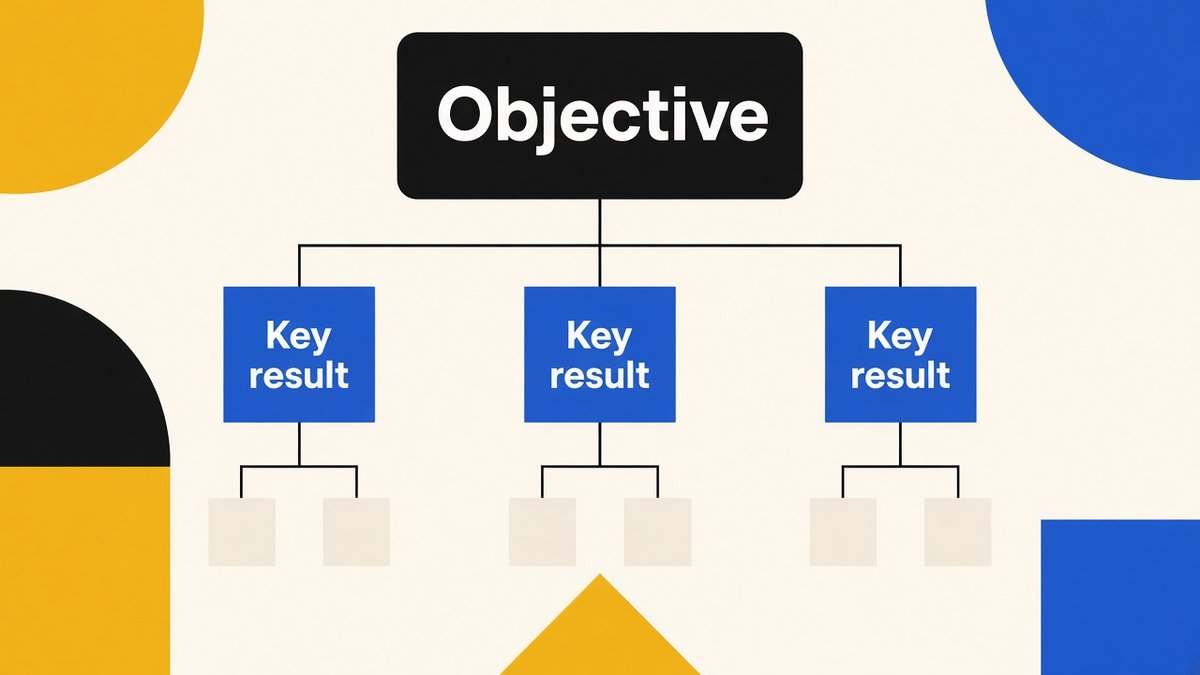
How OKRs cascade: one inspiring objective at the top, measurable key results below, and initiatives that drive them.
Start from your yearly goals
Look at your annual plan or mission and pick the one to three outcomes that matter most in the next 90 days. If you have no plan yet, a quick SWOT analysis will show where the biggest opportunities and risks are.
Write a clear, inspiring objective
Use plain language a new employee would understand. Aim for something ambitious but realistic within a quarter.
Add two to four measurable key results
Each key result needs a metric, a starting point, a target and a deadline. Prefer outcomes customers would notice over internal activity.
Check that the key results really prove the objective
Ask: if we hit every key result, will the objective obviously be achieved? If not, adjust them.
List initiatives separately
Write the projects you think will move each key result, such as a new onboarding email or a pricing test. Keep them flexible; drop the ones that do not work.
Assign one owner per OKR
Shared ownership often means no ownership. One person tracks progress and raises problems, even if the whole team contributes. Use effective delegation to spread the initiatives.
Set a weekly check-in and a quarter-end review
A 15-minute weekly check-in keeps OKRs alive. At the end of the quarter, score each key result, write down lessons and set the next OKRs.
💡 Fewer is better
A team of five rarely has the capacity for more than two or three objectives at once. If everything is a priority, nothing is. Start with one company OKR in your first quarter and add team OKRs once the habit sticks.
OKR examples for small businesses
Here are OKR examples a small business could adapt. Treat the numbers as placeholders and replace them with targets based on your own data.
| Area | Objective | Example key results |
|---|---|---|
| Sales | Build a predictable pipeline of new clients | Increase qualified leads from X to Y a month; raise proposal win rate from X% to Y%; shorten the sales cycle from X to Y days |
| Marketing | Become the go-to local brand for our service | Grow organic website visits by X%; collect X new Google reviews; grow the email list from X to Y subscribers |
| Customer success | Make customers stay and recommend us | Cut monthly churn from X% to Y%; raise customer satisfaction score to Y; get X referrals |
| Operations | Deliver faster without extra cost | Reduce average order fulfilment time from X to Y days; document X core processes; cut refund requests by X% |
| Finance | Strengthen cash flow and margins | Reduce average invoice collection time from X to Y days; raise gross margin from X% to Y% |
| Team | Build a team that can run without the founder | Train two people to cover each key role; hold monthly one-to-ones with every team member; lift team survey score to Y |
Notice that none of the key results are tasks like “launch a new website”. A new website is an initiative; the key result is what it should achieve, such as more enquiries. For sales-focused objectives, a clear client onboarding process is often the initiative that improves retention fastest.
Example: a complete OKR for a small online store
Objective: Turn first-time buyers into loyal customers.
KR1: Raise repeat purchase rate within 90 days from X% to Y%.
KR2: Increase average order value from $X to $Y.
KR3: Collect product reviews from Z% of buyers.
Initiatives: post-purchase email sequence, bundle offers, review request after delivery.
How to score and track OKRs
At the end of each quarter, score every key result from 0.0 (no progress) to 1.0 (fully achieved), then average the scores for the objective. Many teams also track a weekly confidence score from 1 to 10 so problems surface early.
| Score | Meaning | What to do next quarter |
|---|---|---|
| 0.0 to 0.3 | Little progress | Find out why: wrong initiatives, unrealistic target or lack of time |
| 0.4 to 0.6 | Partial progress | Keep the direction, refine initiatives |
| 0.7 to 0.9 | Strong result | Normal sweet spot for stretch OKRs |
| 1.0 | Fully achieved | Great, but check the target was ambitious enough |
⚠️ Do not tie OKRs to bonuses
When OKR scores decide pay, people quietly set easy targets. Keep OKRs for focus and learning, and judge performance on a wider set of factors. In the UK and EU, any change to pay or employment terms should also follow local employment law.
For tracking, a shared spreadsheet or document is enough for most small teams. Dedicated OKR software only makes sense once you have several teams and dozens of OKRs.
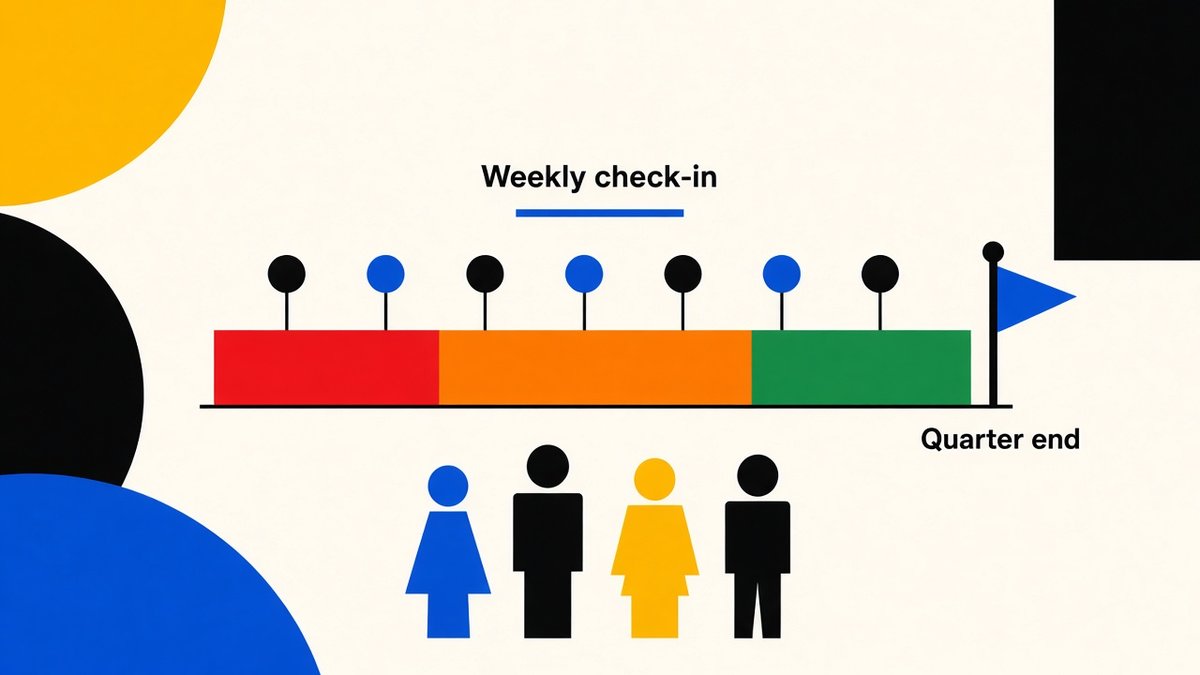
Scoring OKRs at the end of the quarter on a 0.0 to 1.0 scale, with weekly confidence check-ins along the way.
Common OKR mistakes
- Too many OKRs. Five objectives with five key results each is a to-do list, not a strategy.
- Key results that are tasks. “Publish 10 blog posts” is activity; “Grow organic leads by X%” is a result.
- No baseline. Without a starting number you cannot judge progress. Spend week one measuring if needed.
- Set and forget. OKRs that are reviewed only at quarter end rarely succeed.
- Top-down only. Let team members propose their own key results; people commit to goals they help write.
- Ignoring the business plan. OKRs should move the plan forward; see how to write a business plan if yours is out of date.
Copy-and-paste OKR template
Copy this OKR template into a document or spreadsheet, fill in one per objective and share it with your team.
OKR template (one quarter)
Objective: [Short, inspiring statement of what you want to achieve this quarter]
Why it matters: [One sentence linking it to your yearly goal or mission]
Owner: [Name]
KR1: Increase [metric] from [baseline] to [target] by [date]
KR2: Reduce [metric] from [baseline] to [target] by [date]
KR3: Reach [measurable milestone] by [date]
Initiatives: [2 to 4 projects you believe will move the key results]
Weekly confidence (1 to 10): [score] · End-of-quarter score (0.0 to 1.0): [score]
Once your OKRs are set, turn the repeatable initiatives into checklists with standard operating procedures so progress does not depend on memory.
Frequently Asked Questions
What does OKR stand for?
OKR stands for Objectives and Key Results. The objective is what you want to achieve, and the key results are the measurable outcomes that show you achieved it.
How many OKRs should a small business have?
Most small businesses should set one to three objectives per quarter, each with two to four key results. Fewer OKRs create more focus.
How often should OKRs be set?
Most teams set OKRs every quarter and review progress weekly. Some also set a small number of yearly company OKRs that quarterly OKRs support.
What is the difference between OKRs and KPIs?
KPIs are ongoing metrics that show how healthy the business is. OKRs are time-bound goals focused on changing or improving something, and a weak KPI often becomes the subject of an OKR.
What is a good OKR score?
For ambitious OKRs, a score of around 0.6 to 0.7 is usually considered good. Consistently scoring 1.0 suggests targets are too easy.
Do OKRs work for very small teams or solo founders?
Yes. Solo founders can use one quarterly objective with two or three key results to stay focused. Keep it in a simple document and review it every week.
Knowing how to set OKRs is less about the framework and more about the habit: pick a few outcomes that matter, measure them honestly and talk about them every week. Start with one objective this quarter, use the template above and improve your process each time you score. For more ways to grow with focus, explore my guide to the KPIs every small business should track.