A SWOT analysis is a simple four-box framework that shows your business’s Strengths, Weaknesses, Opportunities and Threats on a single page. Knowing how to do a SWOT analysis properly matters, because most people stop at a list of bullet points and never turn it into decisions. This guide walks through the seven steps, the exact questions to ask in each quadrant, a worked small business SWOT analysis example, the TOWS method that turns the four boxes into strategy, and a template you can copy today.
✔ Key takeaways
⏱ About 8 min read · the short version is right here
- SWOT = Strengths and Weaknesses (internal, you control them) plus Opportunities and Threats (external, you don’t).
- Do it for one clear decision or goal, not for ‘the business in general’, or it turns vague fast.
- Use evidence, not opinions: customer reviews, sales data, competitor pages and market news.
- Keep 3 to 5 points per quadrant and rank them by impact.
- Turn it into action with the TOWS matrix: match strengths to opportunities and fix weaknesses that threats could exploit.
📋 In this guide
What is a SWOT analysis?
SWOT stands for Strengths, Weaknesses, Opportunities and Threats. It is a strategic planning tool that helps you see where your business stands before you make a decision: launching a product, entering a new market, raising prices, hiring, or writing a business plan.
The framework splits into two halves. Strengths and weaknesses are internal: things inside your business that you can change, such as your skills, team, cash, brand and processes. Opportunities and threats are external: forces in the market you cannot control but can respond to, such as customer trends, new regulation, competitors and the economy.
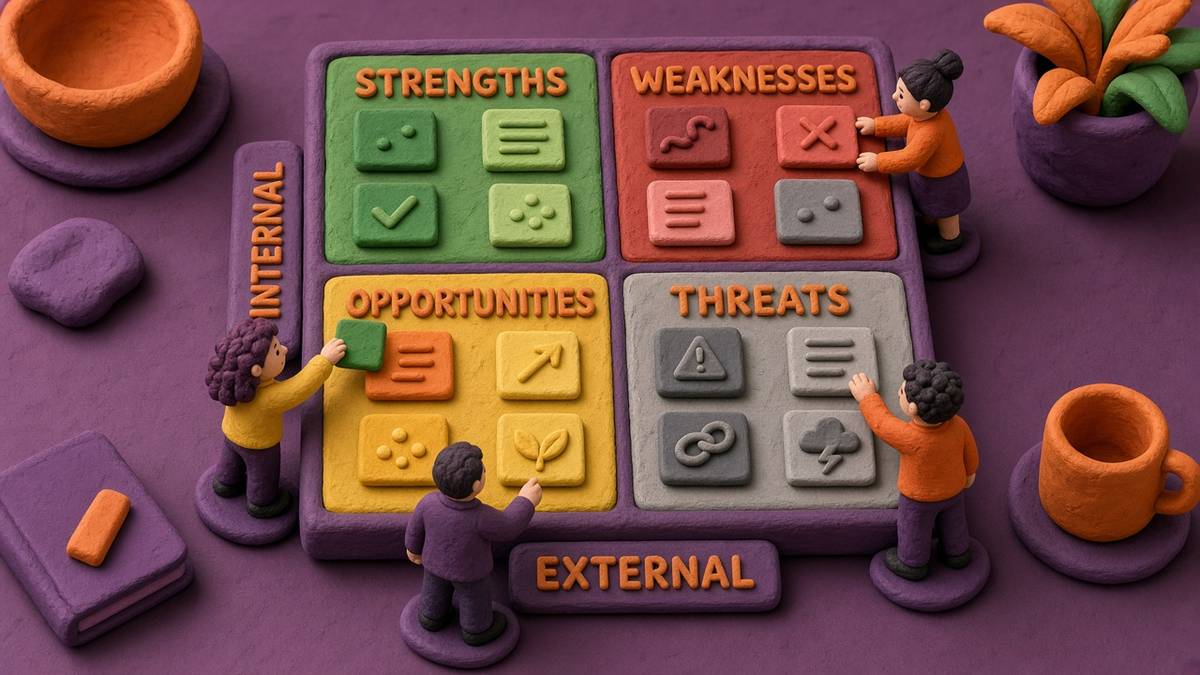
The SWOT matrix: internal factors on top, external factors below.
📌 SWOT in one line
Strengths and weaknesses describe you today. Opportunities and threats describe the world around you. A good SWOT connects the two.
When to do a SWOT analysis
A SWOT analysis is most useful when there is a real decision on the table. Common moments include:
- Annual or quarterly planning, before setting goals and budgets.
- Launching a new product or service or entering a new country.
- Writing a business plan or pitch for a bank, investor or grant.
- After a big change: a new competitor, a lost key client, a price rise from a supplier.
- Before a marketing push, to check what you can credibly promise.
If you don’t have a decision in mind, write one at the top of the page first, for example: “Should we open a second location in 2027?” Every point you add should help answer that question.
The four SWOT quadrants explained
| Quadrant | Internal or external | Helpful or harmful | Typical examples |
|---|---|---|---|
| Strengths | Internal | Helpful | Loyal customers, strong reviews, unique skills, low costs, a recognised brand, good location |
| Weaknesses | Internal | Harmful | Owner does everything, thin cash reserves, outdated website, no email list, high staff turnover |
| Opportunities | External | Helpful | Growing demand, a competitor closing, new sales channels, local events, rising search interest |
| Threats | External | Harmful | New competitors, rising rent or ingredient costs, regulation, platform algorithm changes, recession |
💡 A quick sorting test
Ask: would this still be true if my business disappeared tomorrow? If yes, it is external (opportunity or threat). If it only exists because of your business, it is internal (strength or weakness).
How to do a SWOT analysis in 7 steps
Define the objective
Write one sentence describing the decision or goal. A SWOT for “grow online sales 30% next year” looks very different from one for “hire a second designer”.
Gather evidence first
Pull your last 12 months of sales, customer reviews, survey answers, website analytics and a quick competitor analysis. Facts beat brainstorming from memory.
Invite the right people
Two to six people is ideal: the owner, someone who talks to customers every day, and someone from finance or operations. If you work alone, ask two loyal customers and one peer for honest input.
Brainstorm each quadrant
Spend 10 to 15 minutes per box. Start with strengths and weaknesses, then move to opportunities and threats. Write everything down without debating it yet.
Cut and rank
Merge duplicates, delete vague points (“great service”) or make them specific (“4.8-star average from 230 Google reviews”), and keep the top 3 to 5 per quadrant ranked by impact.
Cross-match with TOWS
Pair strengths with opportunities, weaknesses with threats, and so on (explained below). This is where the analysis turns into strategy.
Turn it into an action plan
Pick two or three actions, give each an owner, a deadline and a metric, and add them to your KPI dashboard. Review the SWOT every quarter or after any big change.
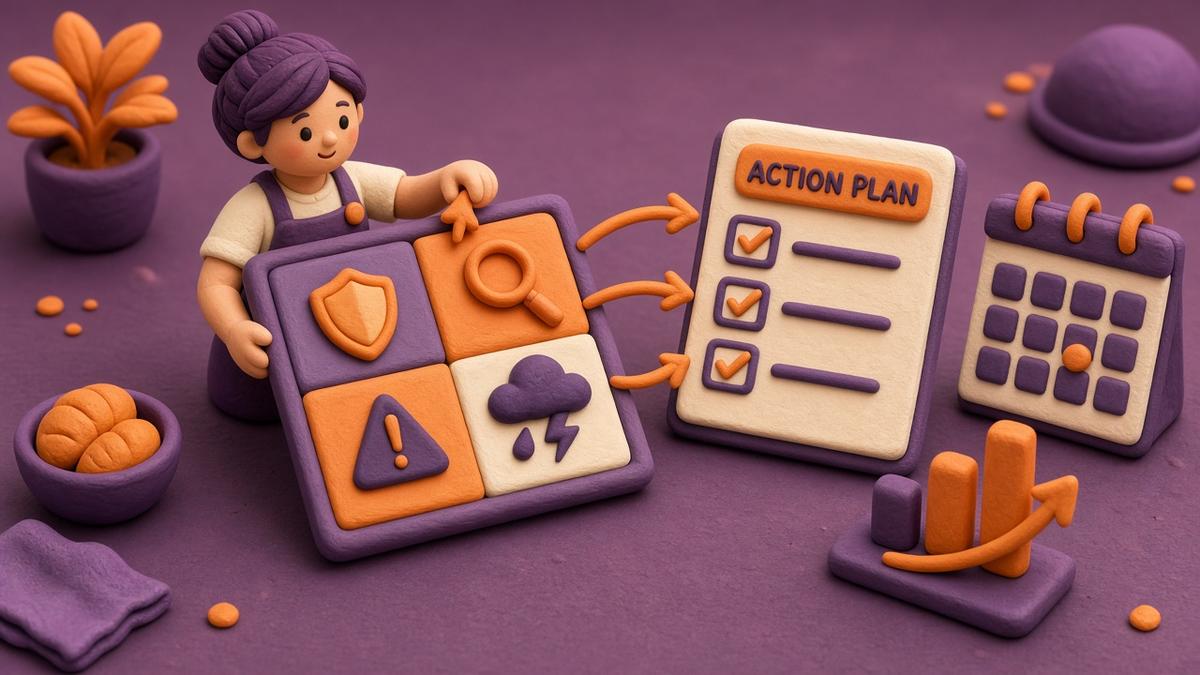
A SWOT only pays off when it ends in a short, owned action plan.
SWOT questions to ask in each quadrant
Use these prompts to get past the obvious answers. You don’t need to answer all of them; pick the ones that fit your decision.
| Quadrant | Questions to ask |
|---|---|
| Strengths | What do customers praise most in reviews? What do we do better or cheaper than competitors? Which assets (skills, data, partnerships, location) are hard to copy? Which products have the best margins? |
| Weaknesses | Where do we lose deals or get complaints? What do we avoid because we lack time, money or skills? Which tasks depend on one person? Where are competitors clearly ahead? |
| Opportunities | Which customer needs are growing? Which channels or markets have we not tried? Are there new tools, partners or funding schemes? What are customers asking for that nobody offers well? |
| Threats | Which competitors are growing fast? Which costs are rising? Could a regulation (for example GDPR, new VAT rules or industry licensing) affect us? How dependent are we on one client, platform or supplier? |
⚠️ Avoid the opinion trap
If a point can’t be backed by at least one piece of evidence, mark it as an assumption and test it before you build a strategy on it.
SWOT analysis example: a small bakery
Here is a SWOT analysis example for a fictional neighbourhood bakery in Manchester that wants to grow revenue by 25% next year. The figures are illustrative.
| Strengths | Weaknesses |
|---|---|
| Award-winning sourdough; 4.8-star reviews; loyal weekday morning regulars; owner is a trained pastry chef | No online ordering; owner bakes, serves and does the books; quiet afternoons; small email list (about 300 contacts) |
| Opportunities | Threats |
|---|---|
| Office workers returning to the area; demand for custom celebration cakes; local food delivery apps; weekend farmers market | National chain opening a café nearby; flour and energy costs rising; delivery app commissions of 25 to 30 percent eat into margin |
Reading the four boxes together suggests a clear plan: launch pre-ordered celebration cakes online (strength in skills plus a growing opportunity), use afternoons to bake for cake orders and the market (fixing a weakness), and build the email list so repeat orders don’t depend on delivery apps (protecting against a threat).
Turning SWOT into strategy with the TOWS matrix
The TOWS matrix is SWOT’s more useful sibling. Instead of four separate lists, you combine them into four types of strategy:
| Strategy type | Combines | Question to ask | Bakery example |
|---|---|---|---|
| SO (maximise-maximise) | Strengths + Opportunities | How can we use our strengths to grab this opportunity? | Sell premium custom cakes online to returning office teams |
| WO (minimise-maximise) | Weaknesses + Opportunities | How can this opportunity help fix a weakness? | Fill quiet afternoons with farmers-market and cake production |
| ST (maximise-minimise) | Strengths + Threats | How can our strengths defend against this threat? | Lean on quality and reviews to stand apart from the chain café |
| WT (minimise-minimise) | Weaknesses + Threats | What must we fix so this threat can’t hurt us? | Build a direct email list and pre-order page to reduce app commissions |
Most small businesses should start with one SO move (growth) and one WT move (protection). The rest can wait for the next review. If a strategy involves new marketing, sketch it in a simple marketing plan and sharpen the message with a clear value proposition.
Common SWOT mistakes
- Being vague. “Good quality” means nothing. “Lowest return rate in our category (2%)” is a strength you can use in marketing.
- Mixing internal and external. “Competitors are cheaper” is a threat; “our costs are higher” is a weakness. Keep them separate.
- Listing 20 points per box. Long lists hide what matters. Cut to the top 3 to 5.
- No decision attached. A SWOT without an objective becomes a pleasant workshop with no result.
- Doing it once. Markets change. Revisit your SWOT quarterly, or whenever a big threat or opportunity appears.
- Skipping the action plan. If nobody owns an action with a deadline, nothing changes.
Free SWOT template you can copy
Copy this into a document, Google Sheets or a whiteboard. Fill each box with 3 to 5 specific, evidence-backed points, then complete the action rows.
| Section | What to write |
|---|---|
| Objective | One sentence: the decision or goal this SWOT supports, with a date |
| Strengths (internal, helpful) | 1. … 2. … 3. … (with evidence) |
| Weaknesses (internal, harmful) | 1. … 2. … 3. … |
| Opportunities (external, helpful) | 1. … 2. … 3. … |
| Threats (external, harmful) | 1. … 2. … 3. … |
| SO and WT strategies | One growth move and one protection move |
| Actions | Action, owner, deadline, success metric |
| Next review date | Usually in 90 days |
💡 Pair it with your numbers
Before committing to a growth action, check it against your break-even point so you know how many extra sales it must bring in to pay for itself.
Frequently Asked Questions
What are the 4 parts of a SWOT analysis?
Strengths, Weaknesses, Opportunities and Threats. Strengths and weaknesses are internal factors you control; opportunities and threats are external factors in the market.
How long should a SWOT analysis take?
For a small business, one focused session of 60 to 90 minutes is enough, plus an hour beforehand to gather evidence such as sales data, reviews and competitor information.
How many points should be in each SWOT quadrant?
Aim for 3 to 5 specific, ranked points per quadrant. More than that usually means the points are too vague or not prioritised.
What is the difference between SWOT and TOWS?
SWOT lists the four factors. TOWS combines them into strategies, such as using strengths to capture opportunities (SO) or fixing weaknesses that threats could exploit (WT).
Can I do a SWOT analysis for myself?
Yes. A personal SWOT works the same way: your skills and habits are strengths and weaknesses, while job market trends, courses and contacts are opportunities and threats.
How often should a business update its SWOT analysis?
Review it at least once a quarter and whenever something big changes, such as a new competitor, a price rise from a key supplier or a new regulation.
A SWOT analysis takes about an hour, costs nothing and gives you a clear, shared view of where your business stands. Pick one decision, gather the evidence, keep each box short, then use TOWS to choose one growth move and one protection move. Put the date of your next review in the calendar before you close the document.