Your break-even point is the number of sales you need before your business stops losing money and starts making a profit. Knowing how to calculate break-even point is one of the most practical skills a small business owner can have: it tells you whether a price works, how much a new hire really costs you, and how many customers you need each month just to stand still. This guide walks through the break-even formula, a six-step method, three worked examples and the levers that bring your break-even point down.
✔ Key takeaways
⏱ About 8 min read · the short version is right here
- Break-even point (units) = fixed costs ÷ (price per unit − variable cost per unit).
- Break-even point (revenue) = fixed costs ÷ contribution margin ratio, which works better when you sell many products.
- Getting the fixed vs variable split right matters more than the maths itself.
- Add your target profit to fixed costs to see how many sales you need to hit a goal, not just survive.
- Raising prices or cutting variable costs usually lowers break-even faster than chasing more volume.
📋 In this guide
- What is a break-even point?
- Break-even point formulas
- Fixed vs variable costs: sorting your numbers
- How to calculate your break-even point in 6 steps
- Break-even examples: coffee shop, freelancer, online course
- Break-even with a profit target and margin of safety
- How to lower your break-even point
- Doing it in Excel or Google Sheets
- Common break-even mistakes
- FAQ
What is a break-even point?
The break-even point is the level of sales at which total revenue equals total costs. Below it, every month ends with a loss. Above it, each extra sale adds profit. You can express it in units (how many cups, hours or licences you must sell) or in revenue (how many dollars or euros must come in).
It is a simple idea, but it answers questions that gut feeling cannot: can this shop pay its rent at today’s prices? How many clients does a new $4,000-a-month hire need to pay for themselves? Should a product be dropped? Banks, investors and grant bodies also ask for it, which is why it shows up in almost every business plan.
📌 Break-even in one line
Break-even is the point where you have made back every cost for the period and your profit is exactly zero. It is a floor, not a goal.
Break-even point formulas
There are two versions of the break-even formula. Both rely on the contribution margin: the money left from each sale after paying the variable cost of that sale. That leftover is what pays for rent, salaries and software, and, once those are covered, becomes profit.
| Formula | Use it when | Calculation |
|---|---|---|
| Break-even units | You sell one main product or a clear unit (a cup, an hour, a licence) | Fixed costs ÷ (Price − Variable cost per unit) |
| Contribution margin per unit | Every break-even calculation | Price − Variable cost per unit |
| Contribution margin ratio | You need a percentage | (Price − Variable cost) ÷ Price |
| Break-even revenue | You sell many products or services at different prices | Fixed costs ÷ Contribution margin ratio |
| Sales for a target profit | You want a goal, not just survival | (Fixed costs + Target profit) ÷ Contribution margin per unit |
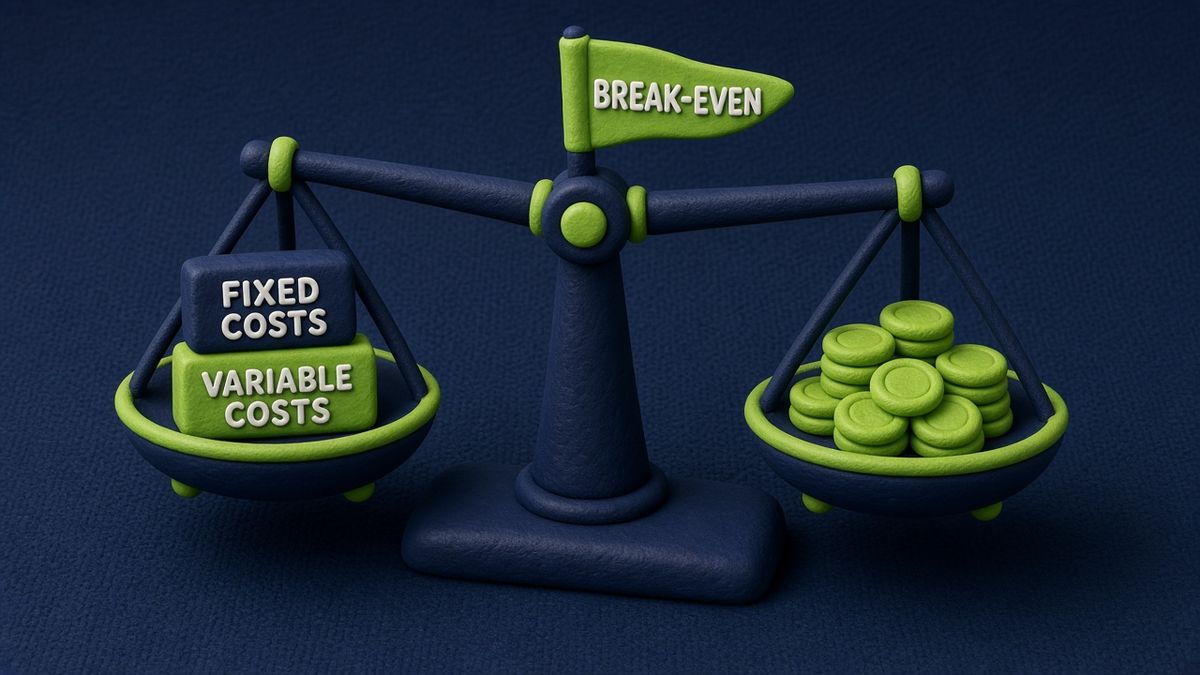
Break-even is the point where fixed and variable costs are exactly balanced by revenue.
Fixed vs variable costs: sorting your numbers
Most break-even mistakes come from putting costs in the wrong bucket. A simple test helps: if you sold nothing this month, would you still pay it? If yes, it is fixed. If it rises and falls with each sale, it is variable.
| Cost | Fixed or variable? | Why |
|---|---|---|
| Rent, insurance, accountant | Fixed | Paid whether you sell 0 or 1,000 units |
| Salaries of permanent staff | Fixed | Same each month regardless of volume |
| Software subscriptions, website hosting | Fixed | Flat monthly fee |
| Raw materials, packaging, stock | Variable | Each sale uses more |
| Card and payment processing fees | Variable | A percentage of each transaction |
| Sales commission, shipping, contractor hours per job | Variable | Only paid when a sale happens |
| Utilities, marketing | Usually semi-variable | Split into a fixed base and a variable part, or treat as fixed to stay conservative |
💡 When in doubt, call it fixed
If you cannot decide, put a cost in fixed. It makes your break-even point slightly higher, which is the safer mistake to make.
How to calculate your break-even point in 6 steps
Pick a time period
Monthly is easiest for most small businesses because rent, payroll and subscriptions are billed monthly.
Add up fixed costs for that period
Use your bank statements or accounting software for the last three months and take the average. Include your own salary if you pay yourself one; otherwise your break-even point hides the fact you work for free.
Find the average price per unit
Use what customers actually pay after discounts, not your list price. For VAT-registered businesses in the UK or EU, use prices excluding VAT, since the VAT is not your money.
Work out variable cost per unit
Materials, packaging, payment fees, shipping and any per-sale commission. Divide total variable costs by units sold if you only know totals.
Calculate contribution margin and break-even
Subtract variable cost from price, then divide fixed costs by that number. Always round up to the next whole unit.
Sense-check it against reality
Convert the answer into daily or weekly sales. If you need 40 sales a day and you average 25, you have a pricing or cost problem to fix, not a marketing one alone.
Break-even examples: coffee shop, freelancer, online course
Example 1: a neighbourhood coffee shop
A coffee shop in Leeds has fixed costs of $12,000 a month (rent, two staff, insurance, equipment lease). The average order is $6.00 and the variable cost per order (coffee, milk, cups, card fees) is $2.10.
| Item | Value |
|---|---|
| Contribution margin per order | $6.00 − $2.10 = $3.90 |
| Contribution margin ratio | $3.90 ÷ $6.00 = 65% |
| Break-even orders per month | $12,000 ÷ $3.90 = 3,077 orders |
| Break-even orders per day (30 days) | about 103 |
| Break-even revenue | $12,000 ÷ 0.65 = about $18,462 |
Example 2: a freelance designer
A freelance designer in Austin pays herself a $4,500 salary and has $1,500 in other fixed costs (software, co-working desk, insurance), so $6,000 a month in total. She bills $90 an hour, and each billable hour carries about $15 of variable cost (stock assets, payment fees, a share of contractor help). Her contribution is $75 an hour, so she must bill 80 hours a month to break even, roughly 20 hours a week. That leaves room for admin and sales, which is healthy.
Example 3: an online course
A course creator in Berlin has $3,200 a month in fixed costs (course platform, email tool, a part-time assistant). The course sells for $49, with about $4 per sale in payment and delivery fees. Contribution is $45, so break-even is $3,200 ÷ $45 = 71.1, rounded up to 72 sales a month. Because variable costs are tiny, every sale after the 72nd is almost pure profit, which is why digital products scale so well.
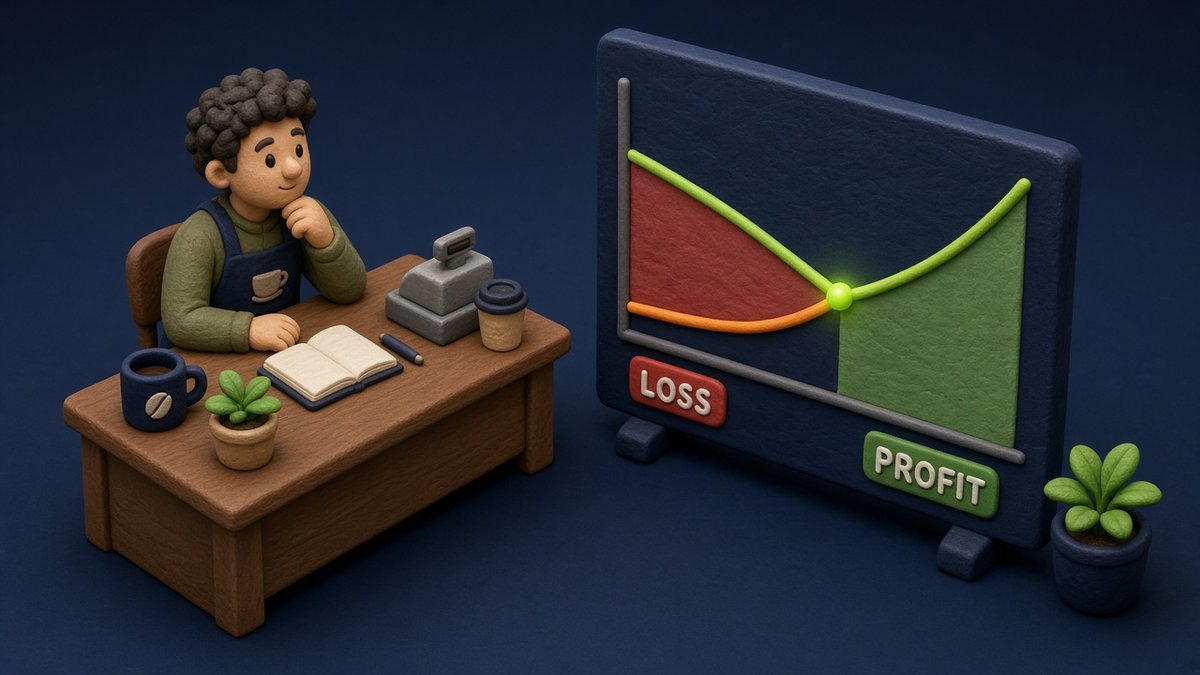
Below the break-even point each month runs at a loss; above it, every extra sale adds profit.
Break-even with a profit target and margin of safety
Break-even tells you how to survive. To plan for profit, add the profit you want to your fixed costs. If the coffee shop wants $4,000 profit a month: ($12,000 + $4,000) ÷ $3.90 = 4,103 orders, or about 137 a day.
The margin of safety shows how far sales can fall before you slip into a loss: (actual sales − break-even sales) ÷ actual sales. If the shop sells 3,800 orders a month, its margin of safety is (3,800 − 3,077) ÷ 3,800 = 19%. A margin under 10% is fragile; one slow month can wipe out the profit.
⚠️ Break-even is not cash flow
You can be above break-even on paper and still run out of cash if customers pay late or you buy stock upfront. Track break-even alongside your cash flow.
How to lower your break-even point
There are only three levers: raise the price, lower variable cost per unit, or lower fixed costs. Small changes add up fast because they all act on the contribution margin.
| Change (coffee shop) | New contribution | New break-even | Difference |
|---|---|---|---|
| Raise average order from $6.00 to $6.50 | $4.40 | 2,728 orders | 349 fewer (about 11%) |
| Cut variable cost by $0.30 per order | $4.20 | 2,858 orders | 219 fewer |
| Cut fixed costs by $1,000 a month | $3.90 | 2,821 orders | 256 fewer |
A small price rise often beats everything else, which is why it is worth reading how to raise prices without losing customers and reviewing how you price your product or service. For the cost side, see practical ways to reduce business costs.
Doing it in Excel or Google Sheets
A three-cell sheet is enough. Put fixed costs in B1, price in B2 and variable cost in B3, then use:
- Break-even units:
=ROUNDUP(B1/(B2-B3),0) - Break-even revenue:
=B1/((B2-B3)/B2) - Target profit units (profit in B4):
=ROUNDUP((B1+B4)/(B2-B3),0) - Margin of safety (actual units in B5):
=(B5-ROUNDUP(B1/(B2-B3),0))/B5
For several products, calculate a weighted average contribution margin ratio from last quarter’s sales mix and use the revenue formula. Review it every quarter, and add break-even revenue to your small business KPI dashboard so you see it next to sales.
Common break-even mistakes
- Using list prices. Discounts, refunds and coupons lower your real price.
- Forgetting your own pay. If you leave out your salary, break-even looks great while you earn nothing.
- Including VAT or sales tax in revenue. It inflates the price and hides losses.
- Treating it as a one-off. Rent rises, suppliers change prices; recalculate quarterly.
- Ignoring capacity. If break-even needs 103 orders a day and you can only serve 90, no amount of marketing will fix it.
Frequently Asked Questions
What is the formula for break-even point?
Break-even point in units equals fixed costs divided by (selling price per unit minus variable cost per unit). Break-even revenue equals fixed costs divided by the contribution margin ratio.
What is a good break-even point for a small business?
There is no single number. A healthy sign is reaching break-even with comfortable capacity to spare and holding a margin of safety above roughly 20 percent once the business is established.
How do I calculate break-even for a service business?
Use billable hours or projects as your unit. Divide monthly fixed costs, including your own salary, by the contribution per hour or project (rate minus any direct cost per hour or project).
Should break-even include my salary?
Yes, if you want an honest answer. Treat a reasonable owner salary as a fixed cost; otherwise you can break even while working for free.
How often should I recalculate my break-even point?
At least once a quarter, and whenever prices, rent, payroll or supplier costs change noticeably.
Is break-even point the same as payback period?
No. Break-even is the sales level where profit is zero in a given period. Payback period is how long it takes to earn back a one-off investment, such as equipment or a new store fit-out.
Once you know your break-even point, every decision about prices, hires and spending gets easier, because you can see exactly how many extra sales it will take to pay for it. Work it out this week, put it on one line in your dashboard and revisit it each quarter.