Learning how to write a case study is one of the highest-leverage skills in sales and marketing. A good case study shows a real customer, a real problem and a measurable result, so prospects can picture themselves succeeding with you. This guide gives you a repeatable process: pick the story, interview the customer, write a clear structure, add proof and publish it across your site, email and sales calls.
✔ Key takeaways
⏱ About 8 min read · the short version is right here
- One strong case study beats ten vague testimonials: problem, approach, result, quote.
- Ask for permission in writing and let the customer approve numbers and quotes before you publish.
- Use a fixed outline every time so drafts take one focused session instead of a week.
- Repurpose the same story into a sales page section, an email, a PDF and a short social thread.
📋 In this guide
Why case studies sell better than feature lists
Feature lists say what you do. Case studies show what changed for someone like your buyer. When a prospect is comparing options, a specific before-and-after story reduces risk more than another bullet about “dedicated support”. That is why case studies sit next to your value proposition and your offer pages.
They also help your team. Sales can send one link instead of rewriting the same story in every email. Content can pull quotes for customer testimonials and social posts. Support can point frustrated users to a peer who solved a similar mess.
Trust
Specific beats vague
“Revenue up 32% in 90 days” lands harder than “great results”.
Sales
Objection killer
Answers “does this work for businesses like mine?” with evidence.
SEO
Long-tail traffic
“[Industry] case study” queries often convert better than broad how-tos.
Pick the right customer story
Not every happy customer makes a strong case study. A shiny logo with a vague compliment is marketing wallpaper; a mid-market customer who names the bottleneck and the timeline is sales fuel. Rank candidates by similarity to the buyers you want next quarter, not by who is easiest to ask.
Prioritise stories with a clear before state, a decision moment, a measurable after state and a customer willing to go on the record. Ideal candidates: people who were stuck, tried something that failed, then succeeded with your offer — and who match the audience you want next. Keep a simple pipeline in a spreadsheet: nominated, asked, interviewed, drafted, approved, published.
- ☑ Result is measurable (%, time saved, revenue, leads, cost cut)
- ☑ Customer resembles your ideal buyer
- ☑ You have permission to name them or use a clear anonymised profile
- ☑ Story is recent enough that the market still cares
- ☑ You can explain what you did without revealing trade secrets they forbid
💡 Ask early
Build the ask into delivery. After a win, send a short note: “Would you be open to a 20-minute call so we can share your results with similar businesses?” Add it to your client onboarding wrap-up when you have one.
Run a 30-minute interview
A short interview beats a long questionnaire. Record the call (with consent), then pull quotes later. Use this script and leave silence so they fill it.
Context
What did your business look like before we worked together? What was broken or stuck?
Stakes
What happened if nothing changed in the next 6–12 months?
Why us
What alternatives did you consider, and why did you choose this approach?
Process
What did the first 30 days feel like? Any surprises?
Results
Which numbers moved, and over what period? Soft wins count too (confidence, clarity).
Quote
If a peer in your industry asked whether this was worth it, what would you say in one sentence?
📌 Permission checklist
Confirm on email: full name and company (or anonymised label), logos, metrics, quotes, photo if any, and where you may publish (site, ads, PDF). Keep that email.
If the customer is shy on camera, offer text-only. If legal is slow, start with anonymised metrics they already shared in a review call. Momentum matters more than perfection on case study one.
The case study structure that converts
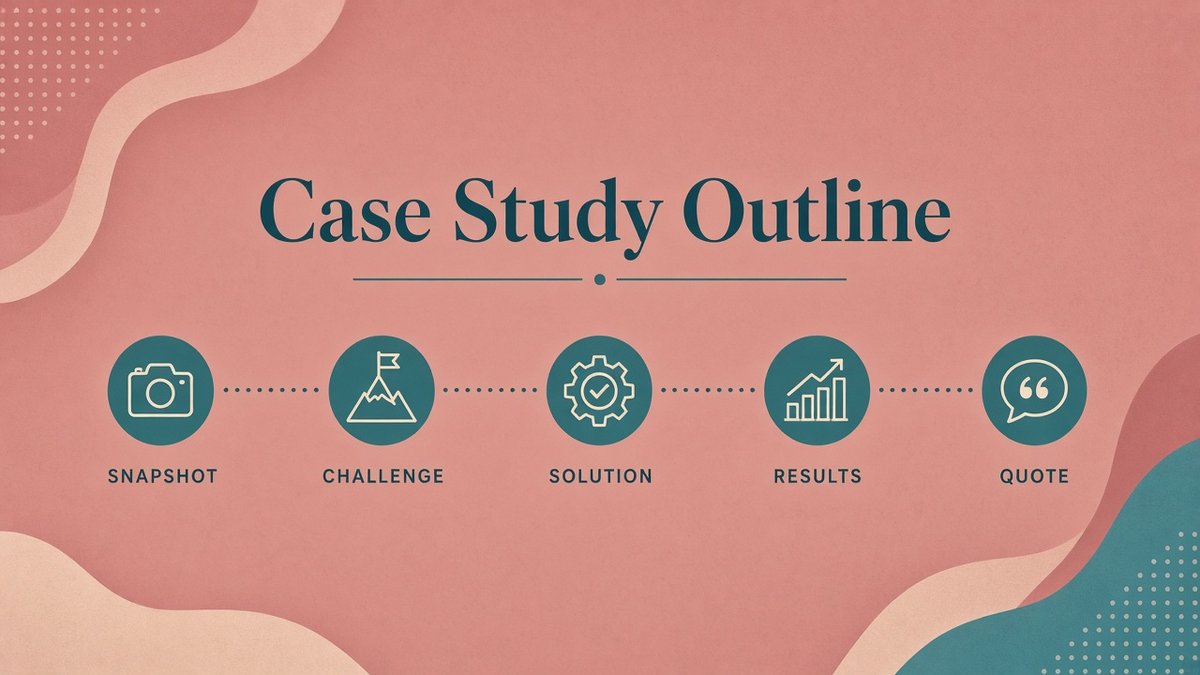
Illustrative case study outline showing customer, challenge, solution, results and quote sections.
Use the same skeleton every time. Readers learn the shape; you write faster. Resist the urge to invent a new format for every industry — consistency makes your library scannable and helps salespeople find the right story in seconds.
Headline formula that works: result + timeframe + who. Example shape: "How a 6-person agency cut proposal time 40% in 60 days." Avoid clever puns that hide the outcome.
| Section | Purpose | Length guide |
|---|---|---|
| Headline | Result + who | 8–14 words |
| Snapshot | Industry, size, offer used | 2–3 lines |
| Challenge | Before state and stakes | 120–180 words |
| Solution | What you did, step by step | 150–220 words |
| Results | Numbers and timeframe | bullets + 1 short para |
| Quote | Customer voice | 1–2 sentences |
| CTA | Next step for the reader | 1 clear action |
💡 StoryBrand lens
If you struggle with narrative, Building a StoryBrand on Amazon.com / Amazon.co.uk is a practical framework for keeping the customer as the hero and your offer as the guide. Optional reading, not required.
Write the draft in one sitting
Block 90 minutes. Write ugly first, then cut. Aim for 700–1,200 words for a web case study; PDFs can run longer with charts. Do not open with your founding story. Open with the customer’s Tuesday morning problem.
A practical drafting order: challenge paragraph, results bullets, solution steps, snapshot box, quote, headline, CTA. Writing the headline last stops you forcing the story to fit a clever title.
Draft the headline last
Write the body, then pull the strongest result into the title.
Lead with the challenge
Open in the customer’s world, not your company bio.
Keep your ego thin
Describe your method as the bridge, not the star.
Put numbers near verbs
“Cut onboarding from 14 days to 5” beats “improved efficiency”.
Send for approval
One edited draft to the customer; incorporate changes; get a written OK.
Illustrative before-and-after results panel for a small business case study page.
Add proof without fluff
Proof can be metrics, screenshots (blurred), timelines, third-party tools or a short video clip. Avoid stacking adjectives. If a number is sensitive, use ranges or percentages the customer approved. For sales conversations, pair the case study with how to handle sales objections so the story answers the doubt in the room.
When you lack hard revenue numbers, use operational metrics the customer owns: hours saved, response time, close rate, churn, pipeline coverage or support tickets closed. Soft outcomes (confidence, clarity, fewer fire drills) belong in the quote, not as fake precision.
- ☑ One primary metric with timeframe
- ☑ One secondary metric or qualitative win
- ☑ One verbatim quote
- ☑ Logo or name as approved
- ☑ Link to related offer or booking page
Publish and reuse everywhere
Publish on your site as a dedicated page or a section under customers/results. Give it a clean URL, an honest title and an internal link from your services or pricing page. Then slice it:
Also add the case study to discovery-call follow-ups. A short email that says "here is how a team like yours solved X" often moves a stalled deal more than another feature deck.
| Asset | How to reuse |
|---|---|
| Sales page block | Challenge → result → CTA near pricing |
| Story in 150 words + link to full case study | |
| PDF one-pager | Leave-behind after discovery calls |
| Social thread | 5 posts: problem, turning point, 3 results |
| Ad creative | Only with explicit permission for paid use |
Add the page to your content calendar so you produce one new case study each quarter instead of never.
Tools that make distribution easy
You can draft in any doc tool. For publishing a simple results page, collecting the lead who wants the PDF, and emailing the story to your list, Systeme.io is enough for many small businesses: funnels or blog pages, forms and email under one login, with a free plan to start (2,000 contacts, unlimited email sends, checked on systeme.io/pricing patterns used across this site; confirm live limits when you sign up).
When the case study feeds a webinar or evergreen funnel, the same account can host the registration path. For software choices see best webinar software for small business (once live) or how to build a sales funnel for the wider funnel. Keep GDPR-friendly opt-in language on every download form.
Turn your case study into a simple funnel
Publish the story on a page, add a PDF opt-in and email it to your list from one Systeme.io account.
Affiliate link. I may earn a commission at no extra cost to you.
Mistakes that kill trust
- ☑ Publishing without written approval
- ☑ Inventing or rounding numbers the customer did not confirm
- ☑ Making your brand the hero of every paragraph
- ☑ Hiding the offer — readers need a next step
- ☑ One giant PDF nobody reads on mobile
- ☑ Using the same story in ads without paid-usage permission
- ☑ Copying a competitor’s structure so closely that it feels generic
Fix weak drafts by cutting the first two paragraphs (usually throat-clearing), moving the strongest number under the headline, and replacing every "we helped them improve" with a concrete change.
⚠️ Compliance note
In regulated industries (finance, health, education) check advertising rules before you claim results. For EU/UK contacts, treat quotes and photos as personal data and honour deletion requests. General information, not legal advice.
FAQ
Frequently Asked Questions
How long should a case study be?
Most web case studies work at 700–1,200 words. Sales one-pagers can be a single screen. Depth matters less than a clear problem, approach and result.
Do I need the customer’s real name?
Named stories convert better, but a detailed anonymised profile with industry, size and approved metrics still works when privacy is required.
How many case studies do I need?
Start with three that match your top buyer segments. Refresh or add one each quarter.
What is the difference between a testimonial and a case study?
A testimonial is a short endorsement. A case study is a structured story with context, process and measurable outcomes.
Can I use the same case study on a sales page?
Yes — pull a short block (challenge, result, quote, CTA) and link to the full write-up.
What tools help distribute case studies?
Any page builder plus email works. Systeme.io is a practical all-in-one for pages, opt-ins and follow-up emails if you want one login.
Affiliate disclosure: some links in this post are affiliate links (including Amazon), so I may earn a commission at no extra cost to you. As an Amazon Associate I earn from qualifying purchases. I only recommend tools and books I’d use myself.