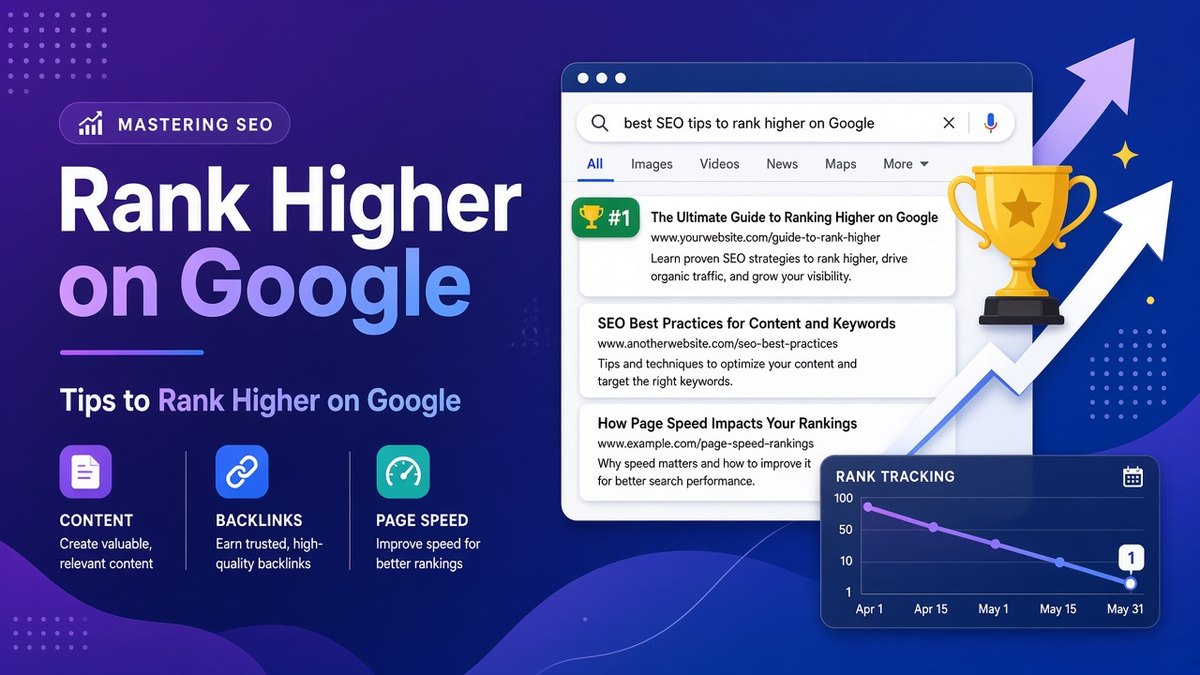
Ranking higher on Google gets harder every year. There is more competition, AI Overviews sit above many results and Google keeps raising the bar for quality. Still, sites move up every day. The difference is usually not a secret trick. Instead, it is better prioritisation and smarter execution.
This guide is for people who already know the basics. You have a working site, some content and Google Search Console set up. Here, you will find ten advanced, practical tips for ranking higher on Google. I use them to push pages from page two onto page one, and then into the top three.
✔ Key takeaways
- Start with pages already ranking in positions 8 to 20. They are the fastest wins.
- Study the current results page and match its format, depth and intent before you write.
- Group content into topic clusters, linked to and from one strong pillar page.
- Refresh outdated posts and merge pages that compete for the same keyword.
- Earn links with useful assets and outreach, never with paid link schemes.
📋 In this guide
- Before you start: check the foundation
- Mine Search Console for quick wins
- Match the SERP, not just the keyword
- Build topic clusters for ranking higher on Google
- Refresh and consolidate old content
- Add information gain and real experience
- Win AI Overviews and featured snippets
- Raise your click-through rate
- Point internal links at priority pages
- Earn backlinks that move rankings
- Track rankings and iterate
- What to do first: an impact vs effort table
- Frequently Asked Questions
Before you start: check the foundation
Advanced tactics only work on a solid base. If Google cannot crawl your pages, or they load slowly on mobile, no content tweak will save them. So, first confirm the basics: HTTPS everywhere, green Core Web Vitals, a clean sitemap and no accidental noindex tags.
If any of that sounds unfamiliar, work through my step-by-step guide to an SEO-friendly website first. And if you are completely new, the beginner guide to SEO explains crawling, indexing and keywords in plain English.
Mine Search Console for quick wins
Your fastest route to ranking higher on Google is hiding in Google Search Console. Open the Performance report, switch on average position and filter for queries ranking between 8 and 20. These are “striking distance” keywords. Google already sees your page as relevant, but not quite good enough.
Next, sort by impressions. A query with thousands of impressions at position 11 can bring real traffic with just a small jump. For each one, check whether the page actually answers that query well. Often, adding a focused section, a clearer heading or a better example is enough.
💡 Pro move
Export the queries for one page and look for related questions you have not answered. Each gap is a ready-made H2 or FAQ for your next update.
Match the SERP, not just the keyword
Keyword research tells you what people type. The results page tells you what Google thinks they want. Before you update any page, search the target keyword and study the top five results closely.
Then, ask yourself a few questions. Are the winners guides, lists, tools or product pages? How long and how deep are they? Do they show videos, a map pack or a “People also ask” box? If every top result is a comparison table and yours is an essay, the format itself is holding you back. In that case, rebuild the page to match, then go one step further.
Build topic clusters for ranking higher on Google
In general, Google rewards sites that cover a topic thoroughly, not just a single keyword. A topic cluster puts this into practice. You write one comprehensive pillar page on a broad topic, then support it with focused articles on each subtopic.
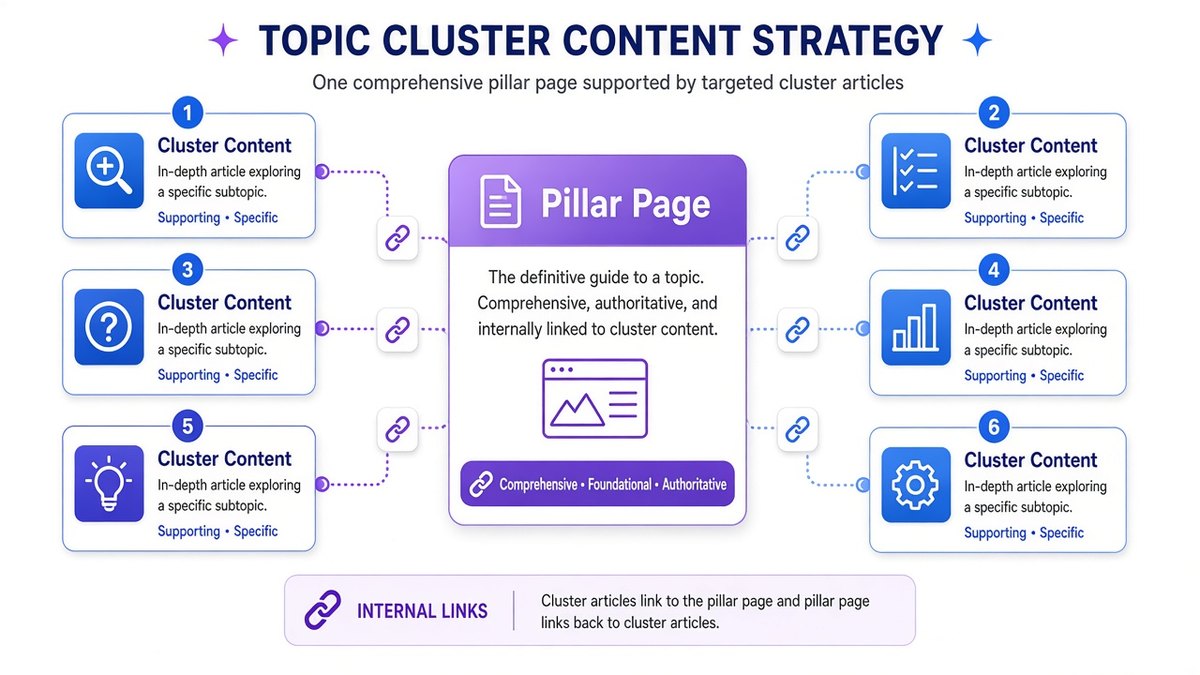
Crucially, every cluster article links back to the pillar, and the pillar links out to every cluster article. As a result, Google sees a tightly connected group of pages on one subject. Authority flows between them, and new cluster posts help the pillar rank too.
For example, a content marketing pillar could link to posts on B2B content strategy, visual content and email marketing for small business. Each one answers a narrower question, while the pillar ties them together.
Refresh and consolidate old content
Old content quietly loses rankings, which makes ranking higher on Google harder over time. For instance, facts go out of date, competitors publish better pages and screenshots stop matching reality. Therefore, plan a content refresh every quarter for your most valuable pages.
While you are at it, look for keyword cannibalisation. Basically, this happens when two or more of your pages target the same query, so Google keeps switching between them. Usually, the fix is to merge them into one stronger page and add a 301 redirect from the weaker URL.
⚠️ Do not fake freshness
Changing only the date or swapping a few words does not count as an update. Google looks for meaningful improvements, so add new data, new examples or clearer answers.
Add information gain and real experience
When every article on page one says the same thing, Google has little reason to rank a new one. Information gain means adding something the existing results lack. For instance, that could be original data, a real case study, a template or a mistake you made and fixed.
This also supports E-E-A-T, which stands for experience, expertise, authoritativeness and trust. To begin with, show your experience with real screenshots and numbers. Add a clear author bio with relevant credentials. Above all, cite reliable sources and keep claims accurate. Consequently, both readers and Google find it easier to trust the page.
Win AI Overviews and featured snippets
AI Overviews and featured snippets both pull short, direct answers from pages. To be the page they pick, structure your content for easy extraction. Put a clear question in a heading, then answer it in 40 to 60 words straight after.
Likewise, lists and tables help, because they are easy to quote. However, do not write only for the snippet. The rest of the page must still deliver depth, otherwise visitors who click through will bounce. Similarly, keep your brand name visible, so readers remember where the answer came from.
Raise your click-through rate
Ranking is only half the battle. You also need people to choose your result. A higher click-through rate is not a simple ranking boost. Even so, more clicks mean more traffic from the same position.
So, review pages with high impressions and a low CTR in Search Console. Then, test sharper title tags. For example, use the main keyword early, add a specific benefit and include a number or the year where it fits. Also, rewrite meta descriptions so they promise exactly what the page delivers.
| Weak title | Stronger title |
|---|---|
| SEO Tips | 12 SEO Tips for Ranking Higher on Google in 2026 |
| Our CRM Review | Best CRM for Small Agencies: 7 Tools Compared |
| Pricing Guide | How to Price Your Service: 3 Methods + Free Calculator |
Point internal links at priority pages
Internal links are the most underrated tool for ranking higher on Google. Unlike backlinks, you control them completely. In fact, every link from a strong page passes some authority to the page it points at.
First, find your strongest pages, usually the ones with the most backlinks or traffic. Then, add contextual links from them to the pages you most want to rank. Also, use descriptive anchor text that includes a variation of the target keyword. Meanwhile, remove or update links that point to redirected or deleted pages.
Earn backlinks that move rankings
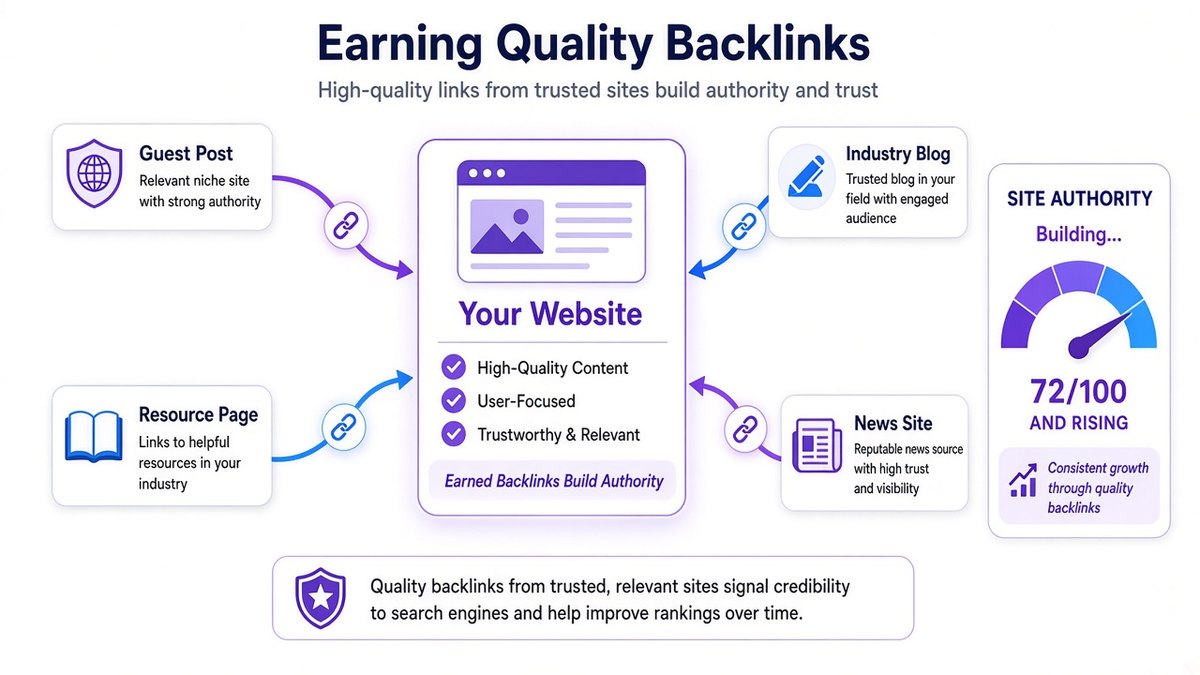
For ranking higher on Google, backlinks remain one of the strongest signals. Yet not all links are equal, of course. One link from a relevant, trusted site in your industry beats a hundred links from random directories.
Create linkable assets
Publish something people want to cite, such as original survey data, a free template, a calculator or an in-depth guide.
Pitch relevant guest posts
Write genuinely useful articles for respected blogs in your niche, not low-quality sites that sell posts.
Get listed on resource pages
Many industry sites keep lists of helpful tools and guides. Find them and suggest your best asset politely.
Reclaim unlinked mentions
Search for your brand name. When a site mentions you without a link, ask them to add one.
⚠️ Stay inside the rules
Buying links, link exchanges at scale and expired-domain tricks break Google’s spam policies. They can trigger manual actions that wipe out years of work. Instead, earn links slowly and safely.
For more on promotion, see my guide to a blended marketing strategy. It shows how social, email and PR work together to attract links naturally.
Track rankings and iterate
You cannot improve what you do not measure. Search Console shows average positions. However, its data arrives with a delay and is hard to follow for specific keywords over time. For that reason, a dedicated rank tracker is worth it once you are working on many pages.
I recommend SE Ranking as an affordable all-in-one option and a strong Semrush alternative. It tracks daily rankings, compares you with competitors, finds keyword gaps and audits your site. Other popular tools include Ahrefs and Moz, so pick the one that fits your budget.
Track every keyword that matters
Use SE Ranking to monitor daily positions, spy on competitors and find your next quick wins.
Affiliate link. I may earn a commission at no extra cost to you.
What to do first: an impact vs effort table
With so many options, prioritisation is everything. Use this table to decide where to spend your next few weeks.
| Tactic | Impact | Effort | When to do it |
|---|---|---|---|
| Improve striking-distance pages | High | Low | Start this week |
| Rewrite titles for low-CTR pages | Medium | Low | Start this week |
| Add internal links to priority pages | High | Low | Every time you publish |
| Merge cannibalised pages | High | Medium | Monthly review |
| Build a topic cluster | High | High | Quarterly plan |
| Create a linkable asset | High | High | One or two per quarter |
| Chase every minor audit warning | Low | High | Only after the above |
In short, do the low-effort, high-impact work first. Then, invest in clusters and link-worthy assets for long-term growth. For the bigger picture, you may also enjoy my thoughts on building a masterplan for SEO.
Frequently Asked Questions
How long does it take to rank higher on Google?
For an existing page in striking distance, improvements can show within a few weeks. New pages and competitive keywords usually take three to six months or longer.
What is the fastest way to improve Google rankings?
Find queries in positions 8 to 20 in Google Search Console. Then improve those pages with better answers, clearer headings, stronger titles and internal links.
Are backlinks still important in 2026?
Yes. Links from relevant, trusted sites remain a strong ranking signal. Quality matters far more than quantity, and paid link schemes can lead to penalties.
How do I get my content into AI Overviews?
There is no special markup for AI Overviews. Write clear, accurate answers under question-style headings, add first-hand detail and keep your page technically sound.
Is SE Ranking a good Semrush alternative?
For many small businesses, yes. SE Ranking covers rank tracking, keyword research, competitor analysis and site audits in one dashboard and usually costs less.
Final thoughts
Ranking higher on Google is a process, not a single fix. Start with the data you already have, match what searchers want and build depth through topic clusters. Then, keep your best pages fresh, link to them wisely and earn links the honest way.
To sum up, pick two tips from this guide and apply them this week. Measure the results, then add the next two. Over a few months, those steady gains compound into real, lasting traffic.
Affiliate disclosure: Some links in this post are affiliate links. If you buy through them, I may earn a commission at no extra cost to you.