Lead generation for small business is the difference between waiting for the phone to ring and having a steady list of people who already want what you sell. A lead is anyone who has shown interest, such as filling in a form, booking a call or joining your email list. In this guide I share 12 lead generation strategies that work on small budgets, a simple system to capture and follow up with leads automatically, the tools worth paying for, and the privacy rules you need to follow for customers in the US, UK and Europe.
✔ Key takeaways
⏱ About 9 min read · the short version is right here
- Lead generation means attracting people who are interested and capturing their contact details with permission.
- Inbound methods (SEO, content, lead magnets) compound over time; outbound methods (cold email, LinkedIn outreach) work faster but need more effort.
- A simple system is: traffic source, landing page, lead magnet or offer, automated follow-up, then a sales conversation.
- Fast follow-up matters: leads contacted within minutes are far more likely to convert than leads contacted days later.
- Track cost per lead and lead-to-customer rate, not just the number of leads.
- For UK and EU contacts, collect clear consent and keep records under GDPR and PECR.
📋 In this guide
- What is lead generation?
- Inbound vs outbound lead generation
- 12 lead generation strategies that work
- How to build a simple lead generation system
- Lead generation tools for small business
- How to measure your leads
- GDPR, CAN-SPAM and PECR basics
- Common lead generation mistakes
- Frequently Asked Questions
- Final thoughts
What is lead generation?
Lead generation is the process of attracting potential customers and getting their permission to follow up. For a local plumber, a lead might be a quote request. For a consultant, it is a discovery call booking. For an online business, it is usually an email sign-up.
Not every lead is equal. A marketing qualified lead has shown interest, for example by downloading a guide. A sales qualified lead has shown buying intent, such as asking for pricing or booking a call. Good lead generation moves people from the first stage to the second.
Inbound vs outbound lead generation
| Inbound | Outbound | |
|---|---|---|
| How it works | Customers find you through search, content, social or referrals | You contact prospects directly |
| Examples | SEO, blog posts, lead magnets, webinars, local SEO | Cold email, LinkedIn outreach, cold calling, events |
| Speed | Slower to start, compounds over time | Faster results |
| Cost | Mostly time; low ongoing cost | Time-heavy; tools and data can add cost |
| Best for | Most small businesses and creators | B2B services with high-value clients |
Most small businesses do best with an inbound base plus a little targeted outbound for high-value clients.
12 lead generation strategies that work
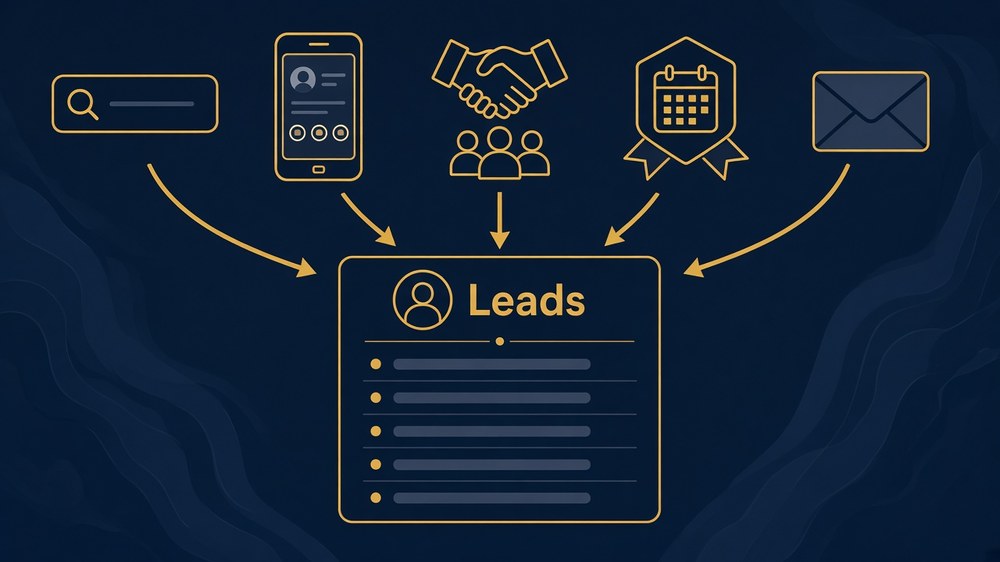
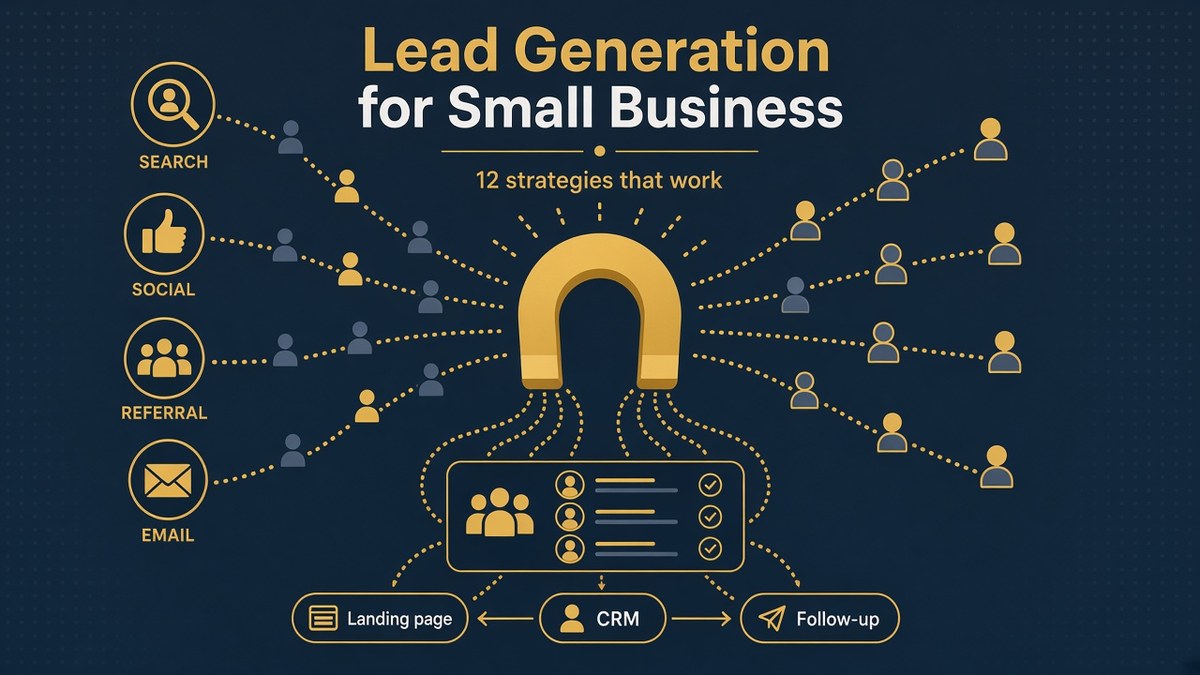
Common lead generation channels for small business: search, social, referrals, events and email, all feeding one lead list.
- 1. Offer a lead magnet: a free checklist, template or mini-course in exchange for an email address. My guide on how to create a lead magnet walks through picking one.
- 2. Build a focused landing page: one offer, one form, one call to action. See how to create a landing page.
- 3. Rank for buyer-intent searches: target keywords like “[service] near me” or “[problem] help”. Start with keyword research for small business.
- 4. Win local searches: a complete Google Business Profile and steady reviews bring calls without ad spend. Read my local SEO guide.
- 5. Add a clear call to action to every page: “Book a free 15-minute call” or “Get a quote in 24 hours”.
- 6. Run a free webinar or workshop: people who give you an hour of attention are warm leads.
- 7. Ask for referrals: happy customers are your cheapest source of leads. Ask at the moment of success, not months later.
- 8. Partner with complementary businesses: an accountant and a bookkeeper, or a web designer and a copywriter, can share leads.
- 9. Use LinkedIn thoughtfully: post useful insights and send personalised connection requests, not copy-pasted pitches.
- 10. Try targeted cold email (B2B): small, well-researched lists with a genuinely relevant offer.
- 11. Retarget website visitors: small ad budgets aimed at people who already visited your pricing page.
- 12. Use a quiz or calculator: “What is your marketing score?” style tools convert well because people want their result.
💡 Start with two channels
Do not try all 12 at once. Pick one fast channel (referrals or outreach) and one compounding channel (SEO or a lead magnet), and give each 90 days.
How to build a simple lead generation system
Leads are only valuable if you capture them reliably and follow up quickly. This five-part system works for almost any small business:
Pick one traffic source
Choose where your ideal customers already spend time: Google search, Instagram, LinkedIn, local directories or a partner’s audience.
Send traffic to a landing page
A dedicated page with one offer converts far better than your homepage.
Offer something valuable
A lead magnet, free consultation, quote or trial gives people a reason to share their details.
Automate the follow-up
Send an instant confirmation and a short email sequence that builds trust. My guide to writing a welcome email sequence shows what to include.
Move warm leads to a conversation
Invite engaged leads to book a call or buy, and track every lead in a simple CRM so nobody slips through.
This is essentially a sales funnel. If you want the full picture, read how to build a sales funnel.
📌 Speed wins
When someone requests a quote or books a call, reply the same day, ideally within an hour. An automatic confirmation email buys you time but does not replace a personal reply.
Lead generation tools for small business
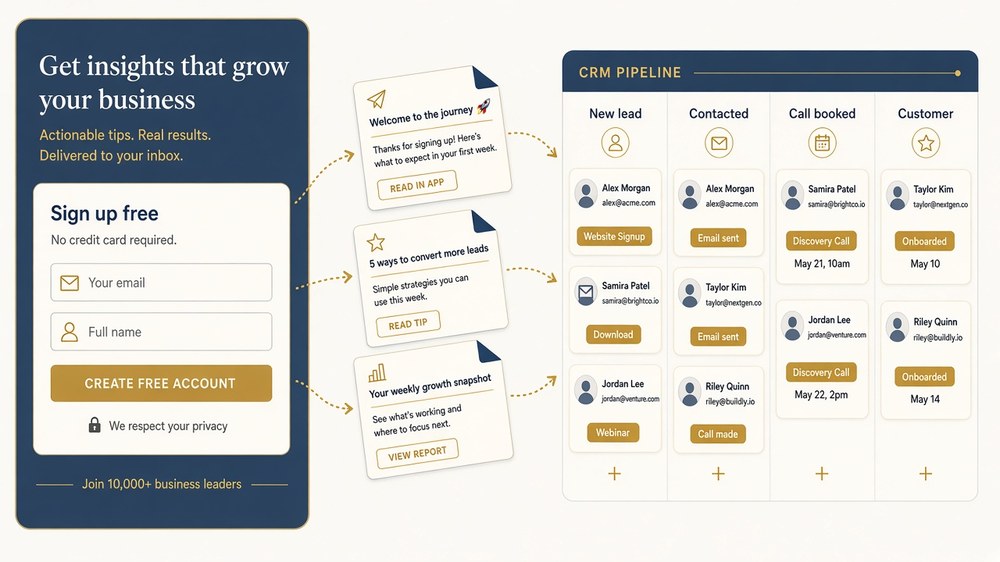
An automated lead capture system: landing page form, instant follow-up emails and a CRM pipeline from new lead to customer.
You do not need an expensive tech stack. Most small businesses need three things: a page to capture leads, email automation for follow-up, and a place to track them.
For solo founders, coaches and creators, Systeme.io covers landing pages, email automation, checkout and courses in one account. When I checked its pricing in late October 2026, the free plan allowed up to 2,000 contacts and 3 funnels, with paid plans from $17 a month.
For agencies and service businesses that need a CRM, appointment booking, SMS and pipelines, GoHighLevel is a stronger fit. It costs more, so it makes most sense once you are handling many leads or managing clients. Compare them in my Systeme.io vs GoHighLevel breakdown.
| Tool | What it does | Best for |
|---|---|---|
| Systeme.io | Landing pages, email automation, checkout, courses | Solo founders, coaches, creators |
| GoHighLevel | CRM, pipelines, booking, SMS, email, funnels | Agencies and service businesses |
| Google Business Profile | Local search visibility, calls and reviews | Local service businesses |
| B2B networking and outreach | Consultants and B2B services | |
| A spreadsheet | Simple lead tracking to start | Very early-stage businesses |
Need a CRM specifically? See my roundup of the best CRM for small agencies.
⚠️ Check current prices
Prices are in USD and change often. UK and EU buyers may also pay VAT, so confirm on each tool’s official pricing page.
How to measure your leads
| Metric | How to calculate | Why it matters |
|---|---|---|
| Cost per lead | Spend divided by number of leads | Shows which channels are affordable |
| Landing page conversion rate | Leads divided by visitors | Shows whether your offer and page work |
| Lead-to-customer rate | Customers divided by leads | Shows lead quality |
| Customer acquisition cost | Total sales and marketing cost divided by new customers | Tells you if growth is profitable |
| Time to first response | Average time before you reply | Faster replies usually close more deals |
Review these monthly. A channel with fewer but better leads often beats one that fills your list with people who never buy. For more numbers worth tracking, see my guide to small business KPIs.
GDPR, CAN-SPAM and PECR basics
If you collect leads from the UK or EU, GDPR applies even if you are based elsewhere. In the UK, PECR also covers marketing emails and texts. In the US, CAN-SPAM sets rules for commercial email.
- Ask for clear, opt-in consent with no pre-ticked boxes, and say what people will receive.
- Link to your privacy policy next to every form.
- Keep a record of when and how each person opted in.
- For B2B cold email in the UK and EU, contact business addresses only, keep messages relevant, and always offer an easy opt-out.
- Include a working unsubscribe link and your business postal address in marketing emails.
- Use tools that offer a data processing agreement (DPA).
Common lead generation mistakes
- Chasing volume over quality: 50 leads who fit your ideal customer beat 500 who do not.
- No follow-up plan: most leads are not ready to buy on day one. Nurture them.
- Asking for too much information: long forms reduce sign-ups. Start with name and email.
- Ignoring existing customers: referrals and repeat buyers are often your best source of new business.
- Buying email lists: it damages deliverability and, in the UK and EU, usually breaks the rules.
- Not tracking the source: if you do not know where leads came from, you cannot double down on what works.
Frequently Asked Questions
What is the best lead generation strategy for a small business?
For most small businesses, a lead magnet with a focused landing page plus referrals gives the best mix of low cost and steady results. Local businesses should add local SEO and a complete Google Business Profile.
How can I generate leads for free?
Use SEO and helpful content, a Google Business Profile, referrals from happy customers, partnerships with complementary businesses and consistent posting on one social platform. A free plan on a funnel builder covers your landing page and email follow-up.
How many leads does a small business need?
Work backwards from your sales goal. If you need 10 new customers a month and 1 in 10 leads buys, you need about 100 qualified leads a month.
What is the difference between a lead and a prospect?
A lead has shown interest, such as signing up for a guide. A prospect is a lead you have qualified as a good fit with a real need and budget.
Is cold email legal in the UK and EU?
B2B cold email to business addresses can be lawful if it is relevant, identifies you and offers an easy opt-out. Rules for individuals and sole traders are stricter, so check ICO guidance for the UK and your local regulator in the EU.
Which tool is best for lead generation?
Solo founders and creators often start with Systeme.io for pages and email. Agencies and service businesses that need a CRM, booking and SMS usually prefer GoHighLevel.
Final thoughts
Lead generation for small business does not need a big budget. Choose two channels, send visitors to a focused landing page, give them a valuable reason to sign up, follow up automatically and track where your best customers come from. Do that consistently for 90 days and you will have a predictable pipeline instead of a quiet inbox.
Your next step: write down your ideal customer, choose your two channels and build your first lead capture page this week.
Capture and follow up with leads for free
Systeme.io gives you landing pages, email automation and checkout in one place, with a free plan to get started.
Affiliate link. I may earn a commission at no extra cost to you.
Affiliate disclosure: some links in this post are affiliate links, so I may earn a commission at no extra cost to you. I only recommend tools I’d use myself.