Learning how to calculate customer acquisition cost (CAC) tells you exactly how much you spend to win each new customer, and whether your marketing is actually profitable. Many small businesses track revenue and ad clicks but never put the two together. In this guide you will learn what customer acquisition cost is, the CAC formula, which costs to include, a 6-step calculation process, worked examples, how CAC compares with customer lifetime value, what a good CAC looks like and practical ways to lower it, plus a simple template you can copy.
✔ Key takeaways
⏱ About 9 min read · the short version is right here
- Customer acquisition cost is the total sales and marketing spend in a period divided by the number of new customers won in that period.
- Include ad spend, marketing tools, content and agency costs, and the share of salaries spent on sales and marketing, not just ads.
- Calculate CAC per channel as well as overall, so you can see which channels bring customers cheaply.
- Compare CAC with customer lifetime value (LTV); many businesses aim for LTV of at least three times CAC.
- Lower CAC by improving conversion rates, investing in referrals and SEO, and retaining customers so each one is worth more.
📋 In this guide
What is customer acquisition cost?
Customer acquisition cost (CAC) is the average amount a business spends on sales and marketing to win one new paying customer. It is one of the most important metrics for any growing business, because it connects what you spend with what that spending achieves.
If you know your CAC, you can answer practical questions: Can we afford to scale this ad campaign? Is our new sales hire paying off? Should we put more into SEO or into paid social? Without it, marketing decisions are guesses. CAC belongs on the short list of small business KPIs every owner should review monthly.
📌 CAC is about new customers only
Customer acquisition cost measures what it takes to win first-time customers. Repeat purchases from existing customers are a retention question, measured with metrics such as churn and lifetime value.
The CAC formula
The basic customer acquisition cost formula is simple:
Both numbers must cover the same period, such as a month or a quarter. For example, if a business spends $6,000 on sales and marketing in a quarter and wins 60 new customers, its CAC is $100. This is an illustration; use your own figures.
Many businesses calculate two versions. Blended CAC divides total costs by all new customers, including those who found you organically. Paid CAC divides only paid advertising costs by customers who came from paid channels. Blended CAC shows overall efficiency; paid CAC shows whether ads alone are worth it.
What to include in CAC
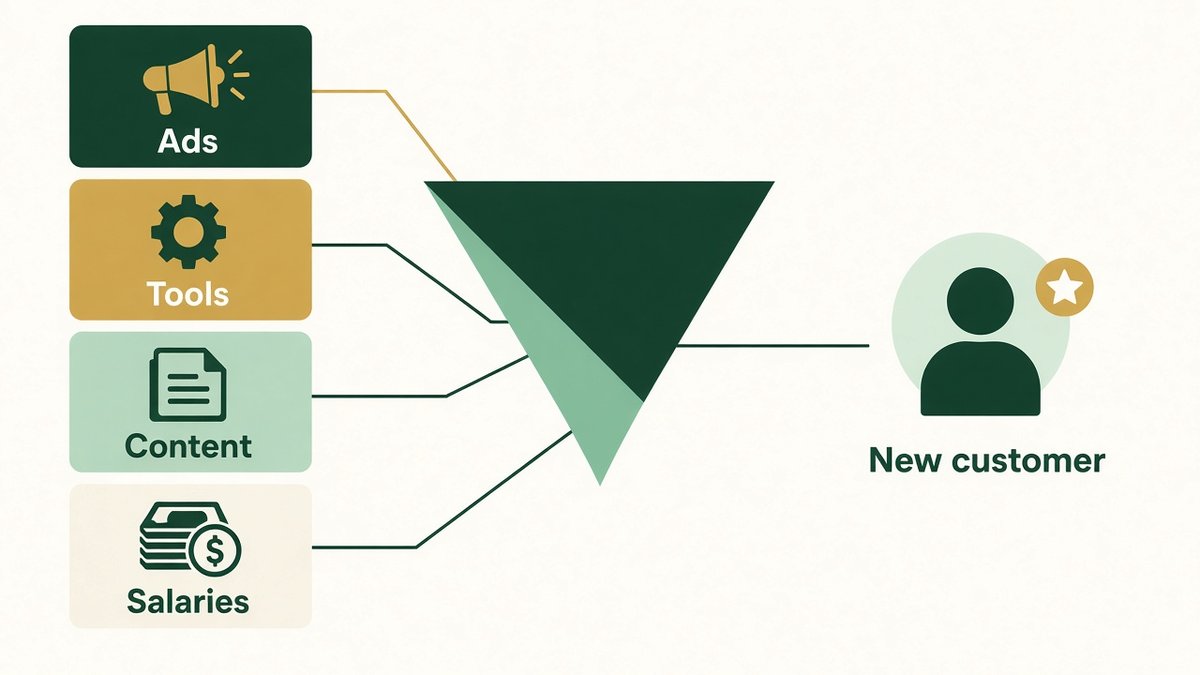
What goes into customer acquisition cost: advertising, marketing tools, content and agency fees, and the share of sales and marketing salaries.
| Cost type | Include in CAC? | Notes |
|---|---|---|
| Paid advertising (Google, Meta, LinkedIn) | Yes | The most obvious cost; include all campaigns aimed at new customers |
| Marketing and sales software | Yes | Email, CRM, landing page and SEO tools, or the share used for acquisition |
| Content, design and agency fees | Yes | Freelance writers, designers, agencies, video production |
| Sales and marketing salaries | Yes | The share of time spent winning new customers, including your own time if you can value it |
| Sales commissions and referral rewards | Yes | Only those paid for new customers |
| Events, trade shows, sponsorships | Yes | If their goal is new business |
| Customer support and onboarding | Usually no | These are service or retention costs |
| Product development | No | Not a sales and marketing cost |
💡 Be consistent above all
There is no single legal definition of CAC. What matters is that you include the same cost types every period, so changes in CAC reflect real changes, not changes in how you count.
How to calculate customer acquisition cost in 6 steps
Choose the period
Pick a month or quarter. Use a quarter if you have few customers or a long sales cycle, so one slow week does not distort the result.
Add up all acquisition costs
Pull ad spend, tool subscriptions, agency invoices and the relevant share of salaries from your accounts for that period. In the UK and EU, use costs excluding reclaimable VAT if you are VAT-registered.
Count new paying customers
Count only customers who made their first purchase in the period. Leads, trial sign-ups and repeat buyers do not count.
Divide costs by customers
Total acquisition costs divided by new customers gives your blended CAC.
Split by channel
Repeat the calculation for each channel using UTM-tagged links and your CRM. My guide on how to track marketing campaigns shows how to attribute customers to channels.
Track the trend
Record CAC every period in a simple spreadsheet and look at the direction over several months rather than a single figure.
⚠️ Watch the time lag
If your sales cycle is long, money spent this month may only produce customers next month or next quarter. In that case, compare costs with customers from a later period, or use a rolling three-month average.
CAC examples for small businesses
Here is how customer acquisition cost works out for three different small businesses. All figures are illustrations to show the method, not benchmarks.
| Business | Costs in the quarter | New customers | CAC |
|---|---|---|---|
| Online shop selling homeware | $4,500 ads + $900 tools and content = $5,400 | 180 | $30 |
| B2B consultancy | $3,000 LinkedIn ads + $9,000 share of founder and sales time = $12,000 | 8 | $1,500 |
| Local fitness studio | €1,200 social ads + €600 flyers and events + €1,200 staff time = €3,000 | 40 | €75 |
A $1,500 CAC sounds alarming next to a $30 one, but the consultancy might earn tens of thousands from each client, while the shop might earn only a little more than $30 from many first orders. CAC only makes sense next to how much each customer is worth.
CAC vs LTV and payback period
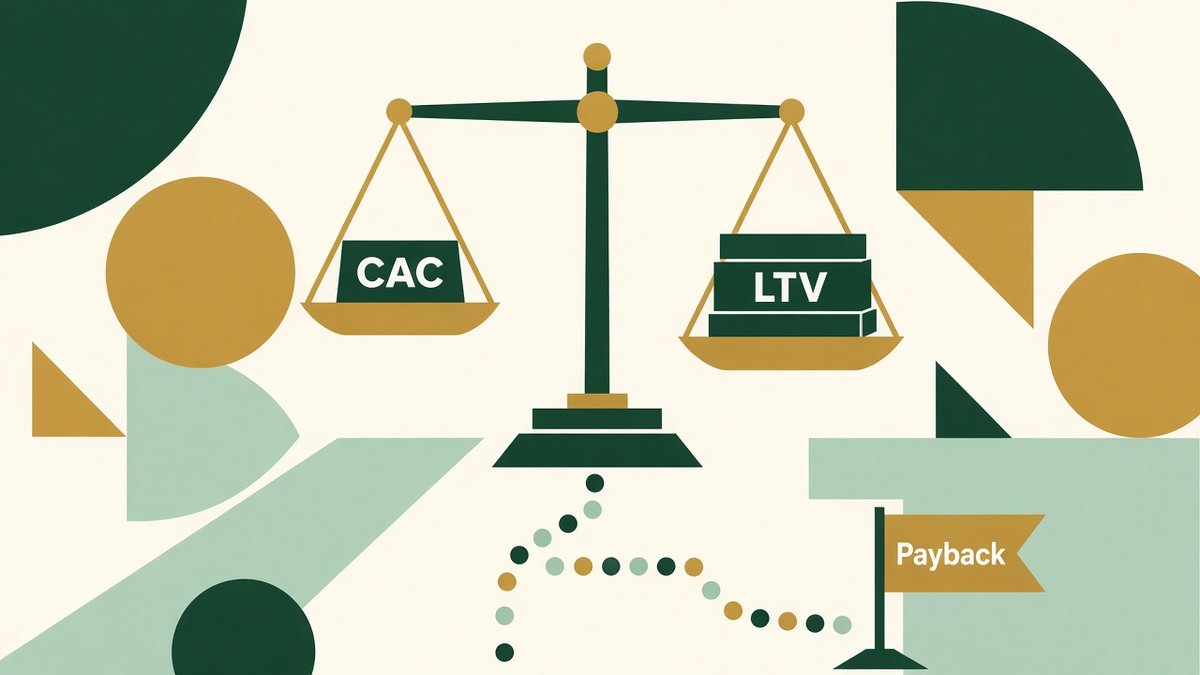
Customer acquisition cost compared with customer lifetime value on a balance, with the CAC payback period shown as a path to break-even.
Customer lifetime value (LTV or CLV) is the total gross profit you expect to earn from a customer over the whole relationship. My guide to customer lifetime value shows how to calculate it. Comparing the two gives you the LTV to CAC ratio:
A widely used rule of thumb, especially among subscription businesses, is to aim for LTV of at least three times CAC. Below about 1:1 you lose money on every customer; far above 3:1 you may be underinvesting in growth.
The second key measure is the CAC payback period: how many months of gross profit from a customer it takes to earn back their acquisition cost. Divide CAC by the monthly gross profit per customer. A shorter payback period protects cash flow, which matters a lot for small businesses; see my tips on how to improve cash flow.
What is a good customer acquisition cost?
There is no universal good customer acquisition cost. It depends on your prices, margins, sales cycle and industry. A good CAC is one that you can recover quickly and that leaves healthy profit over the customer’s lifetime. Use these questions instead of chasing an industry average:
- Is LTV at least around three times CAC?
- Is the payback period short enough for your cash reserves, often within 12 months for subscriptions and on the first or second order for ecommerce?
- Is CAC stable or falling as you grow, rather than rising quickly?
- Can you explain which channel is driving the cost?
If your CAC is too high for your prices, the fix may be on the revenue side. Raising prices or adding upsells improves the ratio as much as cutting costs; my guides on how to raise prices and how to upsell cover both.
How to reduce customer acquisition cost
Convert
Improve conversion rates
Better landing pages, clearer offers and faster follow-up turn more of the same traffic into customers, which lowers CAC directly.
Refer
Build referrals
Happy customers bring new ones at low cost. A simple referral programme often has one of the lowest CACs of any channel.
Compound
Invest in organic channels
SEO, email and content take longer to start but keep bringing customers without paying per click.
- Cut weak channels: move budget from channels with the highest CAC to those with the lowest, then re-test.
- Target better: a clear buyer persona reduces wasted ad spend on people who will never buy.
- Nurture leads: an email sequence converts leads who are not ready to buy today, so you pay for fewer new ones.
- Retain customers: retention does not lower CAC itself, but it raises lifetime value so the same CAC becomes far more profitable. See my customer retention strategies.
CAC calculation template
Copy this customer acquisition cost template into a spreadsheet and fill it in every month or quarter. Keep one row per period and one column per channel.
CAC calculation template (one month or quarter)
Period: [start date] to [end date]
Advertising spend: [$ / €]
Marketing tools and software: [$ / €]
Content, design and agency costs: [$ / €]
Sales and marketing salaries or freelancer fees (share of time): [$ / €]
Other acquisition costs (events, sales commissions, referral rewards): [$ / €]
Total acquisition cost: [sum of the lines above]
New paying customers in the period: [number]
CAC = Total acquisition cost ÷ New customers: [result]
By channel: [repeat for ads, SEO, referrals, outbound]
Once you have three or more periods of data, you will see which channels deserve more budget and whether your growth is becoming more or less efficient. Combine it with your break-even point to see how many customers you need to cover fixed costs.
Frequently Asked Questions
What is the formula for customer acquisition cost?
CAC equals your total sales and marketing costs for a period divided by the number of new customers acquired in that same period.
What costs are included in CAC?
Include advertising, marketing and sales software, content, design and agency fees, sales commissions, referral rewards, events aimed at new business and the share of salaries spent on sales and marketing.
What is a good LTV to CAC ratio?
Many businesses aim for a ratio of about 3:1, meaning a customer’s lifetime value is at least three times what it cost to acquire them. Below 1:1 means you lose money on each new customer.
How often should I calculate CAC?
Monthly is ideal for most small businesses with steady sales. If you win only a few customers a month or have a long sales cycle, calculate it quarterly or use a rolling three-month average.
What is the difference between CAC and CPA?
Cost per acquisition (CPA) usually measures the cost of a single conversion in an ad campaign, such as a lead or sign-up. CAC measures the full cost of winning a paying customer across all sales and marketing.
How can a small business lower its customer acquisition cost?
Improve landing page conversion, focus on your best channels, build referrals and SEO, target a clear buyer persona and nurture leads by email so fewer paid clicks are needed per customer.
Now you know how to calculate customer acquisition cost, what to include and how to judge the result against lifetime value. Start with last quarter’s numbers using the template above, then track CAC by channel every month to make every marketing dollar or euro work harder.