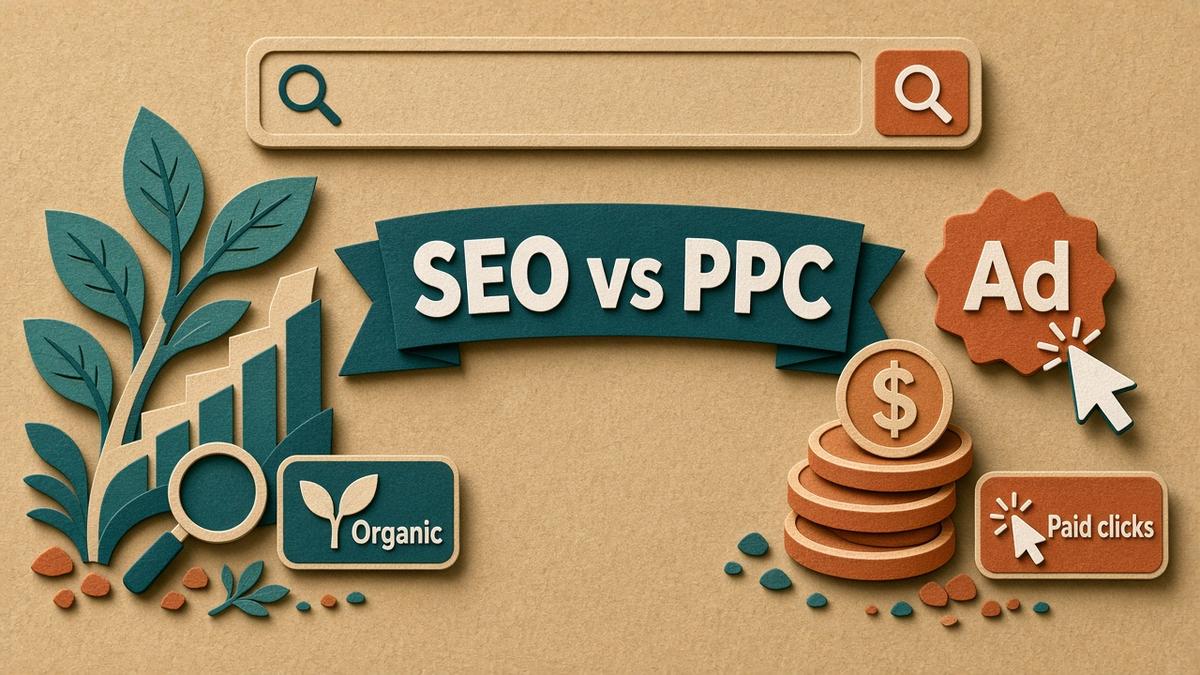
SEO vs PPC is one of the first big marketing decisions a small business faces: do you invest in ranking on Google for free clicks over time, or pay for ads that put you at the top of the page today? Both bring visitors from search, but they work on very different timelines, budgets and risks. In this guide I compare the two side by side, show you the money maths with a simple example, and give you a practical plan for using each one, whether you sell in the US, the UK or across the EU.
🔍 Checked on 10 Nov 2026: Google Ads and Microsoft Advertising have no minimum spend; you set your own daily budget, and Google may spend up to twice your daily budget on a single day but bills no more than about 30.4 days of budget per month. Cost-per-click figures below are illustrative, not quotes.
✔ Key takeaways
⏱ About 11 min read · the short version is right here
- SEO earns free clicks from organic results but usually takes 3 to 6+ months to build; PPC buys clicks from day one and stops the moment you stop paying.
- Choose PPC to test offers, launch fast, run seasonal promotions or win high-intent keywords you cannot rank for yet.
- Choose SEO for compounding traffic, lower long-term cost per lead and trust built through helpful content.
- The strongest setup for most small businesses: PPC for quick data and leads, SEO for the keywords that PPC proves profitable.
- UK and EU advertisers need cookie consent and Google Consent Mode set up properly, or both tracking and remarketing suffer.
📋 In this guide
- SEO vs PPC: the quick answer
- What is SEO?
- What is PPC?
- SEO vs PPC side by side
- The money maths: a simple example
- When SEO is the better choice
- When PPC is the better choice
- How to use SEO and PPC together
- Notes for UK and EU businesses
- Tools to plan both channels
- Common mistakes to avoid
- Frequently Asked Questions
SEO vs PPC: the quick answer
If you need customers in the next 30 days and have a budget to test with, start with PPC. If you can wait a few months and want a channel that keeps working without a meter running, invest in SEO. If you can do both, use PPC to learn which keywords make money and SEO to own those keywords for the long term. That is the short version; the rest of this guide explains why, so you can make the call for your own business.
💡 One search page, two channels
On a typical Google results page, the sponsored results at the top are PPC ads. The regular blue links below them, plus the map pack for local searches, are organic results that you earn with SEO. Searchers see both, which is why the two channels work so well together.
What is SEO?
Search engine optimisation (SEO) is the work of making your website easier for search engines to understand and more useful for the people searching, so your pages rank higher in the organic results on Google, Bing and other engines. It covers four broad areas:
- Keyword research: finding the phrases your customers actually type, and the intent behind them.
- On-page SEO: clear titles, headings, helpful content, internal links and fast, mobile-friendly pages.
- Technical SEO: making sure pages can be crawled and indexed, with no broken links, duplicate pages or slow load times.
- Authority: earning links and mentions from other trusted sites, plus reviews and a complete Google Business Profile for local search.
The big advantage is that you do not pay per click. A page that ranks well can bring visitors for years. The trade-off is time and effort: new sites and competitive keywords can take many months to move. If you are just starting, my guide to keyword research for small business shows how to pick terms you can realistically win.
What is PPC?
Pay-per-click (PPC) advertising means you pay each time someone clicks your ad. On search engines you bid on keywords in platforms such as Google Ads or Microsoft Advertising (which also serves ads on Bing, Yahoo and DuckDuckGo). Social networks run similar paid campaigns, though they usually charge by impressions or clicks on audience targeting rather than search keywords.
The price of a click is set by an auction. Google weighs your bid together with ad quality, landing page experience and expected click-through rate, so a relevant, well-built ad can win a better position for less money than a sloppy one. You control budget, keywords, locations, languages, devices and schedule, and you can switch everything off in seconds.
⚠️ The catch with PPC
Traffic stops the moment your budget runs out, and popular keywords in law, insurance, finance and software can cost several dollars or euros per click. Without conversion tracking it is easy to spend a lot and learn very little.
SEO vs PPC side by side
Here is how the two channels compare on the factors small business owners usually care about most.
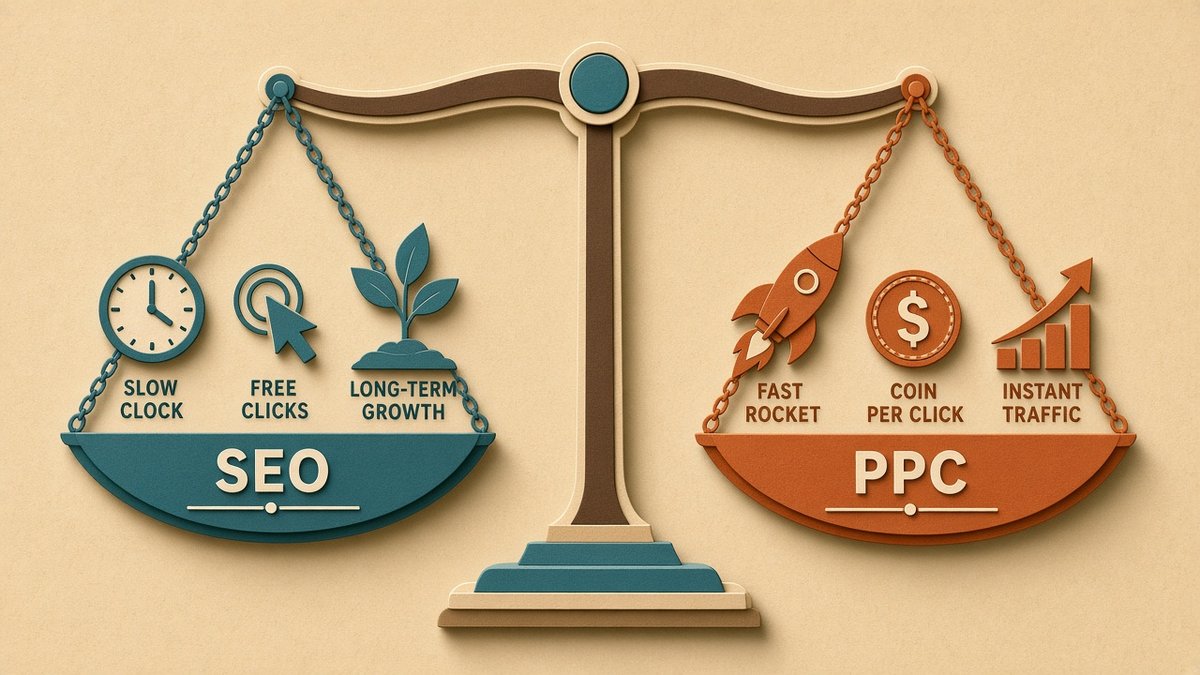
| Factor | SEO | PPC |
|---|---|---|
| Speed to first results | Usually 3 to 6+ months | Hours to days after approval |
| Cost model | Time, content, tools and links; no cost per click | You pay for every click; budget set daily |
| Traffic when you stop investing | Fades slowly, often keeps coming for months | Stops immediately |
| Control over targeting | Limited; Google decides what ranks | High: keywords, location, language, device, schedule |
| Trust and click share | Many searchers prefer organic results | Clear “Sponsored” label; strong for buying-intent terms |
| Testing new offers | Slow feedback | Fast, measurable A/B testing |
| Best fit | Evergreen topics, local services, content-led brands | Launches, promotions, high-intent keywords, new sites |
The money maths: a simple example
Imagine a small bookkeeping firm that sells a $300 (about €280) monthly service. Its main keyword gets clicks at an average of $4 each, and 3 in every 100 visitors become a lead, with 1 in 4 leads becoming a client.
- PPC: 1,000 clicks cost $4,000. That brings about 30 leads and around 7 or 8 clients, so each new client costs roughly $530 to $570. With a $300 monthly fee, the firm earns that back in about two months, then every month after is profit. PPC works here, but only while the budget keeps flowing.
- SEO: suppose the firm spends $3,000 on three strong service pages and a few helpful guides, and after six months those pages bring 500 organic visits a month. At the same conversion rates, that is about 15 leads and 3 to 4 clients every month, with no click cost. The cost per client keeps falling for as long as the pages rank.
The numbers are made up, but the pattern is real: PPC has a predictable, steady cost per customer, while SEO has a high upfront cost that shrinks over time. Plug in your own click costs, conversion rates and customer value before you decide. Your average customer value is the number that matters most, because it tells you how much you can afford to pay for a click.
When SEO is the better choice
- You can wait a few months. SEO rewards patience; it is not a fix for this month’s cash flow.
- Your topic has steady, evergreen demand. Questions people ask every week, such as “how to file VAT” or “best CRM for a small team”, are ideal for content.
- You are a local service business. A complete Google Business Profile, reviews and location pages can win the map pack, often faster than national rankings.
- Clicks in your niche are expensive. When PPC clicks cost $10 or more, ranking organically can save a fortune over a year.
- You want to build trust. Helpful guides position you as the expert before a buyer ever contacts you.
If local customers are your priority, start with my guide to local SEO for small business, which covers the profile, review and citation basics.
When PPC is the better choice
- You are launching something new and need traffic before the site has any authority.
- You run time-limited offers such as Black Friday, seasonal stock or event tickets, where waiting for rankings is pointless.
- You want to test demand quickly. A two-week campaign can tell you which headline, offer or price gets clicks and sign-ups.
- Big brands own the organic results. For some keywords, ads are the only realistic way onto page one in the short term.
- You know your numbers. If you know your customer value and conversion rate, PPC becomes a controllable growth lever rather than a gamble.
How to use SEO and PPC together
The question is rarely SEO or PPC forever. For most small businesses the best answer is a sequence where each channel feeds the other. Here is a simple five-step plan.
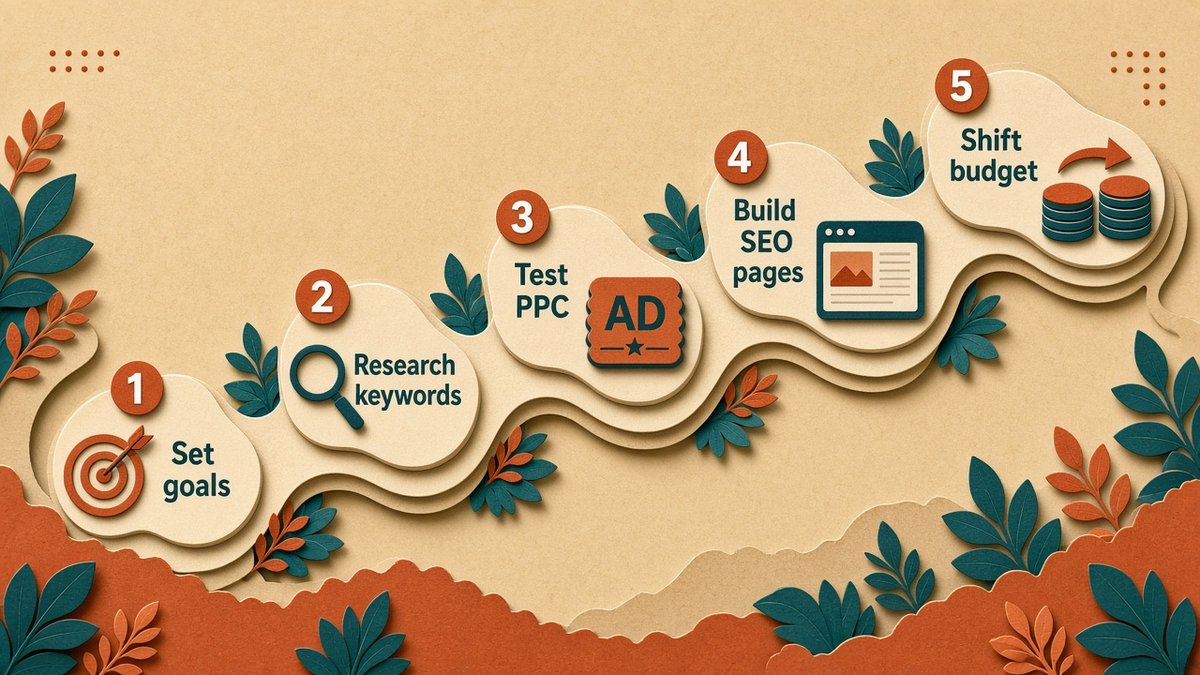
Define the goal and the numbers
Write down what a lead or sale is worth, your target cost per lead and your monthly budget. Without these, neither channel can be judged fairly.
Research keywords once, use them twice
Build one keyword list with search volume, difficulty and intent. A tool such as SE Ranking shows organic difficulty and estimated paid competition for the same terms, so you can see where ads make sense and where content can win.
Run a small PPC test
Pick 5 to 15 high-intent keywords, use exact or phrase match, write two ad variations and send traffic to a focused landing page. Track conversions from day one.
Turn winning keywords into SEO pages
After two to four weeks, check the search terms report. Keywords that convert well become service pages, comparison guides or FAQs on your site, built to rank organically.
Shift budget as rankings grow
Once a page ranks in the top three for a keyword, test lowering bids on that term and move budget to new tests. Keep brand ads running if competitors bid on your name.
This approach also keeps your wider plan coherent. If you have not written one yet, my guide to what a marketing strategy is walks through goals, audiences and channels.
Notes for UK and EU businesses
The SEO vs PPC trade-offs are the same everywhere, but European rules change how you measure them.
- Consent comes first. Under GDPR and the ePrivacy rules (and UK GDPR and PECR in Britain), analytics and advertising cookies generally need consent. Use a consent banner that supports Google Consent Mode, which Google requires for measurement and remarketing features for users in the European Economic Area.
- Expect gaps in data. Visitors who decline cookies will not show up fully in your reports, so compare platform figures with real leads and sales in your CRM.
- Target by language as well as country. A campaign for Belgium or Switzerland may need French, Dutch or German ads; for SEO, use separate pages per language with hreflang tags rather than machine-translated duplicates.
- Show prices in local currency. Euro or pound prices on landing pages usually convert better than dollars and reduce confusion.
- Ad transparency is public. Under the EU Digital Services Act, large platforms keep public libraries of ads, which also makes it easy to research what competitors are running.
Tools to plan both channels
You can start with free tools: Google Search Console shows which searches already bring you organic clicks, and Google Ads Keyword Planner gives rough volumes and bid ranges once you have an account. As you grow, an all-in-one platform saves time. I use SE Ranking for keyword research, rank tracking, site audits and checking which keywords competitors appear for in both organic and paid results, all in one dashboard. You can read my full take in the SE Ranking review. If budget is the deciding factor, here is what SE Ranking costs per month on each plan.
Plan your SEO and PPC keywords in one place
Find keywords you can rank for, track your positions and see which terms competitors pay for, then decide where content beats ads.
For more hands-on software comparisons, browse my Reviews hub. If you prefer a book, Marcus Sheridan’s They Ask, You Answer is a practical guide to the content-led approach that makes SEO work for small businesses (Amazon US / Amazon UK).
Common mistakes to avoid
- Running ads without conversion tracking. Clicks are not customers. Set up conversions before you spend.
- Using broad match on a small budget. Broad match can spend your money on loosely related searches. Start tight and expand.
- Sending ad traffic to your home page. Use a landing page that matches the ad’s promise.
- Expecting SEO results in four weeks. Judge SEO on a quarterly view, tracking rankings and organic leads, not daily traffic.
- Chasing traffic instead of intent. A keyword with 100 buyers a month is worth more than one with 10,000 browsers.
- Treating the two teams as rivals. Share keyword data between SEO and PPC; it is the cheapest win available.
Frequently Asked Questions
Is SEO better than PPC?
Neither is better in every case. SEO is usually better for long-term, lower-cost traffic once you rank, while PPC is better when you need leads this week, want to test an offer or compete for keywords you cannot rank for yet. Most small businesses get the best results by running both with clear roles.
How long does SEO take compared to PPC?
PPC ads can show within hours of your campaign being approved. SEO usually takes three to six months before new pages earn steady traffic, and competitive keywords can take a year or more. Local SEO for a business with a well-set-up Google Business Profile can move faster.
How much should a small business spend on PPC?
Start with a test budget you can afford to lose while you learn, for example $10 to $30 or €10 to €30 a day on a handful of tightly matched keywords. Run it for at least two to four weeks, track cost per lead and only scale the campaigns that pay back.
Does PPC help SEO?
Paid ads do not directly improve organic rankings. They help indirectly: PPC search term reports show which keywords actually convert, so you can write SEO content around proven terms, and brand exposure from ads can lead to more branded searches later.
Is SEO free?
SEO has no cost per click, but it is not free. You pay with time or money for content, technical fixes, tools and links. Free tools such as Google Search Console and Keyword Planner cover the basics; a paid SEO platform saves time once you track many keywords or competitors.
Final thoughts
In the SEO vs PPC debate, the right answer depends on your timeline, budget and how well you know your numbers. Use PPC when you need fast, measurable traffic or want to test an idea. Build SEO for the keywords that matter most, so you own that traffic instead of renting it. Start small with both, track real leads rather than clicks, and move money towards whatever brings customers at the lowest cost.
Affiliate disclosure: the SE Ranking and Amazon links above are affiliate links, so I may earn a commission at no extra cost to you. I only recommend tools I use myself.