Knowing how to write a press release is a cheap, practical way for a small business to earn news coverage, backlinks and credibility without paying for ads. A press release is a short, factual announcement written the way a journalist would write a news story, so a reporter can quickly decide whether your news is worth covering. In this guide you will learn what a press release is, when it is worth sending one, the standard press release format, a 7-step writing process, examples for common announcements, how to pitch journalists in the US, UK and EU, and a free press release template you can copy today.
✔ Key takeaways
⏱ About 10 min read · the short version is right here
- A press release is a one-page news announcement written in the third person, with the most important facts in the first paragraph.
- Only send one when you have real news: a launch, a milestone, a partnership, an event, original research or a key hire.
- Follow the standard format: headline, subheadline, dateline, lead, body, quote, call to action, boilerplate, media contact and ###.
- Keep it around 400 to 600 words, cut the marketing hype and include one strong, human quote.
- Pitch a short, personal email to a handful of relevant journalists rather than blasting a generic list.
📋 In this guide
What is a press release?
A press release (also called a news release or media release) is an official written statement that a business sends to journalists, bloggers and editors to announce something newsworthy. It is written like a news article: factual, in the third person, with the key facts first and supporting detail after.
Journalists receive dozens or hundreds of pitches a week. A well-written release saves them time because it answers the basic questions immediately and gives them quotes and contact details they can use. Even when a reporter does not run your story word for word, a clear release often becomes the starting point for an article, a mention in a roundup or an interview request.
For a small business, the benefits go beyond media coverage. A release published on your own website gives you a page to share with partners and customers, a link to send investors, and a factual record of company milestones. It also fits neatly into a wider marketing strategy alongside content, email and social media.
📌 Press release vs blog post
A blog post can be opinionated, chatty and long. A press release is neutral, factual and short. If a sentence sounds like an advert, it belongs in your marketing copy, not your release.
When a small business should send one
The biggest mistake small businesses make is sending a press release when there is no news. Ask yourself: would someone outside my company care about this? If the honest answer is no, publish a blog post or a social update instead. Good reasons to write a press release include:
| News type | Example | Who might cover it |
|---|---|---|
| Product or service launch | A bakery launches a gluten-free subscription box | Local press, food and lifestyle writers |
| Company milestone | A consultancy opens its first office in Dublin | Local business news, trade press |
| Partnership | A software startup integrates with a major accounting tool | Trade and tech press |
| Event | A free workshop for local founders | Local listings, community news |
| Original research or survey | A study of how freelancers set their rates | National and trade press, bloggers |
| Award or recognition | Winning a regional small business award | Local and trade press |
| Key hire | A new managing director with notable experience | Trade press, LinkedIn news |
Original data is often the strongest angle for a small company, because journalists love fresh numbers they cannot get elsewhere. If you have run a customer survey or collected useful anonymised data, that may be worth more than a product launch. Customer stories work well too; my guide on how to write a case study shows how to turn one into a compelling narrative.
Press release format: the 9 parts
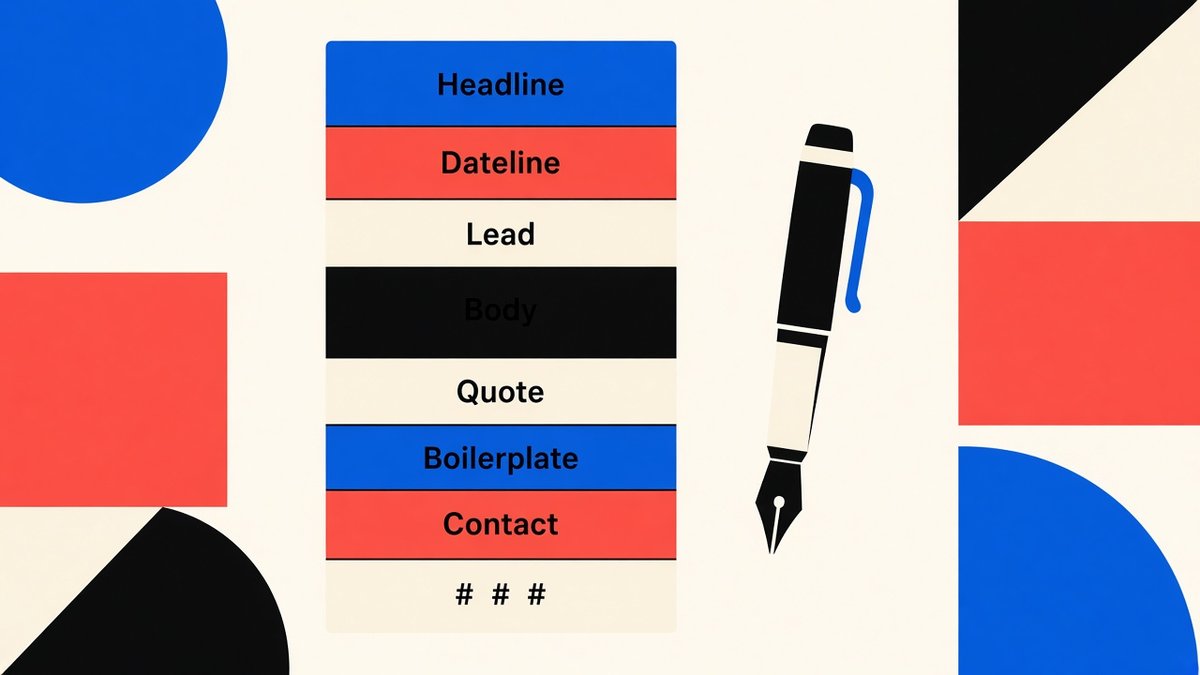
The standard press release format, from the headline and dateline at the top to the boilerplate, media contact and ### at the bottom.
Journalists expect a familiar layout, so using the standard press release format makes your news easier to read and reuse. These are the nine parts, in order:
- Release line: “FOR IMMEDIATE RELEASE”, or “EMBARGOED UNTIL” with a date, time and time zone if the news must not be published before then.
- Headline: a clear, specific summary of the news in under about 12 words.
- Subheadline: one sentence that adds the most interesting supporting fact.
- Dateline: the city, country and date the news is released, for example “LONDON, UK – 17 November 2026 –”.
- Lead paragraph: who, what, when, where and why in two or three sentences.
- Body: two or three short paragraphs with details, context, prices or availability.
- Quote: one or two quotes from a founder, customer or partner that add opinion or emotion.
- Boilerplate: a short “About the company” paragraph you reuse on every release.
- Media contact and ###: a named contact with email and phone, then three hash marks to show the release has ended.
💡 Write the headline last
Draft the body first, then write a headline that matches the strongest fact in your lead paragraph. Headlines written first tend to be vague and full of buzzwords.
How to write a press release in 7 steps
Find the news angle
Write one sentence that explains why your announcement matters to people outside your company. If you cannot, rethink the angle or wait until you have stronger news. Your value proposition can help you phrase the benefit.
Answer the 5 Ws in the lead
Your first paragraph should say who did what, when, where and why. A reporter who reads only this paragraph should understand the story.
Write a specific headline and subheadline
Use plain words, numbers where they are real, and active verbs. “Leeds bakery launches gluten-free subscription box for local cafes” beats “Exciting new chapter for our brand”.
Add detail in order of importance
Use the inverted pyramid: the most important facts first, background last. Keep paragraphs to two to four sentences.
Include one strong quote
A good quote sounds like a real person and adds a view or a feeling, not a list of features. Avoid lines such as “We are thrilled to announce”.
Finish with a call to action, boilerplate and contact
Tell readers where to learn more or how to book an interview, add your standard company paragraph and a real media contact.
Edit hard, then proofread
Cut adjectives, jargon and hype. Aim for 400 to 600 words, check every name, date and figure, and ask someone outside the business to read it.
⚠️ Do not invent figures or quotes
Every number, claim and quote in a press release must be accurate and approved by the person quoted. A false claim can damage your reputation with journalists for years, and in the UK and EU misleading business claims can breach consumer protection rules.
Press release examples by type
Here is how the same structure adapts to different kinds of news. These are short illustrative examples, not real companies.
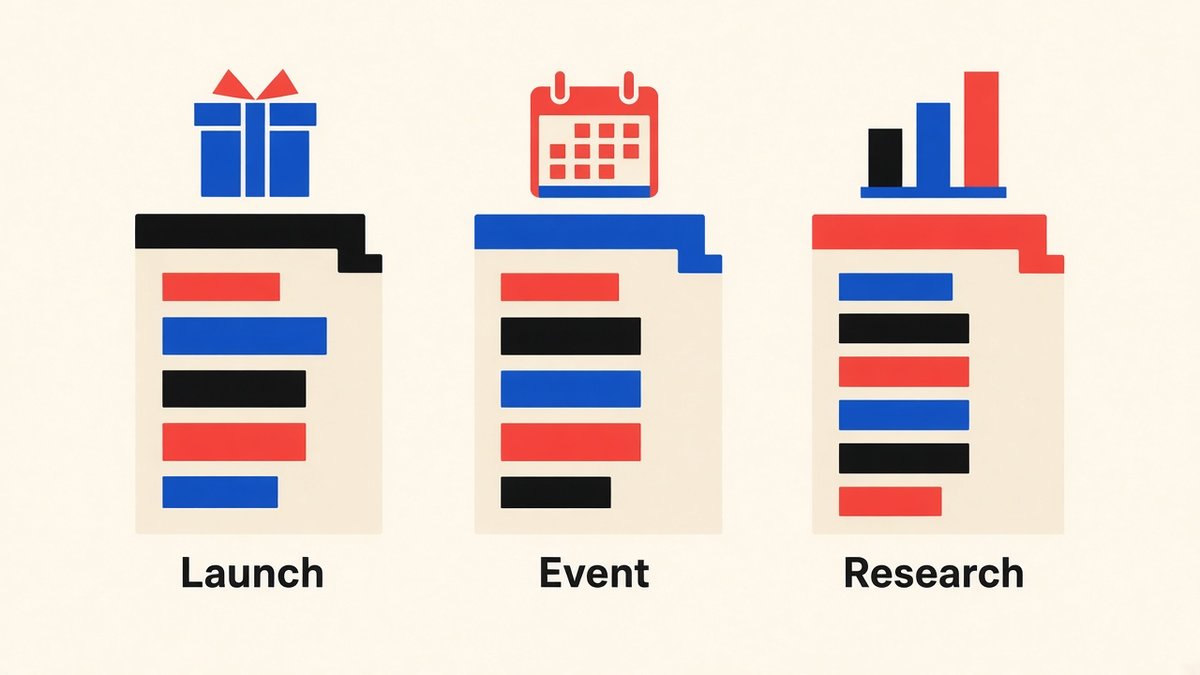
Press release examples: a product launch, an event announcement and an original research release follow the same core structure.
| Type | Example headline | What the lead must cover |
|---|---|---|
| Product launch | Brighton studio launches online yoga course for desk workers | What it is, who it is for, price and launch date |
| Event | Manchester founders invited to free funding workshop on 4 December | Date, venue, who can attend, how to register |
| Research | Survey of 300 UK freelancers finds most raise rates less than once a year | The headline finding, sample size, method, date |
| Partnership | Berlin accounting app partners with regional bank for startup accounts | Both partners, what changes for customers, when |
| Milestone | Family-run Irish tea brand reaches stockists in 10 countries | The milestone, how it happened, what comes next |
Notice that every example headline names who, what and where. That is what makes it scannable in a crowded inbox. For research releases, always state the sample size, dates and method so journalists can judge the data, and keep your raw results ready to share.
How to send it to journalists
Writing the release is only half the work. How you send it decides whether anyone reads it.
Option 1
Personal pitch emails
Find five to twenty journalists who have covered similar stories recently. Send each a short, personal email with the headline, two lines of context and the release pasted below or linked.
Option 2
Newswire services
Paid wire services push your release to many outlets and news databases. They can help with reach and visibility, but rarely replace personal pitches.
Option 3
Your own newsroom
Publish every release on a press page on your website, share it on LinkedIn and email it to customers and partners.
A few practical rules: put the news in the subject line, paste the text in the email body instead of only attaching a file, add a link to a press kit with photos and logos, and follow up once after a few days, not more. If you have a mailing list, my guide on how to start a newsletter shows how to turn announcements into regular updates for subscribers.
📌 GDPR when pitching in the UK and EU
Journalists’ work emails are personal data under the UK GDPR and EU GDPR. Pitching a relevant story to a journalist is usually justified as a legitimate interest, but keep your media list small and relevant, say how you got their details if asked, and remove anyone who asks you to stop.
Common press release mistakes
- No real news: announcing a website redesign or a minor update rarely interests anyone outside the company.
- A buried lead: starting with company history instead of the announcement.
- Marketing hype: words like “revolutionary”, “world-class” and “game-changing” make journalists stop reading.
- Too long: anything over one or two pages; journalists can always ask for more.
- Weak quotes: quotes that repeat the facts instead of adding opinion or context.
- No contact details: a reporter with a question and no one to call will move on.
- Bad timing: sending late on a Friday or during a big news event, or ignoring time zones when pitching across the US, UK and Europe.
Treat your first releases as experiments. Track which pitches get replies or coverage, just as you would track your marketing campaigns, and keep refining your angle and list.
Copy-and-paste press release template
Copy this press release template into a document and replace every bracket. Delete any line that does not apply to your news.
Press release template
FOR IMMEDIATE RELEASE [or: EMBARGOED UNTIL date, time, time zone]
Headline: [Company] [does something new] [for whom / why it matters]
Subheadline: [One sentence adding the most interesting supporting fact]
Dateline: [CITY, Country] – [Month Day, Year] –
Lead paragraph: [Who, what, when, where and why in 2 to 3 sentences]
Body paragraph 1: [Details: how it works, who it helps, price or availability]
Quote: “[A real, human sentence on why this matters],” said [Name], [Title] at [Company].
Body paragraph 2: [Supporting facts, customer or partner quote, background]
Call to action: [Where to learn more, buy, register or book an interview]
About [Company]: [3 to 4 sentence boilerplate: what you do, since when, where, for whom]
Media contact: [Name], [email], [phone], [press kit link]
###
💡 Make a reusable press kit
Keep a folder with your logo files, founder headshots, product photos, boilerplate and a short company fact sheet. Link to it in every release so journalists never have to ask.
A press release works best as one part of a consistent story about your business. Combine it with a sharp elevator pitch for interviews and a clear marketing plan so every announcement supports your bigger goals.
Frequently Asked Questions
How long should a press release be?
Most press releases are 400 to 600 words, or about one page. Keep it short enough to read in a minute or two and offer extra detail, photos and data in a linked press kit.
What is the format of a press release?
A standard press release has a release line, headline, subheadline, dateline, lead paragraph, body paragraphs, at least one quote, a call to action, a boilerplate about the company, a media contact and ### at the end.
Can a small business write its own press release?
Yes. You do not need a PR agency. A founder who follows the standard format, has genuine news and pitches relevant journalists personally can earn coverage on a small budget.
Should a press release be written in the first or third person?
Third person. Refer to your company by name and use first person only inside quotes, so the release reads like a news story a journalist could use.
What is the best day to send a press release?
Many PR teams prefer Tuesday to Thursday mornings in the journalist’s own time zone. Avoid Friday afternoons, weekends and days dominated by major news.
Do press releases help SEO?
They can help indirectly. A release itself rarely ranks, and links in paid wire releases are usually nofollow, but genuine news coverage can earn natural links, brand searches and referral traffic.
Now you know how to write a press release that journalists can actually use: pick real news, lead with the facts, add a human quote and pitch it personally. Start with the template above for your next launch or milestone, and build a small, relevant media list over time.