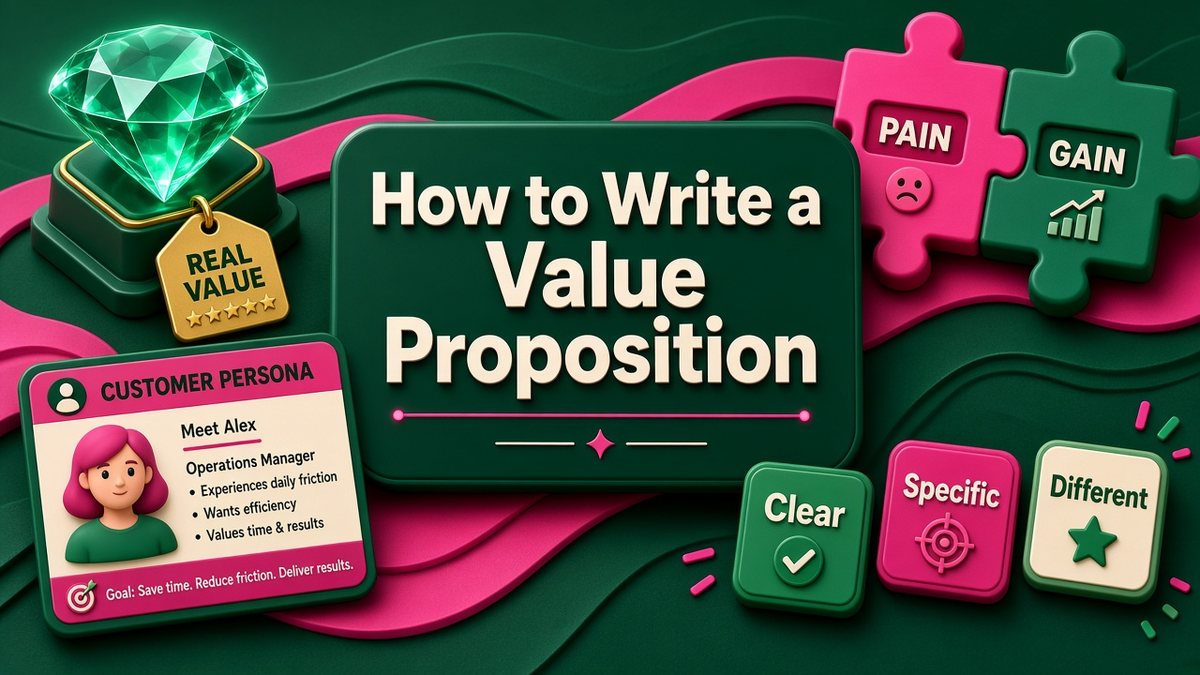
Learning how to write a value proposition is the fastest way to fix a website that gets visitors but no enquiries. Your value proposition is the one clear promise that tells a stranger who you help, what result you deliver and why they should pick you over every other option in their browser tabs. Get it right and your homepage, sales calls and ads all get easier. Get it wrong and even great products look like ‘just another option’.
✔ Key takeaways
⏱ About 10 min read · the short version is right here
- A value proposition is a specific promise of a result for a specific customer, not a slogan or mission statement.
- Strong ones answer three questions in seconds: what do you do, who is it for, and why you instead of the alternatives.
- Write it from customer research (their words, their pains), then compress it into a headline, subheadline and 3 proof points.
- Test it cheaply: a five-second test, a landing page A/B test or a handful of sales calls will tell you more than internal debate.
📋 In this guide
What a value proposition is (and is not)
A value proposition is a short statement of the main benefit a customer gets from you, aimed at a defined customer, with a reason to believe it. It usually lives at the top of your homepage, but it also shapes your sales pitch, ad copy and email signature.
It is not your tagline. “Just do it” is a tagline; it works because Nike already has decades of brand recognition. A small business does not have that luxury, so your words have to do the explaining. It is also not your mission statement, which describes why you exist. A value proposition describes what the customer gets.
| Value proposition | Tagline / slogan | Mission statement | |
|---|---|---|---|
| Purpose | Explain the result and why you | Be memorable | Describe your purpose |
| Audience | A specific buyer | Everyone | Team, investors, public |
| Length | Headline + 1-2 lines + proof | 3-6 words | 1-3 sentences |
| Example | “Bookkeeping for UK cafés, done by Friday, fixed €/£ fee” | “Numbers made simple” | “Helping small firms thrive” |
📌 Value proposition vs USP
A unique selling proposition (USP) is the single differentiator, such as ‘the only gym in town open 24/7’. Your value proposition is bigger: it includes the outcome, the audience and the proof. A good USP usually becomes one of your proof points.
The 5 parts of a strong value proposition
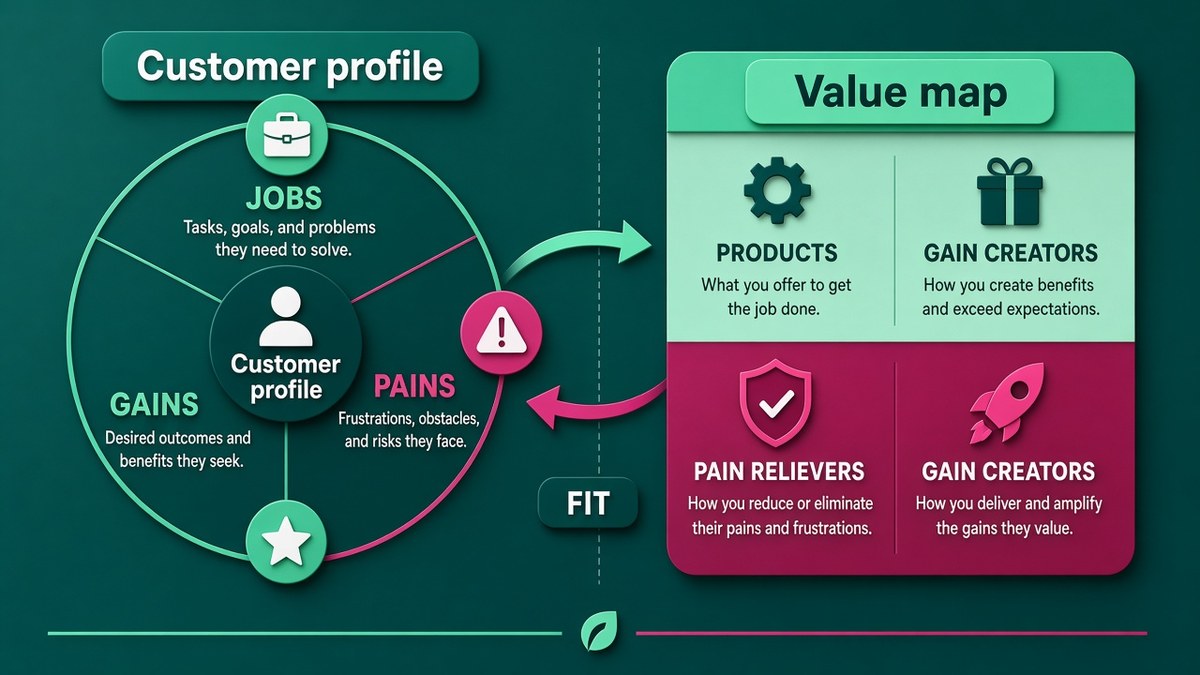
The value proposition canvas: match customer jobs, pains and gains to what your product actually does.
Almost every high-converting value proposition I have seen has the same five building blocks. You do not need all five in the headline, but you need them somewhere above the fold.
- Headline: the end benefit in plain language, ideally in under 10-12 words.
- Subheadline: one or two sentences on what you offer, who it is for and why it is useful.
- Three benefit bullets: the specific outcomes or features that matter most to the buyer.
- Proof: a number you can stand behind, a recognisable client, a review score or a guarantee.
- Visual: a product shot, before/after or a person who looks like your customer.
The framework behind this is the Value Proposition Canvas from Strategyzer. On the right side you map the customer: the jobs they are trying to get done, the pains that annoy them and the gains they hope for. On the left you map your offer: products and services, pain relievers and gain creators. ‘Fit’ happens when your pain relievers and gain creators line up with the pains and gains customers rank as most important. The book Value Proposition Design by Alexander Osterwalder and team walks through the canvas with worksheets (UK readers: Value Proposition Design on Amazon UK).
How to write a value proposition in 7 steps
Here is the process I use with small business clients. Block out an afternoon; the research steps matter more than the writing ones.
Pick one customer segment
Write down the single buyer you most want more of, e.g. ‘independent physiotherapy clinics with 2-10 staff’. If you try to speak to everyone, your message gets vague. You can write extra versions for other segments later.
List their jobs, pains and gains
Interview 5-10 recent customers or read reviews of competitors. Note the exact phrases they use: ‘no-shows kill our week’, ‘I hate chasing invoices’. Customer language is the raw material for your copy. My guide to collecting customer testimonials has interview questions you can reuse.
Rank the pains
Highlight the two or three pains that are frequent, intense and expensive. A value proposition that solves a mild inconvenience will never beat one that removes a costly headache.
Map what you do against them
For each top pain, write the specific way your product relieves it. If you cannot connect a feature to a pain or gain, it does not belong above the fold.
Check the alternatives
What would the customer do if you did not exist: a competitor, a spreadsheet, a freelancer, nothing? Your ‘why us’ must beat that real alternative. A quick competitor analysis shows how rivals position themselves so you can avoid sounding the same.
Draft 10 headlines, then cut
Write at least ten headline options using the formulas below. Read each aloud. Delete anything that a competitor could also say truthfully. Keep the two clearest.
Add subheadline, bullets and proof
Expand your best headline with a subheadline, three benefit bullets and one piece of proof. Then test it (section below) before rolling it across your site.
💡 Steal your customers’ words
The best headline I have written for a client came straight from a review: ‘Finally, a bookkeeper who answers emails.’ If a phrase shows up in three or more reviews or interviews, it is probably your headline.
Fill-in-the-blank formulas
Formulas are training wheels, not finished copy. Use them to get a first draft, then rewrite in your own voice.
| Formula | Template | Example |
|---|---|---|
| XYZ (Steve Blank) | We help [X] do [Y] by [Z] | We help busy dentists fill cancelled slots by texting their waiting list automatically |
| Geoffrey Moore positioning | For [target] who [need], [product] is a [category] that [benefit]. Unlike [alternative], we [difference]. | For freelance designers who hate admin, Invoicely is an invoicing app that gets you paid in days. Unlike spreadsheets, it chases late payers for you. |
| Outcome + timeframe | [Result] in [time], without [pain] | A booked-out calendar in 30 days, without cold calling |
| Pain killer | Stop [pain]. Start [gain]. | Stop chasing invoices. Start getting paid on time. |
⚠️ Only promise what you can prove
If you write ‘in 30 days’, make sure most customers actually get there. Under the US FTC Act, the UK’s consumer protection rules and EU unfair commercial practices law, specific performance claims must be truthful and supported by evidence. Vague but honest beats specific but misleading.
Before and after rewrites
Seeing weak copy next to a rewrite is the quickest way to learn. These are anonymised versions of real small business headlines.
| Before (vague) | After (specific) | What changed |
|---|---|---|
| Innovative solutions for your business | Payroll for UK and EU startups, filed on time or we pay the fine | Named audience, clear outcome, risk reversal |
| Quality cleaning services | Office cleaning before 8am, so your team walks into a spotless workspace | Concrete benefit and timing |
| Your trusted marketing partner | More booked calls for B2B consultants from LinkedIn, in 90 days | Audience, channel, result, timeframe |
| Best coffee in town | Single-origin coffee roasted Tuesday, on your doorstep by Friday | Proof of freshness instead of a claim |
Notice that none of the ‘after’ versions use words like innovative, leading, world-class or solutions. Those words are invisible to readers because everyone uses them.
Where to use it on your website
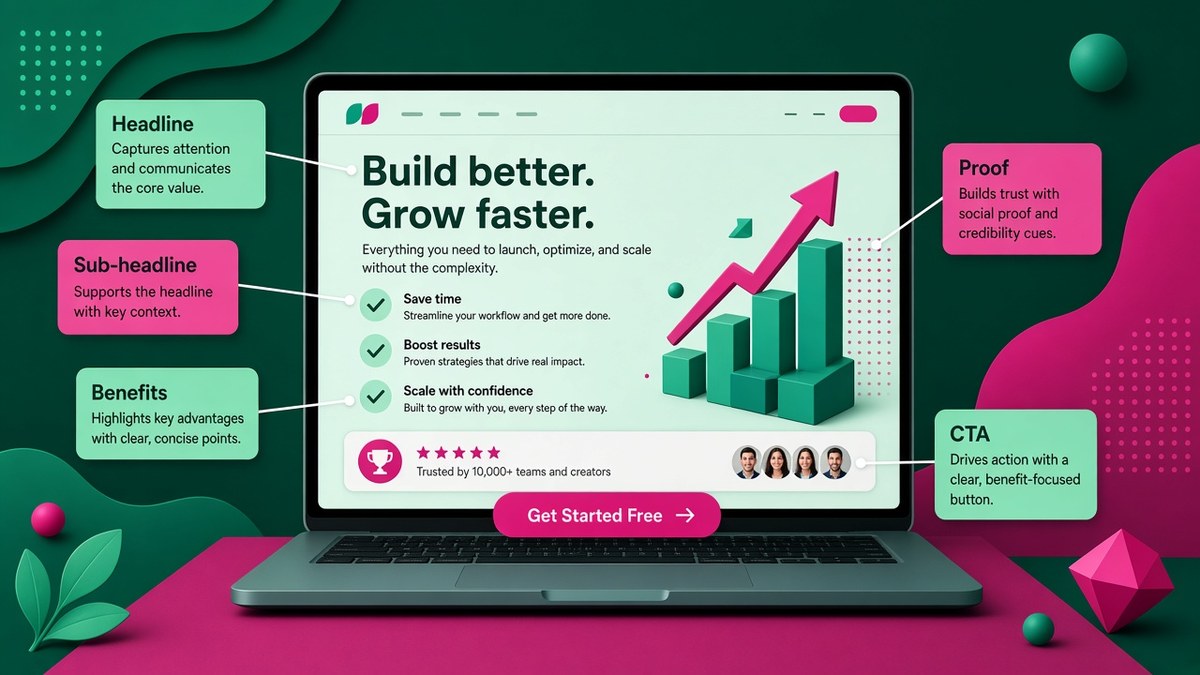
A homepage hero built around the value proposition: headline, subheadline, benefit bullets, proof and one call to action.
Your value proposition should be the first thing a new visitor reads on your homepage and on any key landing page. A simple layout works best:
- Above the fold: headline, subheadline, a single primary button and one proof element (rating, client logos or a guarantee).
- Directly below: the three benefit bullets expanded into short sections with icons or screenshots.
- Mid-page: testimonials that echo the headline’s promise.
- Everywhere else: a one-line version in your email signature, social bios, proposals and the opening of your sales calls.
If you sell online, make sure each stage of your sales funnel repeats the same core promise. A mismatch between the ad, the landing page and the checkout is one of the most common reasons people drop off.
How to test your value proposition
You do not need a big budget to test. Start with the cheapest method and move up only if you are unsure.
| Test | How it works | Cost | Best for |
|---|---|---|---|
| Five-second test | Show the page to 5-10 people in your target market for five seconds, then ask what you do and who it is for | Free | Clarity |
| Sales call check | Open your next 10 calls with the new value proposition and note reactions and questions | Free | B2B and services |
| Landing page A/B test | Send equal traffic to two versions with different headlines and compare sign-ups or enquiries | Low | Online offers |
| Small ad test | Run two ad variants with different promises for a few days | From a small daily ad budget | Fast signal on demand |
For A/B tests, a funnel builder with built-in split testing saves a lot of fiddling. Systeme.io lets you build landing pages on its free plan and lists A/B tests among its funnel features (check its pricing table for which plans include split testing); paid plans are $17, $47 and $97 a month if you need more funnels and contacts (checked on 4 November 2026 on systeme.io/pricing). Keep everything else identical between the two versions so the headline is the only variable, and wait until each version has a meaningful number of visitors before deciding.
💡 Measure the right thing
Judge a value proposition by enquiries, trial sign-ups or sales, not by time on page or likes. A clever headline that gets compliments but no leads has failed. Track the numbers in a simple KPI tracker.
Common mistakes to avoid
- Leading with features: ‘256-bit encryption’ means nothing until you say ‘your client files stay private’.
- Talking to everyone: ‘for businesses of all sizes’ tells nobody it is for them.
- Copying competitors: if your headline still works with a rival’s logo on it, rewrite it.
- Hiding it: a value proposition below a sliding carousel or a wall of stock photos might as well not exist.
- Never updating it: revisit it when you change prices, add a new segment or see conversion drop. Raising prices? My guide on how to raise prices shows how to reframe value at the same time.
Test your value proposition for free
Build a landing page and start collecting leads on the Systeme.io free plan, then split-test your headline as you grow. No credit card needed.
Affiliate link. I may earn a commission at no extra cost to you.
Frequently Asked Questions
How long should a value proposition be?
The core is a headline of roughly 6-12 words plus a one or two sentence subheadline. Supporting bullets and proof can follow, but a visitor should understand the main promise in about five seconds.
What is the difference between a value proposition and a USP?
A USP is the single thing that makes you different. A value proposition is the fuller promise: who you help, the result they get and why to believe you. Your USP is often one of the proof points inside it.
Do I need a different value proposition for each product?
Keep one company-level value proposition for your homepage, then write product or segment versions for landing pages. Each should feel like a more specific version of the main promise, not a contradiction.
How do I know if my value proposition is working?
Look at conversion: enquiries, sign-ups or sales from the page where it appears. Run a five-second test for clarity and an A/B test for performance, changing only the headline at a time.
What is the Value Proposition Canvas?
It is a one-page tool from Strategyzer that maps customer jobs, pains and gains against your products, pain relievers and gain creators. It helps you check that what you offer matches what customers care about most.
Can I use numbers in my value proposition?
Yes, if they are true and you can back them up. Specific results such as delivery times or guarantees are persuasive, but advertising law in the US, UK and EU requires claims to be supported by evidence.
Related reading: lead generation for small business and how to price your product or service.
Affiliate disclosure: Some links in this post are affiliate links. If you buy through them, I may earn a commission at no extra cost to you. I only recommend tools and books I believe are genuinely useful. As an Amazon Associate I earn from qualifying purchases.