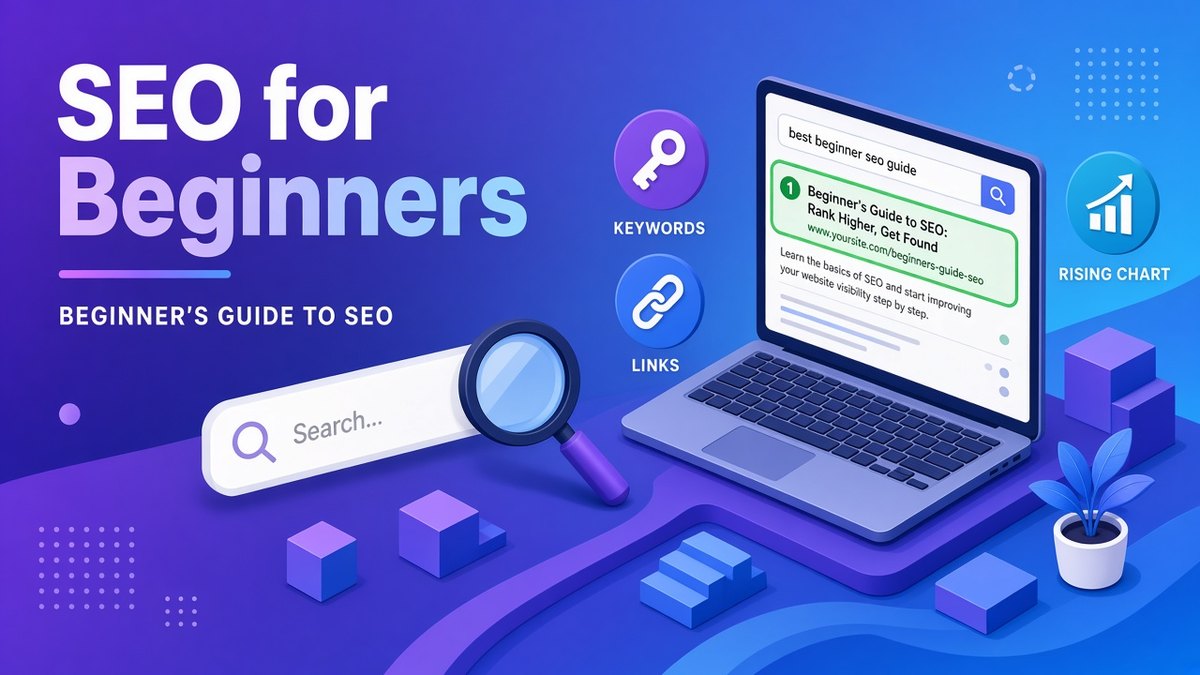
SEO for beginners can feel like a foreign language. People talk about crawl budgets, schema, backlinks and Core Web Vitals, and it is easy to give up before you start. However, the basic idea is simple. You want the right people to find your page when they search, and you want that page to answer them better than anyone else.
In this guide, I explain SEO from zero. First, you will learn how Google finds and ranks pages. Then, you will see the three pillars of SEO, how keywords really work and what changed with AI Overviews. Finally, you will get a simple 30-day plan, so you can stop reading and start doing.
✔ Key takeaways
- SEO means making your pages easy to find, easy to understand and genuinely useful for searchers.
- Google works in three stages: it crawls pages, stores them in an index and then ranks them for each search.
- Search intent matters more than keyword stuffing. Match what the searcher actually wants.
- In 2026, helpful, first-hand content and a fast, mobile-friendly site still win, even with AI Overviews.
- Start with free tools such as Google Search Console, then add an all-in-one tool when you need tracking.
📋 In this guide
- What is SEO, in plain English?
- How search engines work: crawl, index, rank
- The three pillars of SEO
- Keywords and search intent made simple
- E-E-A-T and helpful content
- SEO in 2026: AI Overviews and what changed
- SEO for beginners: your first 30-day plan
- Common beginner SEO mistakes
- Free and paid SEO tools for beginners
- Frequently Asked Questions
What is SEO, in plain English?
SEO stands for search engine optimization. In short, it is the work you do so that search engines can find, understand and recommend your pages. Unlike paid ads, you do not pay for each click. Instead, you earn visibility by being the most relevant and trustworthy answer.
Think of Google as a librarian with billions of books. The librarian wants to hand every visitor the single best book for their question. Your job is to write that book, label it clearly and make sure other people recommend it. That, in essence, is SEO for beginners and experts alike.
Of course, SEO is not the only way to get traffic. If you are weighing it against ads, read my comparison of SEO vs PPC first. Most small businesses use both, but SEO keeps paying off long after you stop working on a page.
📌 Why SEO is worth learning
Organic search is still one of the largest sources of website visits. Better still, a page that ranks well can bring visitors every day for years, while an ad stops the moment your budget runs out.
How search engines work: crawl, index, rank
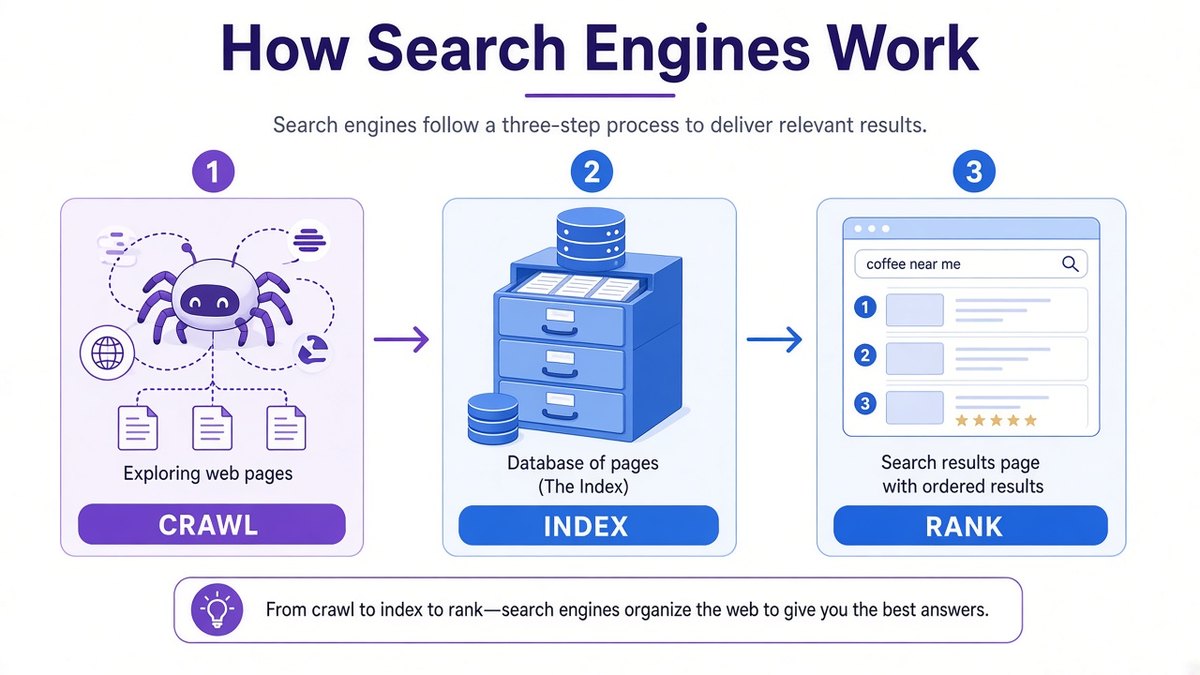
Before you optimise anything, you need to know what happens behind the search box. Google, Bing and other engines all follow the same three broad steps.
Crawl
Automated programs called crawlers, such as Googlebot, follow links from page to page. As a result, a page with no links pointing to it is hard to discover.
Index
Next, Google reads each page, works out what it is about and stores it in a huge database called the index. If a page is not indexed, it cannot rank at all.
Rank
Finally, when someone searches, Google picks the most helpful indexed pages and orders them. It looks at relevance, quality, usability and hundreds of other signals.
For beginners, the key lesson is this: ranking problems often start earlier, at the crawl or index stage. So, before you rewrite a page, check that Google can actually see it. The free URL Inspection tool in Google Search Console tells you whether a page is indexed.
The three pillars of SEO
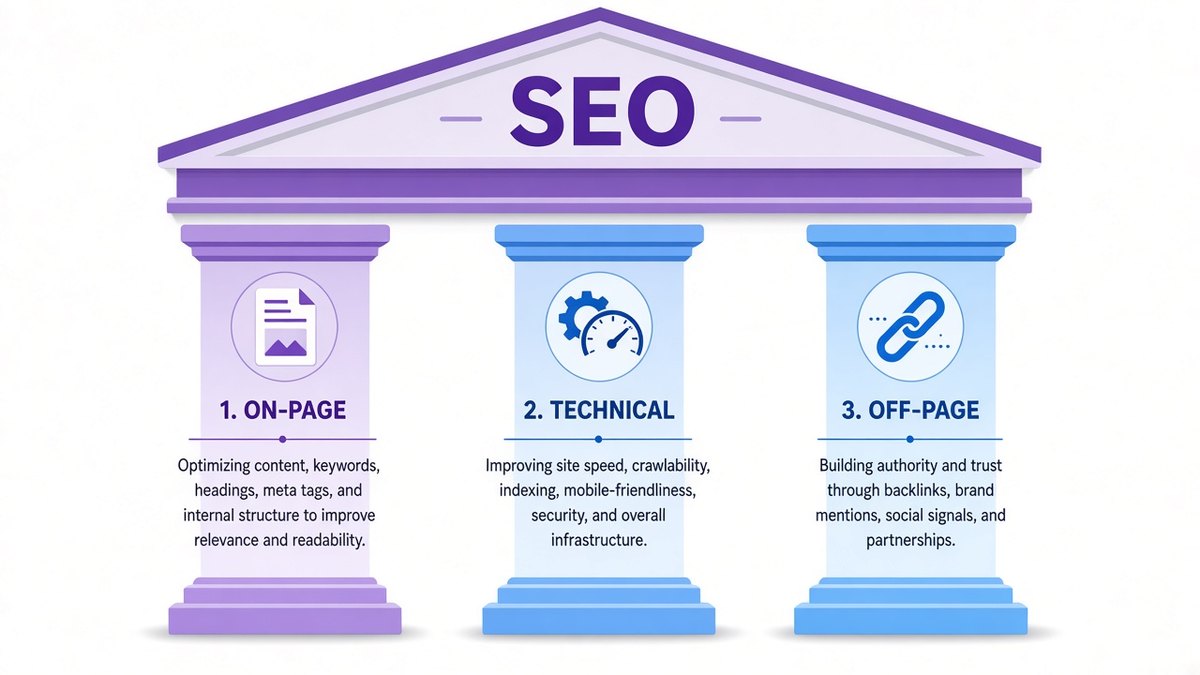
Every SEO task fits into one of three pillars. Keeping them separate helps you see where your site is weak and where to spend your time.
| Pillar | What it covers | Beginner example |
|---|---|---|
| On-page SEO | Content, keywords, headings, title tags, meta descriptions and internal links | Writing a clear title that matches what people search |
| Technical SEO | Crawlability, indexing, site speed, mobile-friendliness, HTTPS and structured data | Submitting an XML sitemap and fixing slow pages |
| Off-page SEO | Backlinks, brand mentions, reviews and reputation across the web | Getting a local newspaper or partner site to link to you |
In SEO for beginners, on-page work is the best place to start, because you control it completely. Technical SEO sounds scary, yet tools like Yoast handle much of it on WordPress. If you want the hands-on version, my step-by-step guide to building an SEO-friendly website walks through the technical setup in detail.
Off-page SEO takes the longest. Even so, it matters, because links from respected sites work like votes of confidence. In the beginning, focus on creating content that deserves those votes.
Keywords and search intent made simple
A keyword is simply the phrase someone types into Google. For example, a bakery owner might target “eggless birthday cake near me”. Good keywords have three qualities: people search for them, they fit your business and you can realistically compete for them.
However, the words alone are not enough. You also need to understand search intent, which is the reason behind the search. Google is very good at spotting intent, so a page that ignores it rarely ranks.
| Intent type | What the searcher wants | Example search | Best page type |
|---|---|---|---|
| Informational | To learn something | what is seo | Guide or blog post |
| Navigational | To reach a specific site | google search console login | Home or login page |
| Commercial | To compare options before buying | best seo tools for small business | Comparison or review |
| Transactional | To buy or sign up now | buy eggless cake online | Product or pricing page |
💡 Quick intent check
Search your keyword in a private browser window. Look at the top five results. If they are all guides, write a guide. If they are all product pages, a blog post will struggle to rank.
As a beginner, aim for long-tail keywords first. These are longer, more specific phrases with lower competition. For instance, “seo tips for dentists in Pune” is far easier to win than “seo”. Over time, many small wins add up to real traffic.
E-E-A-T and helpful content
Google wants to show content that is genuinely helpful, written for people rather than for search engines. In March 2024, Google folded its helpful content system into its core ranking systems. In other words, helpfulness is now part of how every page is judged.
To describe quality, Google’s guidelines use the term E-E-A-T. It stands for Experience, Expertise, Authoritativeness and Trustworthiness. It is not a single score, but it is a useful checklist for your own writing.
- Experience: show that you have actually done the thing. Share your own results, photos, mistakes and examples.
- Expertise: explain topics accurately and in enough depth to solve the problem.
- Authoritativeness: build a reputation, for example through mentions, links and a clear author bio.
- Trustworthiness: be honest about who you are, keep facts up to date and disclose affiliate links clearly.
⚠️ Avoid this trap
Do not publish dozens of thin pages just to target every keyword variation. Google’s spam policies call this scaled content abuse, and it can pull down the whole site, whether the pages were written by people or by AI.
SEO in 2026: AI Overviews and what changed
The biggest change for beginners in recent years is AI Overviews. These are AI-generated summaries that appear above the normal results for many searches. Naturally, many site owners worry that nobody will click anymore.
The reality is more balanced. AI Overviews still cite and link to source pages. Therefore, the pages that get cited tend to be clear, well-structured and trustworthy. Moreover, many searches, especially commercial and local ones, still send plenty of clicks to websites.
So, what should you do differently? Very little, in fact. Answer questions directly near the top of a section. Use clear headings and short paragraphs. Add first-hand detail that a generic summary cannot copy. Most importantly, build a brand people search for by name, because that traffic does not depend on rankings at all.
📌 Good news for small sites
Google’s own guidance says there is no special trick for AI features. The same SEO basics that help normal rankings also help your pages appear as a source in AI Overviews.
SEO for beginners: your first 30-day plan
Theory is useful, but action is better. Here is a simple plan you can follow in your first month. It assumes you already have a website, ideally on WordPress.
Week 1: Set up your tools
Verify your site in Google Search Console, submit your sitemap and install an SEO plugin like Yoast SEO. Also, check your speed in PageSpeed Insights.
Week 2: Find 10 keywords
List the questions your customers ask. Then check which ones people search for, and group them by intent. Pick ten long-tail phrases you can realistically win.
Week 3: Improve or write 3 pages
Start with pages that already get some impressions in Search Console. Improve the title, answer the question early, add helpful detail and link to related pages.
Week 4: Earn your first links
Ask suppliers, partners and local associations to list you. In addition, create one genuinely useful resource, such as a checklist, that people will want to share.
After that, repeat the cycle every month. SEO for beginners is mostly about consistency. Once the basics feel easy, move on to my advanced tips for ranking higher on Google.
Common beginner SEO mistakes
Most guides on SEO for beginners skip the mistakes, yet almost everyone makes the same few at the start. Luckily, they are easy to avoid once you know them.
- Targeting huge keywords too early. A new site will not rank for “marketing”. Instead, start specific.
- Keyword stuffing. Repeating a phrase ten times in one paragraph reads badly and does not help.
- Ignoring mobile visitors. Google uses the mobile version of your site for indexing, so test on a phone.
- Publishing and forgetting. Old posts lose rankings as facts change. Update your best pages at least once a year.
- Buying cheap backlinks. Paid link schemes break Google’s spam policies and can trigger penalties.
- Expecting instant results. SEO usually takes three to six months to show clear gains. Read about the future of SEO to see why patience pays.
Free and paid SEO tools for beginners
When it comes to SEO for beginners, you do not need expensive software. In fact, Google’s own free tools cover most beginner needs. Here is a simple starter kit.
| Tool | Cost | Best for |
|---|---|---|
| Google Search Console | Free | Indexing status, search queries, clicks and errors |
| PageSpeed Insights | Free | Core Web Vitals and speed tips |
| Yoast SEO | Free plan | Titles, meta descriptions, sitemaps and readability on WordPress |
| Moz SEO learning centre | Free | Beginner-friendly SEO lessons |
| SE Ranking | Paid, free trial | Keyword research, rank tracking and site audits in one dashboard |
Once you publish regularly, you will want to track rankings and spot technical issues automatically. At that point, SE Ranking is a beginner-friendly, budget-conscious Semrush alternative. It combines keyword research, a rank tracker and a site audit, so you do not have to juggle several tools.
Ready to track your first keywords?
Try SE Ranking to research keywords, audit your site and watch your rankings grow, all from one simple dashboard.
Start your SE Ranking free trial →
Affiliate link. I may earn a commission at no extra cost to you.
Frequently Asked Questions
What is SEO in simple words?
SEO, or search engine optimization, is the work you do so search engines can find, understand and recommend your pages. The goal is to appear when the right people search for what you offer.
How long does SEO take for beginners?
Most new pages take three to six months to show clear ranking gains. Long-tail keywords and pages that already get impressions in Search Console usually improve faster.
Can I learn SEO for free?
Yes. Google Search Console, PageSpeed Insights, Google’s SEO Starter Guide and free learning centres like Moz cover the basics. Paid tools only become useful once you publish regularly.
Do AI Overviews mean SEO is dead?
No. AI Overviews still cite and link to source pages, and many searches still send clicks to websites. Clear, helpful, first-hand content gives you the best chance of being cited.
What should a beginner focus on first in SEO?
Start with on-page SEO. Choose specific keywords, match search intent, write clear titles and answer the question early. Then make sure Google can index your pages.
Final thoughts
SEO for beginners comes down to three habits. First, make your pages easy for Google to crawl and index. Second, answer real questions better than anyone else. Third, earn trust over time through links, mentions and honest content.
Start small, follow the 30-day plan and measure your progress in Search Console. Within a few months, you will understand SEO far better than most website owners.
Affiliate disclosure: Some links in this post are affiliate links. If you buy through them, I may earn a commission at no extra cost to you.