Learning how to improve cash flow is the fastest way to make a small business calmer and safer. Plenty of profitable companies still run out of money because cash arrives later than bills fall due. This guide shows you how to measure your cash flow, 12 practical ways to speed up money coming in and slow down money going out, how to build a simple 13-week forecast, and the late-payment rules that protect small businesses in the US, UK and EU.
✔ Key takeaways
⏱ About 12 min read · the short version is right here
- Cash flow is the timing of money in and out. A business can be profitable on paper and still be short of cash.
- Track three numbers every month: operating cash flow, days sales outstanding (DSO) and your cash runway.
- The quickest wins are on the income side: invoice immediately, shorten payment terms, take deposits and make paying you easy.
- A rolling 13-week cash forecast shows a cash gap weeks before it hits, while you still have options.
- Separating money into profit, owner pay, tax and expenses accounts stops you spending money that is already spoken for.
- UK and EU law lets you charge statutory interest and fixed compensation on late business invoices; in the US your contract terms do the work.
📋 In this guide
🔍 Checked on 13 Nov 2026: UK late-payment interest rules checked on GOV.UK; EU rules from the Late Payment Directive (2011/7/EU). Figures in the examples are illustrative, not benchmarks. This is general information, not tax or legal advice.
What cash flow is (and why profit is not cash)
Cash flow is the movement of money into and out of your business over a period of time. Money comes in from customer payments, loans and investment. It goes out on stock, wages, rent, software, tax and loan repayments. When more comes in than goes out, cash flow is positive. When the reverse happens, it is negative and you are eating into your reserves.
The trap is that profit and cash are measured differently. Your profit and loss statement records a sale when you invoice it. Your bank account only sees the money when the customer actually pays, which might be 30, 60 or 90 days later. Meanwhile you have already paid for the materials, the staff time and the VAT or sales tax on that sale.
📌 Example: profitable but broke
A design studio invoices $40,000 in March on 60-day terms and pays $28,000 in wages and costs the same month. On paper March made $12,000 profit. In the bank, the studio is $28,000 down until the end of May. Two months like that in a row and a healthy business needs an emergency overdraft.
That is why improving cash flow is mostly about timing: getting paid sooner, paying out later (fairly), and never being surprised. The picture below shows the loop every product or service business goes through.
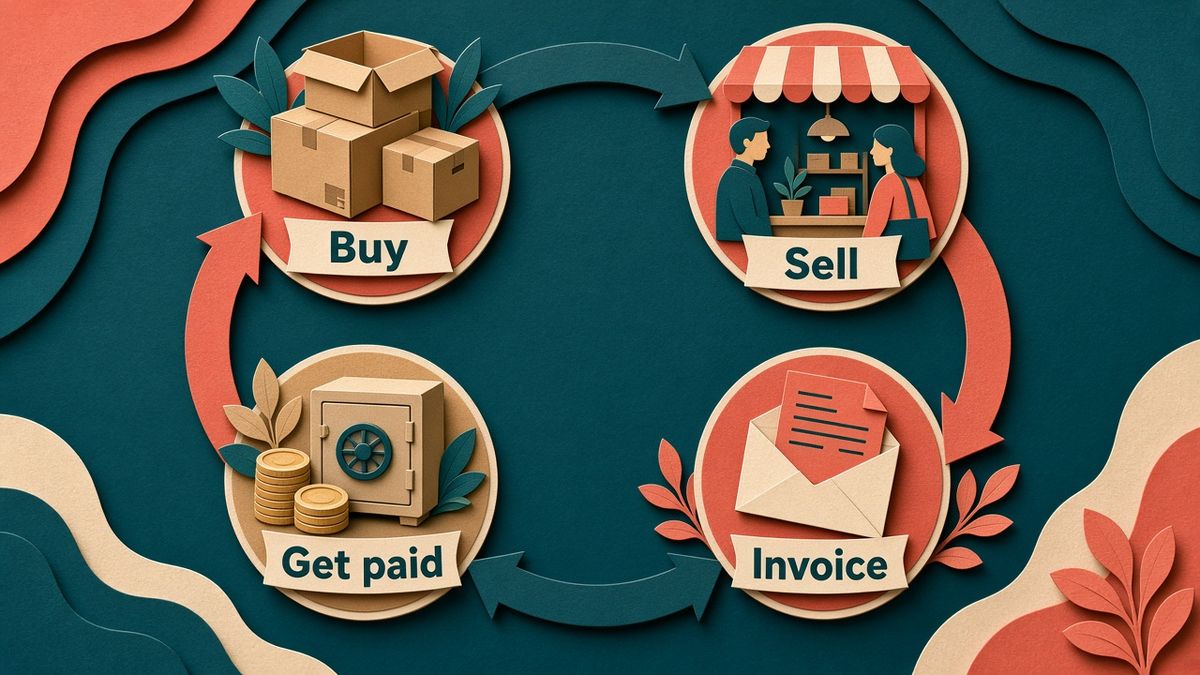
The cash cycle: you pay for stock or time first, then sell, invoice and finally get paid. The shorter this loop, the healthier your cash flow.
Three numbers that show your cash flow health
You do not need an accountant’s dashboard. These three numbers, checked once a month, tell you most of what you need. If you already track a small business KPI dashboard, add them to it.
| Metric | How to work it out | What good looks like |
|---|---|---|
| Operating cash flow | Cash received from customers minus cash paid for running costs in the month | Positive most months; a negative month should have a clear reason |
| Days sales outstanding (DSO) | (Accounts receivable ÷ revenue for the period) × days in the period | Close to your stated payment terms, e.g. around 30 if your terms are 30 days |
| Cash runway | Cash in the bank ÷ average monthly net cash outflow | At least three months of costs as a buffer; six is more comfortable |
| Cash conversion cycle | Days of inventory + DSO − days payable outstanding | As low as possible; service businesses with no stock can get close to zero or below |
💡 Quick DSO example
If customers owe you $30,000 and your yearly revenue is $240,000, your DSO is (30,000 ÷ 240,000) × 365 = about 46 days. If your terms are 30 days, customers are paying you roughly two weeks late on average, and that is the first thing to fix.
To get these numbers you need clean books. If your receipts and invoices are scattered, start with my guide to business record keeping so your figures are accurate before you act on them.
12 ways to improve cash flow in a small business
The first six ideas speed up money coming in. The next four slow or smooth money going out. The last two give you a safety net. Pick the two or three that fit your business and do them this month rather than trying all twelve at once.
Speed up money coming in
Invoice the same day you deliver
Every day between finishing the work and sending the invoice is a day added to your cash cycle. Send the invoice when the job is done, or set up automatic invoicing in your accounting software for recurring work.
Shorten your payment terms
If you default to 30 or 60 days, ask whether you need to. Many small businesses move new clients to 14-day terms or payment on receipt without losing anyone. Put the terms clearly on every quote, contract and invoice.
Take deposits and staged payments
For projects, ask for 30–50% upfront and the rest at agreed milestones. For products made to order, take payment before you buy materials. Deposits turn your customers’ money, not yours, into working capital.
Make paying you effortless
Add a pay-now link for card, bank transfer and local methods such as ACH in the US, Faster Payments in the UK or SEPA in the EU. Offer direct debit or card-on-file for retainers so payment happens automatically on the due date.
Chase late invoices on a fixed schedule
Send a friendly reminder a few days before the due date, another on the day, then at 7, 14 and 30 days overdue. Automate the first reminders and make a phone call at the 14-day mark. A clear process removes the awkwardness and gets you paid faster.
Turn one-off sales into recurring revenue
Retainers, maintenance plans, subscriptions and memberships bring in predictable cash every month. Even one recurring offer alongside project work makes forecasting far easier.
Slow down or smooth money going out
Negotiate supplier terms
Ask your main suppliers for 30 or 45-day terms once you have a good payment history. Pay on the due date rather than early unless there is an early-payment discount worth taking. Never pay late, though: your reputation with suppliers is a cash asset too.
Cut or pause costs that do not earn their keep
Review every recurring charge each quarter: software seats nobody uses, duplicate subscriptions, unused memberships. Moving annual software to monthly billing can also protect cash when money is tight, even if it costs slightly more.
Keep stock lean
Stock sitting on a shelf is cash you cannot use. Reorder smaller quantities more often for slow-moving lines, clear dead stock with a sale, and focus your buying on items that sell quickly.
Raise prices or improve margins
Many cash problems are really margin problems. A small price rise on your best-selling products can do more for cash than any cost cut. My guides on how to price your product or service and how to calculate your break-even point help you find the right number.
Build a safety net
Keep a cash reserve
Aim for at least three months of fixed costs in a separate savings account. Build it by moving a small fixed percentage of every payment you receive. It is boring, and it is exactly what keeps a business alive through a slow quarter.
Arrange finance before you need it
A business line of credit, overdraft or invoice finance facility is far easier to get when your numbers look healthy. Set one up as a backup, not as a plan. If you are weighing outside money, see how to get funding for a startup business.
⚠️ Do not borrow to cover a margin problem
If you lose money on every sale, more finance only makes the hole deeper. Check your margins and break-even point first. Borrowing works for timing gaps, not for an unprofitable business model.
Build a simple 13-week cash flow forecast
A cash flow forecast is a simple table that predicts your bank balance week by week. A 13-week (one quarter) rolling forecast is the most practical format for small businesses because it is short enough to be accurate and long enough to spot problems early.
| Row | What to enter |
|---|---|
| Opening balance | Cash in the bank at the start of the week |
| Cash in | Customer payments you realistically expect that week (by due date, adjusted for clients who usually pay late), plus any loans or grants |
| Cash out | Wages, rent, suppliers, software, loan repayments, tax and VAT or sales tax payments, owner drawings |
| Net cash flow | Cash in minus cash out |
| Closing balance | Opening balance plus net cash flow; this becomes next week’s opening balance |
Update it every Monday: replace last week’s estimates with actual figures and add a new week at the end. When a closing balance dips below your safety level, you will see it weeks ahead and can chase invoices, delay a purchase or draw on your credit line in good time.
💡 Remember the big quarterly bills
VAT returns in the UK and EU, US estimated tax payments, annual insurance and software renewals are where most cash surprises come from. Put them in the forecast the moment you know the date.
Profit First: a simple system for your cash
One of the most practical cash systems for small business owners comes from Mike Michalowicz’s book Profit First (UK edition on Amazon.co.uk). The idea flips the usual formula. Instead of Sales − Expenses = Profit, you treat it as Sales − Profit = Expenses: you take your profit first and run the business on what is left.
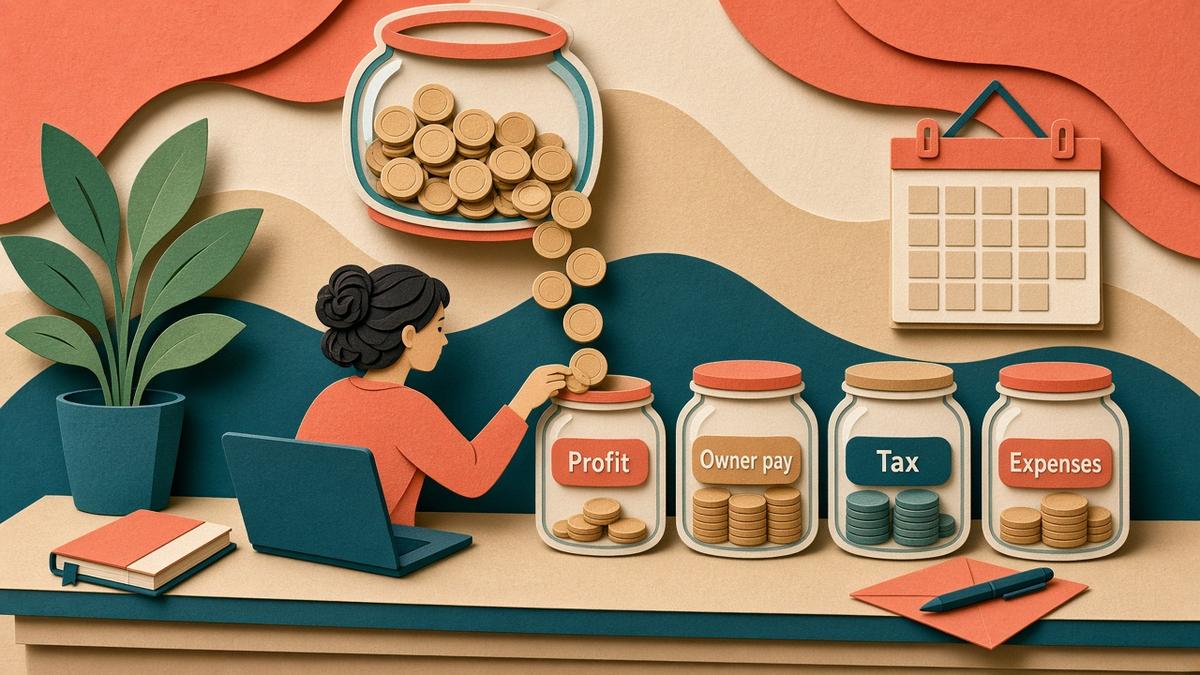
Profit First in practice: every payment is split into separate accounts for profit, owner pay, tax and running expenses.
In practice, you open a few separate bank accounts, typically Income, Profit, Owner’s Pay, Tax and Operating Expenses. All money lands in Income. Twice a month (the book suggests the 10th and the 25th) you move set percentages into the other accounts. Whatever sits in Operating Expenses is what you can spend. The book gives target percentages by revenue size, and you start with small allocations and raise them each quarter.
Why it helps cash flow: tax money is no longer mistaken for spare cash, owner pay becomes regular, and overspending shows up immediately because the expenses account runs low. Many owners say it is the first time they understood their finances without a spreadsheet.
Want a simple cash system that sticks?
Profit First explains the full method, the account setup and the percentages to start with. It is one of the most practical small business finance books in print.
Affiliate link. I may earn a commission at no extra cost to you.
Reading from the UK or Europe? Here is Profit First on Amazon.co.uk. For more tools and books I have tested, browse my reviews hub.
Late payment rules in the US, UK and EU
Payment terms are a cash flow tool, and the law in some regions backs you up when business customers pay late. Here is a quick summary for business-to-business (B2B) invoices.
| Region | Default rules for late B2B payments | What you can do |
|---|---|---|
| United Kingdom | If no terms are agreed, payment is due 30 days after the invoice or delivery. Statutory interest is 8% plus the Bank of England base rate. | Claim statutory interest plus fixed compensation of £40, £70 or £100 depending on the size of the debt, unless your contract sets a different rate. |
| European Union | The Late Payment Directive (2011/7/EU) limits B2B payment terms to 60 days unless expressly agreed and not grossly unfair; public authorities generally pay within 30 days. | Claim interest of at least 8 percentage points above the ECB reference rate plus a minimum €40 compensation per late invoice. National rules can add detail. |
| United States | No general federal late-payment law for private B2B deals. Late fees and interest come from your contract and state law. Federal agencies paying contractors follow the Prompt Payment Act. | Write clear terms, late fees and interest into every contract and invoice, within your state’s legal limits. |
📌 Cash accounting for tax can help too
In the UK, the VAT Cash Accounting Scheme lets eligible small businesses pay VAT when customers pay them rather than when they invoice. Several EU countries offer similar schemes, and most small US businesses can use the cash method for income tax. Ask your accountant whether one fits your business.
Cash flow mistakes to avoid
- Confusing profit with cash. Check the bank balance and the forecast, not just the profit and loss report.
- Spending the VAT or sales tax. That money belongs to the tax office. Move it to a separate account as soon as it arrives.
- Growing too fast. Taking on big orders can drain cash because you pay for materials and staff long before the customer pays you.
- Relying on one big client. If a client that makes up half your revenue pays late, your whole business stalls.
- Being too polite about late invoices. A clear, friendly, automatic reminder process is professional, not rude.
- Ignoring small recurring costs. Ten forgotten $20 subscriptions add up to $2,400 a year.
Frequently Asked Questions
What is the fastest way to improve cash flow?
The fastest wins are usually on the income side: invoice the same day you deliver, chase overdue invoices on a fixed schedule, ask for deposits on new work and offer easy payment links. These can bring cash in within days without cutting anything.
What is the difference between cash flow and profit?
Profit is revenue minus expenses for a period, recorded when sales are invoiced. Cash flow is the actual money moving in and out of your bank account. A business can be profitable but short of cash if customers pay late or it spends heavily on stock in advance.
How much cash reserve should a small business keep?
A common rule is at least three months of fixed operating costs, with six months being more comfortable for seasonal or project-based businesses. Build it gradually by setting aside a small percentage of every payment you receive.
How do I make a cash flow forecast?
List your opening bank balance, expected cash in and planned cash out for each week over the next 13 weeks. Subtract cash out from cash in to get net cash flow, carry the closing balance forward and update it every week with actual figures.
Can I charge interest on late invoices?
In the UK you can claim statutory interest of 8% plus the Bank of England base rate and fixed compensation on late B2B invoices. EU law sets a minimum of 8 points above the ECB reference rate plus €40. In the US, late fees and interest depend on your contract and state law.
Is the Profit First method worth trying?
For many owner-led small businesses, yes. Splitting income into separate accounts for profit, owner pay, tax and expenses makes cash visible and stops tax money being spent by mistake. Start with small percentages and adjust each quarter.
Start this week: work out your DSO, send any invoices you have not sent yet and set up a basic 13-week forecast. Then add one habit from the list each month, and your cash flow will steadily become something you control rather than something that happens to you.
Affiliate disclosure: some links in this post are affiliate links, so I may earn a commission at no extra cost to you. As an Amazon Associate I earn from qualifying purchases. I only recommend tools I’d use myself.