Knowing how to calculate churn rate tells you how fast you are losing customers, and that number quietly decides whether a subscription, membership or service business grows or shrinks. You can win plenty of new customers every month and still stand still if just as many leave through the back door. In this guide you will learn what churn rate is, the difference between customer churn and revenue churn, the exact formulas, a 5-step calculation process, worked examples, how to convert monthly churn into annual churn, how to judge whether your churn is good and practical ways to reduce it, plus a template you can copy.
✔ Key takeaways
⏱ About 10 min read · the short version is right here
- Customer churn rate is the share of customers you had at the start of a period who left during it: customers lost divided by customers at the start, times 100.
- Never count customers you won during the period in the churn formula, or your churn will look better than it really is.
- Revenue churn often matters more than customer churn, because losing one large account can hurt more than losing ten small ones.
- Monthly churn compounds: a churn rate that looks small each month adds up to a big share of your customers over a year.
- Reduce churn by fixing onboarding, recovering failed payments, talking to customers before renewal and learning from every cancellation.
📋 In this guide
What is churn rate?
Churn rate, sometimes called attrition rate, measures the percentage of customers who stop doing business with you during a set period. For a subscription business that means cancelling or not renewing. For a service business with retainers it means ending the contract. For a shop or agency without contracts, it usually means a customer who has not bought again within the time you would normally expect.
Churn is the mirror image of retention. If you start a month with 100 customers and keep 95 of them, your retention rate is 95% and your churn rate is 5%. Because it is a percentage, churn lets you compare months, plans and customer groups fairly, which is why it sits on almost every list of small business KPIs.
📌 Define “lost” before you calculate
Write down what counts as a lost customer for your business: a cancelled subscription, a contract not renewed, or no purchase in 90 days. Use the same rule every month, otherwise your churn trend means nothing.
Customer churn vs revenue churn
There are two main ways to measure churn, and most growing businesses should track both.
| Metric | What it measures | Best for |
|---|---|---|
| Customer churn rate | The share of customers who left | Seeing how many people you lose and spotting problems with onboarding or service |
| Gross revenue churn | The share of recurring revenue lost from cancellations and downgrades | Understanding the money impact of churn, especially when plans have different prices |
| Net revenue churn | Revenue lost minus extra revenue from existing customers who upgraded | Seeing whether your existing customer base is shrinking or growing on its own |
| Voluntary vs involuntary churn | Customers who chose to leave vs those lost to failed or expired payments | Choosing the right fix: product and service changes or better payment recovery |
Imagine an agency with ten small clients and one large client. If two small clients leave, customer churn looks high but the revenue impact is modest. If the large client leaves, customer churn looks tiny while half the revenue disappears. Looking at both numbers side by side stops you drawing the wrong conclusion.
Churn rate formulas
Here are the formulas you need. Use the same period, usually one month, for every part of the calculation.
- Customer churn rate = Customers lost during the period ÷ Customers at the start of the period × 100
- Retention rate = 100% − Customer churn rate
- Gross revenue churn rate = Recurring revenue lost from cancellations and downgrades ÷ Recurring revenue at the start × 100
- Net revenue churn rate = (Revenue lost − Expansion revenue from existing customers) ÷ Recurring revenue at the start × 100
- Average customer lifetime (rough estimate) = 1 ÷ Monthly churn rate, giving the answer in months
⚠️ Leave new customers out
A common mistake is to divide lost customers by the number at the end of the month, or to subtract new sign-ups from losses. New customers hide churn. Keep them in a separate line and only use your starting count in the formula.
If your customer numbers change a lot within a month, some analysts divide by the average of the starting and ending count instead. That is fine, as long as you use the same method every time and say which one you used when you share the figure.
How to calculate churn rate in 5 steps
Pick the period
Choose a month for most subscription and service businesses, or a quarter if you have few customers and long contracts. Write down the exact start and end dates.
Count customers at the start
Take the number of active, paying customers on the first day of the period. Exclude free trial users unless you also track trial churn separately.
Count customers lost
Count customers from that starting group who cancelled, did not renew or failed to pay and were not recovered by the end of the period. Ignore anyone who joined during the period.
Divide and multiply by 100
Divide customers lost by customers at the start, then multiply by 100 to get your churn rate as a percentage.
Repeat for revenue and record reasons
Do the same with recurring revenue to get revenue churn, then note the main cancellation reasons. The reasons tell you what to fix; the rate tells you whether it worked.
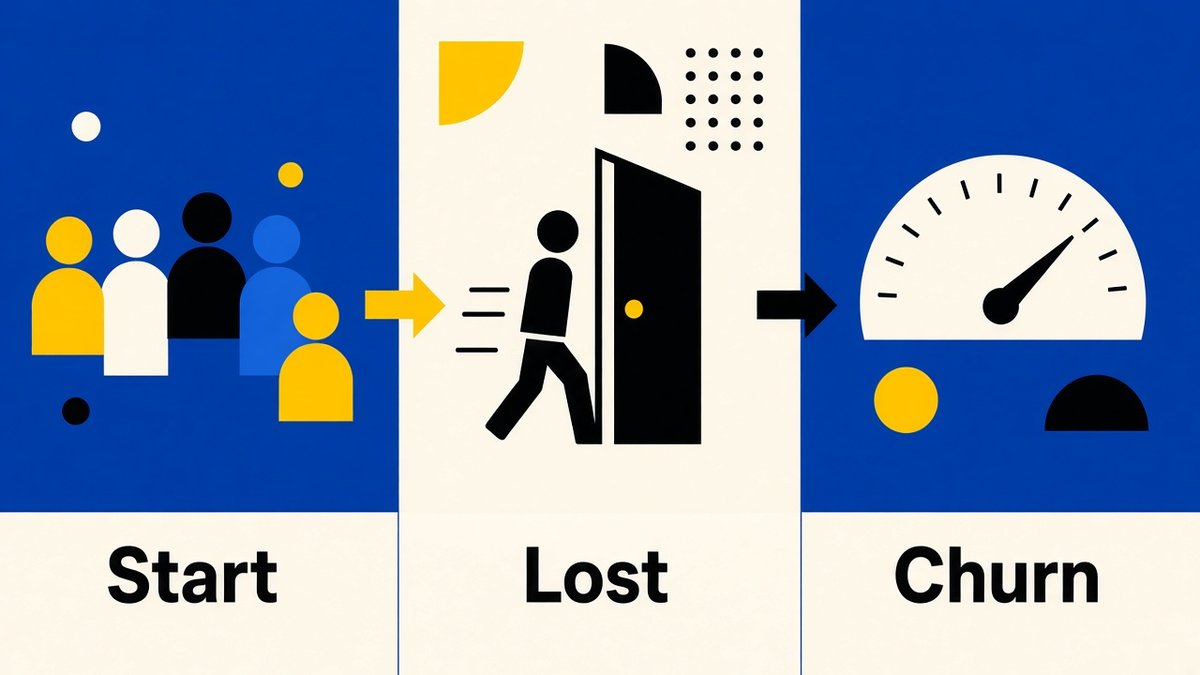
How to calculate churn rate: customers at the start of the month, customers lost and the churn percentage that results.
Churn rate examples
These examples use round, made-up numbers so the maths is easy to follow. Swap in your own figures.
Example 1: monthly customer churn
An online membership starts March with 400 paying members. During March it gains 60 new members and loses 20 existing members. Churn rate = 20 ÷ 400 × 100 = 5%. The 60 new members do not change the churn rate; they show up in your growth figures instead.
Example 2: revenue churn with different plan sizes
A software business starts the month with $20,000 in monthly recurring revenue. Cancellations remove $1,200 and downgrades remove another $300. Existing customers upgrade and add $900. Gross revenue churn = ($1,200 + $300) ÷ $20,000 × 100 = 7.5%. Net revenue churn = ($1,500 − $900) ÷ $20,000 × 100 = 3%.
Example 3: a service business without contracts
A cleaning company decides a client is lost if they have not booked for 60 days. At the start of the quarter it has 150 active clients; by the end, 18 of them have not booked for 60 days. Quarterly churn = 18 ÷ 150 × 100 = 12%.
💡 Segment your churn
Split churn by plan, acquisition channel, country or customer size. Churn is rarely spread evenly, and the group that churns most is usually where the quickest win is.
Monthly vs annual churn rate
Monthly churn compounds, so you cannot simply multiply it by 12. If you keep 95% of customers each month, after a year you keep 95% multiplied by itself 12 times, which is roughly 54%. That means a 5% monthly churn rate is closer to 46% annual churn, not 60%.
- Annual churn from monthly churn = 1 − (1 − monthly churn)12
- Monthly churn from annual churn = 1 − (1 − annual churn)1/12
| Monthly churn (illustration) | Customers kept after 12 months | Approximate annual churn | Rough average lifetime |
|---|---|---|---|
| 2% | About 78% | About 22% | About 50 months |
| 5% | About 54% | About 46% | About 20 months |
| 10% | About 28% | About 72% | About 10 months |
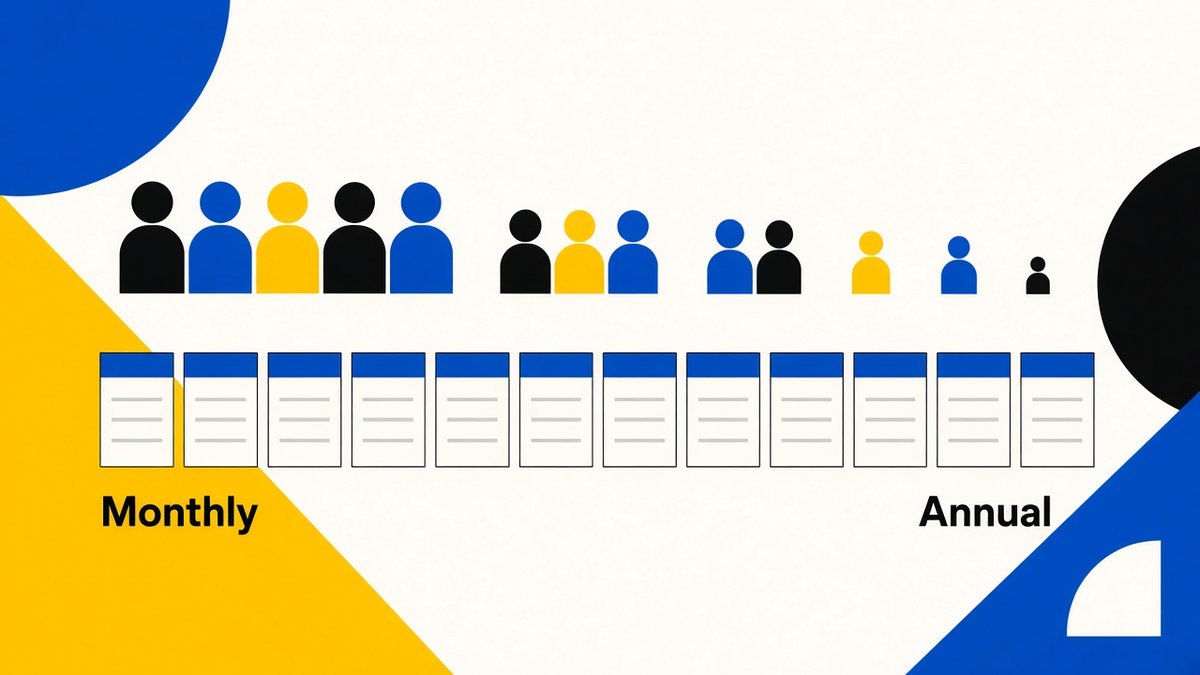
Monthly vs annual churn rate: a small monthly loss of customers compounding into a much larger share lost over twelve months.
This is also why churn has such a big effect on customer lifetime value. Halving your monthly churn roughly doubles how long an average customer stays, and so doubles what you can afford to spend to win them. Compare that with your customer acquisition cost to see whether growth is actually profitable.
What is a good churn rate?
There is no single good churn rate. A low-cost monthly app, a coaching programme and an annual B2B software contract all behave very differently. Customers on cheap monthly plans leave more easily, while customers on annual contracts or deeply embedded tools churn less often but in bigger chunks at renewal time.
Instead of chasing a number from someone else’s industry, use these checks:
- Trend: is your churn stable or falling over the last 6 to 12 months?
- Growth maths: are you adding more customers each month than you lose? If not, marketing is only refilling a leaky bucket.
- Net revenue churn: if upgrades from existing customers outweigh losses, net revenue churn turns negative, which means your customer base grows even with no new sales.
- Early churn: what share of customers leave in their first 30 to 90 days? High early churn usually points to onboarding, not to the product itself.
📌 Churn feeds your forecast
Use your monthly churn rate when you plan revenue. My guide on how to create a sales forecast shows how to build lost customers into a realistic forecast.
How to reduce churn rate
Onboarding
Win the first 30 days
Most churn starts early. Give new customers a quick first result with a clear welcome sequence and a short checklist.
Payments
Recover failed payments
Send card-expiry reminders, retry failed payments and email customers before access is cut off.
Feedback
Learn from every exit
Ask one short question when people cancel and review the answers monthly.
- Improve onboarding: my client onboarding process guide shows how to set expectations and deliver an early win.
- Check in before renewal: contact annual customers a few weeks before renewal to review results and fix problems while they still care.
- Map the journey: a customer journey map shows where customers get stuck or lose interest.
- Offer a pause or downgrade: some customers leave because of budget or timing, not dissatisfaction. A pause keeps the relationship alive.
- Use proven retention tactics: see my list of customer retention strategies for loyalty, service and communication ideas.
- Respect privacy: if you serve customers in the EU or UK, collect cancellation feedback and usage data under GDPR rules: be clear about why you collect it and do not keep it longer than you need.
⚠️ Do not trap customers
Hard-to-find cancel buttons may lower churn for a month, but they create chargebacks, bad reviews and, in many places, legal risk. Consumer rules in the EU, UK and many US states expect cancelling to be as easy as signing up.
Churn rate calculation template
Copy this churn rate template into a spreadsheet, with one row per month. After three to six months you will see your trend, your revenue churn and the reasons that come up again and again.
Churn rate template (one row per month)
Month: [month and year]
Customers at start of month: [number]
New customers won this month (do not use in the churn formula): [number]
Customers lost this month (cancelled, not renewed or failed payment not recovered): [number]
Customers at end of month = Start + New − Lost: [number]
Customer churn rate = Lost ÷ Start × 100: [%]
Recurring revenue at start (MRR, excluding VAT or sales tax): [$ / €]
Revenue lost from cancellations and downgrades: [$ / €]
Revenue gained from upgrades and add-ons from existing customers: [$ / €]
Gross revenue churn = Lost revenue ÷ Start MRR × 100: [%]
Net revenue churn = (Lost − Expansion) ÷ Start MRR × 100: [%]
Top cancellation reasons this month: [notes]
Review it with your team every month. Pick the most common cancellation reason, decide one fix, and check whether churn for that group falls the following month.
Frequently Asked Questions
How do you calculate churn rate?
Divide the number of customers you lost during a period by the number of customers you had at the start of that period, then multiply by 100. Do not include customers who joined during the period.
What is the difference between churn rate and retention rate?
They are two sides of the same number. Retention rate is the share of starting customers you kept, and churn rate is the share you lost, so retention rate equals 100% minus churn rate.
What is revenue churn?
Revenue churn measures the share of recurring revenue lost from cancellations and downgrades. Net revenue churn also subtracts extra revenue from existing customers who upgraded or bought add-ons.
How do I convert monthly churn to annual churn?
Use annual churn = 1 minus (1 minus monthly churn) to the power of 12. For example, 5% monthly churn works out to roughly 46% annual churn, not 60%.
Should I calculate churn monthly or yearly?
Monthly is best for subscription and service businesses because you can react quickly. If you have few customers or annual contracts, a quarterly or yearly figure gives a more stable picture.
What is the fastest way to reduce churn?
Start with involuntary churn: recovering failed payments is often the quickest win. Then improve onboarding so new customers get a result in their first weeks, which is when most cancellations begin.
Now you know how to calculate churn rate for customers and revenue, how to turn monthly churn into an annual figure and how to bring it down. Fill in the template with last month’s numbers today, and track it every month alongside your growth so you always know whether your business is truly moving forward.