Knowing how to calculate profit margin is one of the simplest ways to see whether your business is truly healthy. Revenue can look great while profit quietly shrinks, because costs rise, discounts creep in or a best-selling product barely breaks even. In this guide you will learn what profit margin is, the difference between gross, operating and net margin, the exact formulas, a 5-step calculation process, worked examples, how margin differs from markup, what a good margin looks like and practical ways to improve it, plus a template you can copy.
✔ Key takeaways
⏱ About 9 min read · the short version is right here
- Profit margin is profit divided by revenue, shown as a percentage: it tells you how many cents of each dollar or euro of sales you keep.
- Gross margin covers direct costs only, operating margin adds running costs, and net margin is what is left after everything, including interest and tax.
- Always use revenue excluding VAT or sales tax, because that tax is not your money.
- Margin and markup are different: a 50% markup is only a 33% margin, a common pricing mistake.
- Improve margin by pricing better, cutting direct costs, focusing on your most profitable products and reducing waste in operating costs.
📋 In this guide
What is profit margin?
Profit margin is the share of revenue that remains as profit after costs. If you sell $100 of products and keep $25 after paying for them, your margin is 25%. Because it is a percentage, it lets you compare months, products and even businesses of different sizes.
Profit in money tells you how much you made. Profit margin tells you how efficiently you made it. A business with $1 million in sales and a 2% net margin keeps $20,000; a business with $200,000 in sales and a 20% margin keeps $40,000. That is why lenders, investors and buyers look at margins first, and why it belongs on your list of small business KPIs.
📌 Margin is a ratio, not cash
A healthy margin does not guarantee money in the bank. Customers who pay late or stock sitting on shelves can leave you short even when margins look fine. Track margin alongside cash flow.
Gross, operating and net profit margin
There are three profit margins worth knowing. Each one subtracts a wider set of costs from revenue, so each one answers a different question.
Gross
Gross profit margin
Revenue minus cost of goods sold (COGS). It shows whether your products or services are priced well above what they cost to deliver.
Operating
Operating profit margin
Gross profit minus operating expenses such as rent, software, marketing and salaries. It shows how efficiently you run the business.
Net
Net profit margin
Everything left after all costs, including interest and tax. It is the bottom line: what the business truly keeps.
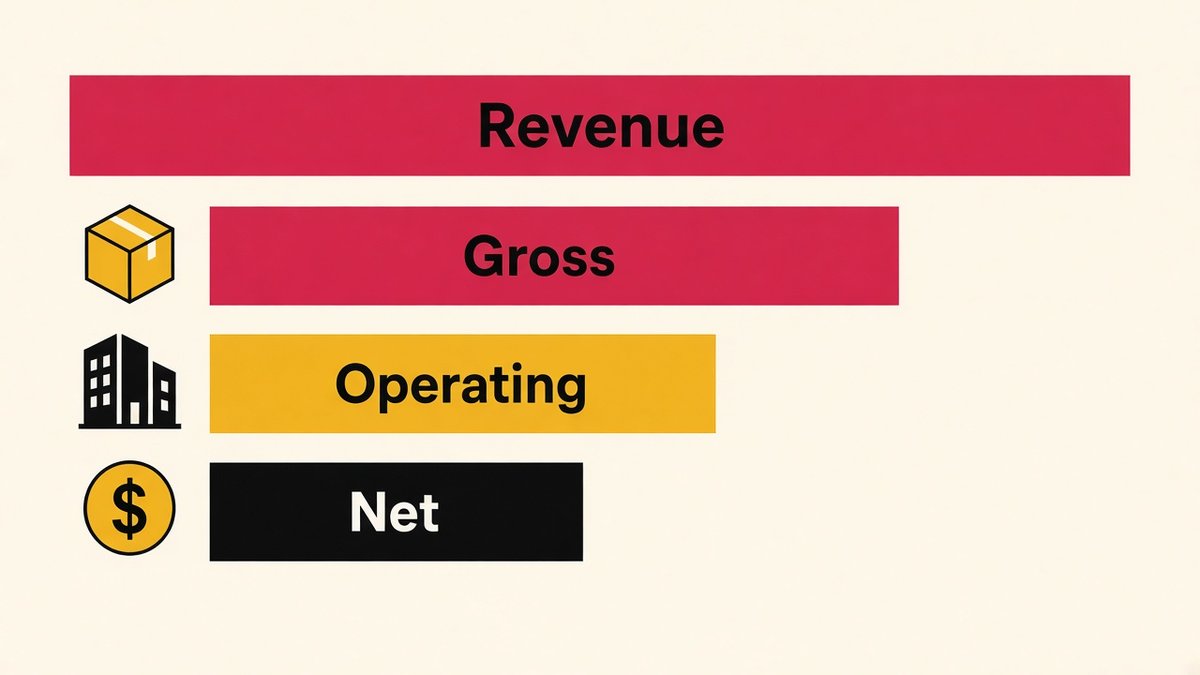
Gross, operating and net profit margin: each level removes more costs from the same revenue.
For a service business, cost of goods sold is usually the direct cost of delivering the work, such as freelancer fees or materials used on a job. For an online shop, it includes the product cost, packaging, payment processing fees and often delivery.
Profit margin formulas
| Margin | Formula | What it tells you |
|---|---|---|
| Gross profit margin | (Revenue − COGS) ÷ Revenue × 100 | Whether pricing covers direct costs with room to spare |
| Operating profit margin | Operating profit ÷ Revenue × 100 | How efficient day-to-day operations are |
| Net profit margin | Net profit ÷ Revenue × 100 | How much of each sale the business keeps in the end |
All three use the same revenue figure at the bottom of the fraction. Use net revenue: sales after refunds and discounts, and excluding VAT in the UK and EU or sales tax in the US. If you are VAT-registered, the VAT you collect goes to the tax authority, so including it would make your margin look better than it is.
💡 Use the same period for every number
Revenue and costs must cover the same month, quarter or year. Mixing a quarter of revenue with a month of costs is the most common reason margin calculations look wildly off.
How to calculate profit margin in 5 steps
Pick a period and pull your numbers
Export revenue and costs from your accounting software or bookkeeping spreadsheet for one month, one quarter or one year.
Calculate net revenue
Start with total sales, then subtract refunds, discounts and VAT or sales tax collected.
Separate direct costs from overheads
Put costs that rise with each sale (stock, materials, direct labour, payment fees) into COGS. Everything else, such as rent, software and marketing, is an operating expense.
Work out each profit figure
Gross profit is revenue minus COGS. Operating profit is gross profit minus operating expenses. Net profit is operating profit minus interest, tax and any one-off items.
Divide by revenue and multiply by 100
Each profit figure divided by net revenue, times 100, gives the margin as a percentage. Record it each period so you can see the trend.
⚠️ Do not forget your own time
Many owner-run businesses look very profitable because the founder takes no salary. Add a fair salary for your own work into operating expenses to see the real margin, especially before you raise prices or hire.
Profit margin examples
Here is how profit margin works out for three small businesses. All figures are illustrations to show the method, not benchmarks.
| Business (one year) | Revenue | COGS | Operating costs | Gross margin | Operating margin |
|---|---|---|---|---|---|
| Online shop selling skincare | $200,000 | $90,000 | $70,000 | 55% | 20% |
| Marketing consultancy | €150,000 | €30,000 (freelancers) | €75,000 | 80% | 30% |
| Café | £180,000 | £63,000 (food and drink) | £99,000 | 65% | 10% |
The consultancy has the highest gross margin because it sells expertise, not products. The café has a solid gross margin but thin operating margin, because rent and staff eat most of it. Each business would also subtract interest and tax to reach net margin.
Margins also differ by product inside one business. Calculate gross margin per product or service, not just overall. You may find that one popular item is barely profitable, which matters when you decide how to price your product or service.
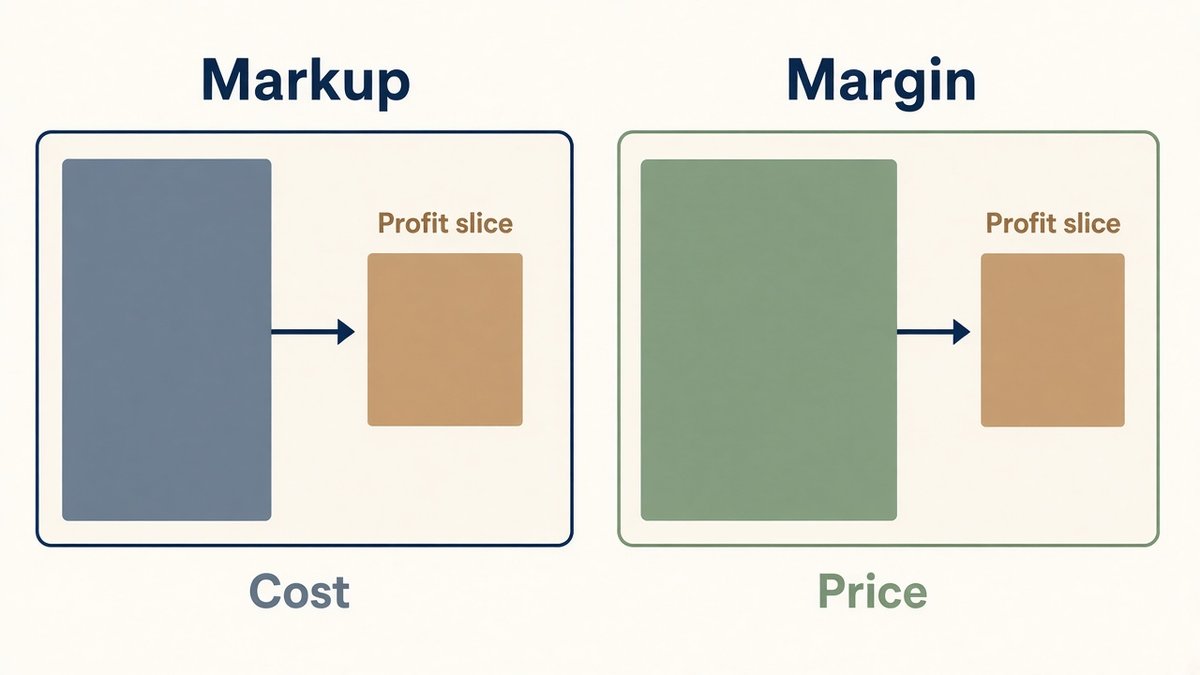
Profit margin vs markup: the same profit looks smaller as a share of price than as a share of cost.
Profit margin vs markup
Markup and margin both describe the gap between cost and price, but they divide by different numbers. Markup divides profit by cost. Margin divides profit by price. Mixing them up is one of the most expensive pricing mistakes a small business can make.
| Cost | Price | Profit | Markup (profit ÷ cost) | Margin (profit ÷ price) |
|---|---|---|---|---|
| $50 | $75 | $25 | 50% | 33% |
| $50 | $100 | $50 | 100% | 50% |
| $50 | $150 | $100 | 200% | 67% |
If you want a 40% margin, you cannot simply add 40% to your cost. Instead, divide the cost by (1 − target margin). For a $60 cost and a 40% target margin: $60 ÷ 0.6 = $100. Check the result: $40 profit on a $100 price is a 40% margin.
💡 Quick conversion
Margin = Markup ÷ (1 + Markup). Markup = Margin ÷ (1 − Margin). Keep both formulas in your pricing spreadsheet.
What is a good profit margin?
There is no single good profit margin. It depends on your industry, business model and stage. Software and consulting businesses often run high gross margins because they have few direct costs. Retail, restaurants and construction usually run lower margins and rely on volume.
Instead of chasing a universal number, use these checks:
- Compare with yourself: is your margin stable or rising over the last 6 to 12 months?
- Compare with your sector: trade associations, industry reports and your accountant can give typical ranges for businesses like yours.
- Cover your fixed costs: your gross margin must be high enough to pay overheads at realistic sales volumes. My guide on how to calculate your break-even point shows how to check this.
- Leave room for growth: marketing, hiring and new products need profit to fund them. A margin that only just covers costs leaves no buffer.
📌 Net margin can be negative for a while
Early-stage businesses often invest heavily in growth and show losses. That can be fine if gross margin is strong and you have a clear path to profit, but watch your cash runway closely.
How to improve your profit margin
Price
Charge what you are worth
Small, well-explained price increases often lift margin more than any cost cut. Test them on new customers first.
Costs
Cut direct costs
Negotiate with suppliers, buy in bulk where it makes sense, reduce waste and compare payment processors.
Mix
Sell more of what earns most
Promote your highest-margin products and services, and bundle or drop the ones that barely break even.
- Raise average order value: add-ons and bundles spread fixed costs over bigger sales. See my guide on how to upsell.
- Keep customers longer: repeat customers cost less to win, which protects operating margin. Read about customer lifetime value and customer acquisition cost.
- Audit subscriptions: review software and services every quarter and cancel what you no longer use.
- Reduce discounts: track how much discounting costs you each month; deep, frequent discounts quietly erode margin.
- Watch cash as well: faster invoicing and payment terms do not change margin, but they make profit usable sooner. My guide on how to improve cash flow covers this.
Profit margin calculation template
Copy this profit margin template into a spreadsheet. Keep one column per month or quarter so you can see the trend at a glance.
Profit margin template (one month, quarter or year)
Period: [start date] to [end date]
Revenue (excluding VAT or sales tax): [$ / €]
Cost of goods sold (materials, stock, direct labour, payment and delivery fees): [$ / €]
Gross profit = Revenue − COGS: [result]
Gross margin = Gross profit ÷ Revenue × 100: [%]
Operating expenses (rent, software, marketing, salaries not in COGS): [$ / €]
Operating profit = Gross profit − Operating expenses: [result]
Operating margin: [%]
Interest, tax and other items: [$ / €]
Net profit and net margin: [result] / [%]
Once you have a few periods filled in, compare gross margin by product and operating margin by quarter. Those two views usually show where to act first.
Frequently Asked Questions
How do you calculate profit margin?
Subtract costs from revenue to get profit, divide profit by revenue, then multiply by 100. For gross margin use cost of goods sold; for net margin use all costs including interest and tax.
What is the difference between gross and net profit margin?
Gross margin only subtracts the direct cost of what you sell. Net margin subtracts every cost, including rent, salaries, marketing, interest and tax, so it is always lower.
Should I include VAT or sales tax in revenue?
No. Use revenue excluding VAT or sales tax. The tax you collect belongs to the tax authority, so including it would overstate your margin.
Is a 50% markup the same as a 50% margin?
No. A 50% markup on a $50 cost gives a $75 price and a $25 profit, which is a 33% margin. To reach a 50% margin you need a 100% markup.
How often should a small business calculate profit margin?
Monthly is ideal for most small businesses, with a quarterly review of margin by product or service. Annual figures are useful for tax and lenders but too slow for decisions.
What is the fastest way to improve profit margin?
Pricing is usually the fastest lever. A modest price increase on new sales, or cutting your least profitable discounts, improves margin immediately, while cost savings and product mix changes take longer.
Now you know how to calculate profit margin at every level, how it differs from markup and how to lift it. Fill in the template with last quarter’s numbers today, then check your margins every month so pricing and cost decisions are based on facts, not guesses.