Knowing how to write a business proposal is the difference between a good sales call and a signed client. A strong proposal restates the client’s problem in their words, lays out a clear solution, scope, timeline and price, and makes saying yes feel like the obvious next step. This guide walks through the structure I use, how to present pricing with options, a copy-ready template, and the follow-up that turns a sent PDF into a deal.
✔ Key takeaways
⏱ About 8 min read · the short version is right here
- A proposal is a sales document, not a brochure: it should be about the client’s problem, the outcome and the next step.
- Always run a discovery call first. Proposals written without one are guesses, and clients can tell.
- Use nine sections: summary, problem, goals, solution, scope, timeline, pricing, proof and next steps.
- Offer three pricing options with the middle one as your recommendation, and price on value, not hours.
- Send it within 24 to 48 hours, walk the client through it live if you can, and follow up on a set schedule.
📋 In this guide
What a business proposal is (and is not)
A business proposal is a document you send to a specific prospect explaining how you will solve a specific problem, what it will cost and what happens next. It is different from a business plan, which is written for you or investors (see my guide on how to write a business plan for that), and from a quote, which only lists a price.
There are two broad kinds. A solicited proposal is one the client asked for, often after a call or as part of a formal request for proposal (RFP). An unsolicited proposal is one you send on your own initiative. Solicited proposals win far more often, which is why the discovery call matters so much.
| Document | Who it is for | Main job |
|---|---|---|
| Business proposal | One specific client | Win a project or contract |
| Quote or estimate | A client who already knows what they want | Confirm a price |
| Business plan | You, a bank or investors | Explain how the business will make money |
| Contract or statement of work | Both parties after a yes | Make the agreement legally binding |
Before you write: the discovery call
The best proposals are mostly written before you open a document. On a 30 to 45 minute discovery call, your only job is to understand the problem well enough to repeat it back better than the client can. Ask about:
- The problem: what is not working, and what it is costing them in money, time or stress.
- The goal: what success looks like in numbers and by when.
- What they have tried: previous agencies, tools or in-house attempts, and why they fell short.
- Budget: a range, even a rough one. “Projects like this usually run between $3,000 and $8,000; where do you sit?” works well.
- Decision process: who signs, who else has a say and when they want to start.
💡 Use their words
Write down the exact phrases the client uses to describe the problem. Quoting them back in the proposal makes it feel tailored and shows you listened.
The 9 sections of a winning proposal
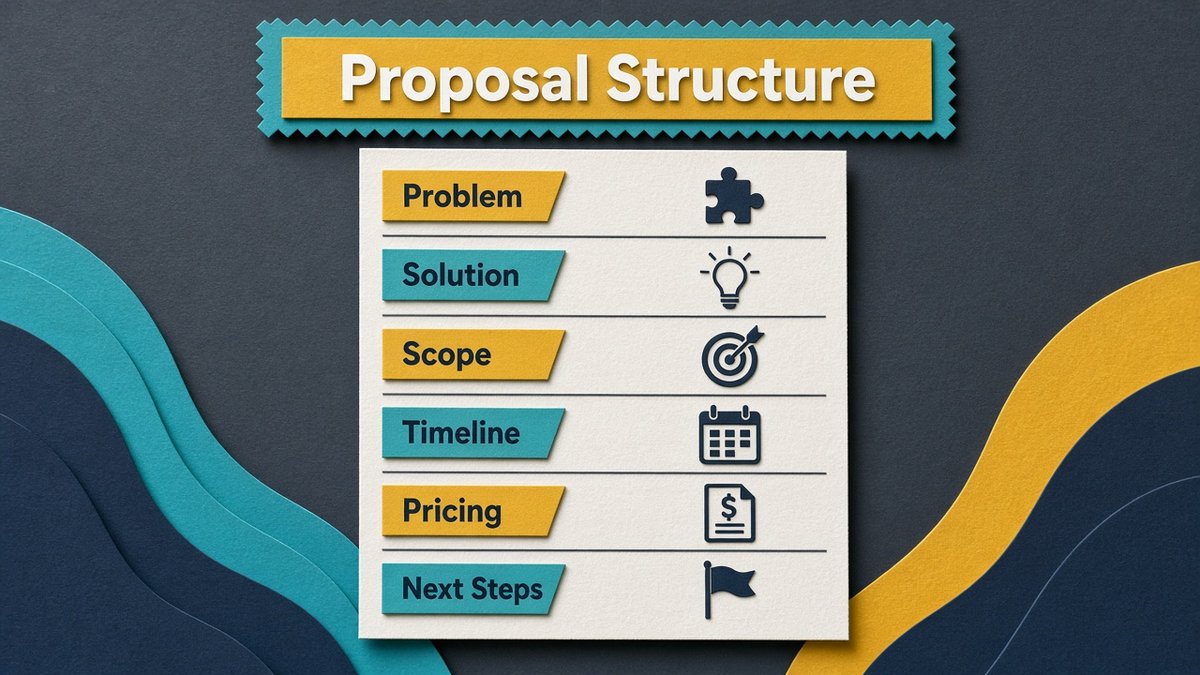
Illustrative outline of a business proposal: problem, solution, scope, timeline, pricing and next steps.
Every proposal I send follows the same skeleton. The order matters: problem and goals come before your solution and price, so by the time the client reaches the numbers they already agree they need help.
Executive summary
Three to five sentences: who the client is, the problem, your recommended solution, the expected outcome and the investment. Many decision-makers only read this part, so make it stand on its own.
The problem
Restate the challenge in the client’s words and add the cost of doing nothing, such as lost leads per month or hours wasted per week.
Goals and success measures
List two to four measurable goals, for example “increase booked calls from 8 to 20 a month by March”.
Your solution
Explain your approach in plain language. Focus on outcomes and why this approach fits them, not on every task you will perform.
Scope and deliverables
Be specific about what is included and, just as important, what is not. Clear scope prevents scope creep later.
Timeline
Break the work into phases or milestones with dates. Note what you need from the client, such as access or feedback, and when.
Pricing and options
Show the investment clearly, ideally as three options. More on this below.
Proof
Add one or two short results from similar clients. A brief case study or a couple of customer testimonials do more than a long About Us page.
Next steps
Tell the client exactly how to say yes: sign here, pay the deposit, book the kick-off call. Include a validity date for the offer.
How to present pricing
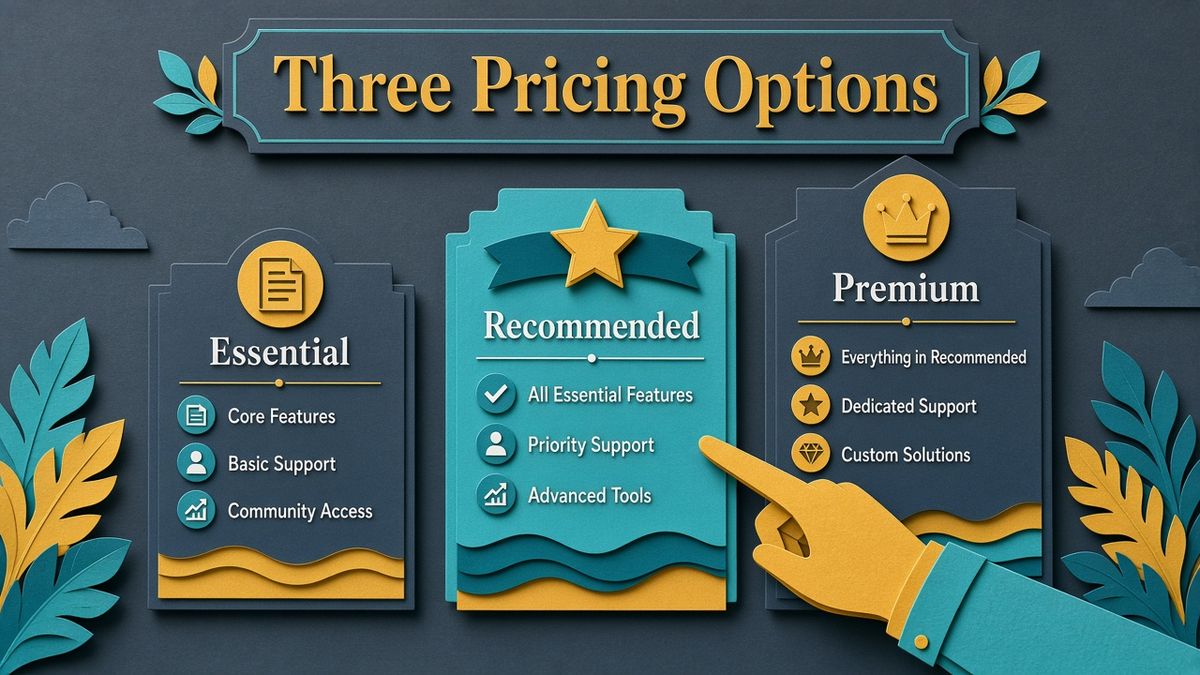
Illustrative three-option pricing section in a business proposal, with the recommended middle option highlighted.
Pricing is where most proposals lose the deal, usually because the price arrives as a single surprising number. Three habits help:
- Offer three options. An essential option, a recommended option and a premium option. Most clients pick the middle one, and the conversation shifts from “yes or no” to “which one”.
- Price on value, not hours. Anchor the price against the cost of the problem or the value of the goal. If the project could bring in $60,000 of new revenue, a $6,000 fee looks reasonable.
- Be clear about payment terms. Deposit, milestones, due dates and currency. For EU and UK clients, state whether prices include VAT.
| Option | What is included | Example price |
|---|---|---|
| Essential | Core deliverable only, standard timeline | $2,500 |
| Recommended | Core deliverable plus setup, training and 30 days of support | $4,500 |
| Premium | Everything above plus faster delivery and 90 days of support | $7,500 |
The example prices are illustrative only. If you are unsure where to set your numbers, read how to price your product or service, and when existing clients are due a change, how to raise prices without losing customers.
⚠️ Avoid hourly line items
Listing hours invites clients to negotiate each line. Group work into deliverables and price the outcome instead.
A simple proposal template you can copy
Copy this outline into your document editor and fill it in after each discovery call. It keeps proposals consistent and quick to produce.
Proposal for [Client name]: [Outcome] by [Date]
1. Summary: [Client] wants to [goal]. Today [problem] is costing roughly [cost]. We recommend [solution], delivered by [date], for [price].
2. The challenge: In your words, “[quote from call]”.
3. Goals: [Goal 1 with number and date]; [Goal 2].
4. Our approach: [Phase 1], [Phase 2], [Phase 3].
5. Scope: Included: [list]. Not included: [list].
6. Timeline: [Milestone and date] for each phase. We need [access or feedback] from you by [date].
7. Investment: Essential [price], Recommended [price], Premium [price]. [Deposit and payment terms; VAT note].
8. Results for similar clients: [One short result].
9. Next steps: Choose an option, sign below and pay the deposit by [date] to start on [date]. This proposal is valid until [date].
Contracts, VAT and GDPR basics
A proposal is persuasive; a contract is protective. Once the client says yes, put the agreement into a signed contract or statement of work that covers scope, payment, intellectual property, confidentiality and how either side can end the work. Many small businesses combine the two by adding terms and an e-signature block at the end of the proposal.
- US: e-signatures are generally valid under the federal ESIGN Act and state laws based on UETA.
- UK and EU: e-signatures are recognised under eIDAS (and the UK’s version of it). State whether your prices include VAT, and for EU business clients consider whether the reverse charge applies.
- GDPR: if the project involves handling the client’s customer data, you may need a data processing agreement alongside the contract.
📌 Not legal advice
This section is general information, not legal or tax advice. For large or unusual contracts, have a qualified lawyer or accountant in your country review the terms.
How to send and follow up
Speed matters. Send the proposal within 24 to 48 hours of the discovery call while the conversation is fresh. Better still, book a 20-minute call to walk the client through it live, so you can answer questions and handle objections in real time instead of waiting for silence.
Then follow up on a schedule rather than when you remember. A simple rhythm is day 2 (check it arrived and offer a walkthrough), day 5 (share a relevant result or answer a likely question) and day 10 (ask directly whether to keep the slot open). If you use a CRM, set these as tasks so none slip. Once they sign, a smooth client onboarding process keeps the momentum going.
| When | What to send |
|---|---|
| Day 0 | Proposal plus an offer to walk through it |
| Day 2 | Short check-in: any questions on scope or options? |
| Day 5 | A relevant result or answer to a likely objection |
| Day 10 | Direct question: should I hold the start date for you? |
Common proposal mistakes
- Talking about yourself first. Clients care about their problem; put your company story at the end, if at all.
- Vague scope. “Ongoing support” means different things to each side. Spell it out.
- One take-it-or-leave-it price. Options give clients a way to say yes on their terms.
- Too long. Most small-business proposals work best at four to eight pages.
- No deadline or next step. Without a validity date and a clear action, proposals stall.
- Skipping research. A quick look at the client’s market and rivals (my guide to competitor analysis helps) makes your solution sharper.
Frequently Asked Questions
How long should a business proposal be?
For most small-business projects, four to eight pages is enough. Lead with a one-paragraph summary so busy decision-makers can understand the problem, solution, price and next step without reading everything.
What is the difference between a proposal and a quote?
A quote simply lists prices for a defined job. A business proposal explains the client’s problem, your solution, the scope, timeline, proof and pricing options, and is designed to persuade the client to choose you.
Should I include pricing in a business proposal?
Yes. Clients expect to see the investment. Present it after the problem, goals and solution, ideally as three options, and state payment terms, currency and whether VAT is included.
Can a business proposal be legally binding?
It can be if it contains clear terms and both sides sign it, but it is safer to use a separate contract or statement of work. Rules differ by country, so get legal advice for large deals.
How soon should I follow up after sending a proposal?
Follow up within two days to confirm it arrived and offer a walkthrough, then again around day five and day ten. A fixed schedule keeps deals moving without feeling pushy.
What should I do if a client says the proposal is too expensive?
Ask which part of the value is not clear, then point to a smaller option rather than cutting your price. Reducing scope protects your margin and keeps the client’s trust.