Learning how to write a sales page is different from assembling a landing page. A landing page captures a click; a sales page makes the case for an offer — headline, story, proof, objections, guarantee and a clear next step. This guide is a copy-first walkthrough you can follow in one focused writing session, whether you sell a group programme, a digital course or a consulting package in the US, UK or EU.
✔ Key takeaways
⏱ About 10 min read · the short version is right here
- Decide the one offer and the one reader before you touch the headline.
- Write in this order: promise, problem, story, offer stack, proof, objections, guarantee, CTA, FAQ.
- Specific proof (named results, quoted buyers, a clear mechanism) beats adjectives.
- A sales page can be long if every section earns the next scroll; padding is what feels long.
📋 In this guide
- Sales page vs landing page
- Before you write: offer, buyer, promise
- The sales page outline that converts
- How to write a sales page section by section
- Proof, testimonials and specifics
- Layout, length and tools
- Honest claims, guarantees and privacy
- Mistakes that quietly kill the sale
- Ship the first version this week
- FAQ
Sales page vs landing page
People mix these two pages up, then wonder why a pretty opt-in form does not sell a €2,000 programme. A landing page is usually short: one promise, one form or button, little navigation. I cover structure and tools for that in how to create a landing page. A sales page is long-form sales copy. It answers “why you, why this, why now” and only then asks for the card or the call. Both sit inside a sales funnel — content or ads bring someone in, email warms them, the sales page closes.
Landing page
Capture
One promise, one form. Lead magnet, webinar registration, waitlist.
Sales page
Convince
Headline, offer, proof, objections, guarantee, CTA. The buying decision.
Thank-you / upsell
Continue
What happens after they buy or book — not the same document.
📌 Same site, different job
You can host both page types in the same builder. The difference is the copy, not the software.
Before you write: offer, buyer, promise
Do not open a blank page and hope a headline appears. Write three sentences on paper first: who this is for, what outcome you are selling, and what they must do next (buy, book, or apply). That is your value proposition in working clothes. If you cannot say it in one breath, the page will ramble.
- ☑ One reader: a specific person (“overwhelmed operations consultant in the UK who wants inbound leads”), not “anyone who wants success”
- ☑ One offer: one price, one start date or one booking type — save bundles for an order bump later
- ☑ One next step: checkout, application form or calendar, not all three as equals
- ☑ Mechanism: how your method works in plain language, so the result feels believable
- ☑ Proof you already have: a result, a quote, a screenshot, a named logo — gather it before you draft
💡 If the offer is fuzzy, fix that first
A sales page cannot rescue an unclear package. Productise the scope, timeline and price, then write. The page will almost write itself once the offer is honest.
The sales page outline that converts
Use the same skeleton every time. You can change the voice; do not invent a new structure for each launch. Readers have seen good sales pages before — they are looking for answers, not a plot twist.
| Section | Job it does | Typical length |
|---|---|---|
| Headline + subhead | Name the reader and the outcome | 1–2 sentences |
| Lead / opening story | Show you understand the status quo and the cost of staying there | 2–4 short paragraphs |
| Promise and mechanism | What changes, and why your approach can cause it | A short section plus bullets |
| Offer stack | What they get, what it includes, what it is not | Bullets, maybe a comparison table |
| Proof | Evidence from people like them | Quotes, numbers, a mini case study |
| Objection handling | Answer the quiet “yes, but” list | FAQ-style blocks or a myth/fact pair |
| Guarantee | Reduce the felt risk of saying yes | 1 clear paragraph |
| CTA (repeated) | Tell them exactly what to click and what happens next | Buttons after proof, guarantee and close |
| FAQ / fine print | Logistics: start dates, VAT, refunds, who it is not for | 5–8 questions |
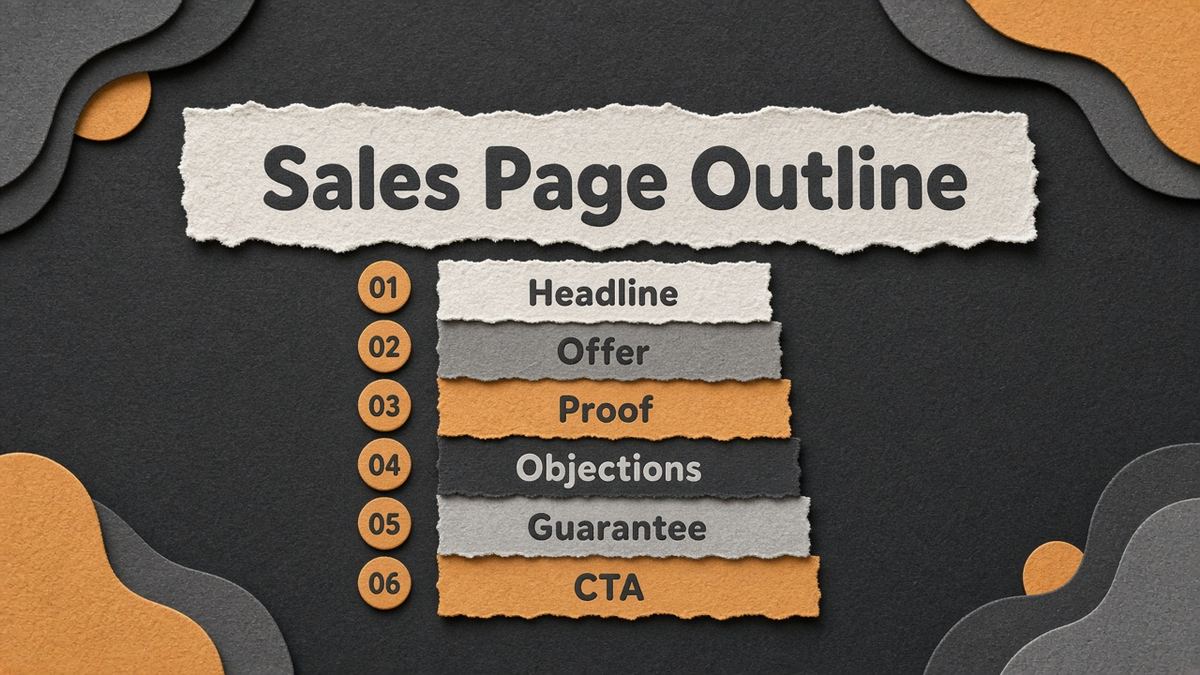
Illustrative sales page outline showing headline, offer, proof, objections, guarantee and call-to-action blocks in order.
How to write a sales page section by section
Write the headline last-first
Draft a working headline that says who it is for and what they get: “A 90-day pipeline reset for independent consultants who are tired of feast-or-famine retainers.” Then write the page. Come back and tighten the headline so every important word earns its place. Avoid clever puns that hide the offer.
Open on their status quo
The first screen should feel like you overheard their Tuesday. Name the workaround they already tried (more posts, cheaper leads, longer hours) and the cost of another quarter like this. Empathy is not sympathy; it is accuracy.
State the promise and the mechanism
Tell them the outcome in their language, then the “how” in yours. A mechanism (“we rebuild your offer around one inbound asset and a weekly conversion conversation”) makes the promise feel designed rather than magical. If you cannot explain the how, the page will lean on hype.
Stack the offer without fluff
List modules, calls, templates or access as concrete items. Add what is not included (ad spend, extra seats, custom legal) so operations does not fight you later. A simple table of “you do this / I do that” prevents disappointment.
Handle objections in their words
Price, time, “I have been burned”, “I should wait until January”, “I need to ask my co-founder”. Answer each with a short, specific paragraph — not a slogan. Link to a deeper case study if one story does the heavy lifting.
Write the guarantee and the CTA as a pair
A guarantee without a clear button is theatre; a button without risk-reversal asks for bravery. Say exactly how refunds or pause clauses work. Then the button label should be the next step (“See pricing and enrol”, “Apply for a strategy call”), not “Submit”.
Repeat a short CTA after the offer, after the strongest proof, and at the end. Readers arrive from email at random scroll depths. They should never have to hunt for what to do next.
💡 Read it out loud on your phone
If you run out of breath, the sentence is too long. If you skip a paragraph while skimming, cut or turn it into a subhead. Sales pages are read in fragments.
Proof, testimonials and specifics
Proof is the difference between a brochure and a sales page. Borrow from the work you already did to get customer testimonials: a named person, a specific starting point, a result, and permission in writing. One detailed story beats six “great to work with” lines. If you have a fuller write-up, excerpt it and link the case study rather than pasting the whole thing.
Use numbers the customer approved. “Cut onboarding from 14 days to 6” is evidence. “Skyrocket your revenue” is an adjective. In the UK and US, keep claims consistent with advertising rules: you should be able to back up a typical-result statement, and you should not imply that unusual results are normal. When a result is exceptional, say so.
| Weak line | Stronger line |
|---|---|
| “Clients love our process” | “Maya, a Manchester-based designer, cut her proposal time from two days to one afternoon after the second workshop.” |
| “Proven system” | “You get the same 5-call sequence we used with 12 retainers last year — the agenda for each call is in the syllabus.” |
| “Join hundreds of students” | “47 people finished the April cohort; 39 completed the implementation homework.” |
⚠️ Do not invent social proof
Never write a composite quote as if it were one person, and never publish a metric a client has not signed off. Fake proof is a legal and trust problem, not a copywriting trick.
Layout, length and tools
Layout should serve scanning: a clear H1, short paragraphs, subheads that still make sense if someone only reads those, and buttons that look like buttons. On mobile, fat paragraphs become a wall. Put the price near the offer — hiding it until the last line feels like a trick. Long enough to answer a careful buyer is the right length; padding is what feels long. A low-ticket template can close in a few screens. A high-ticket application usually needs more proof and FAQ.
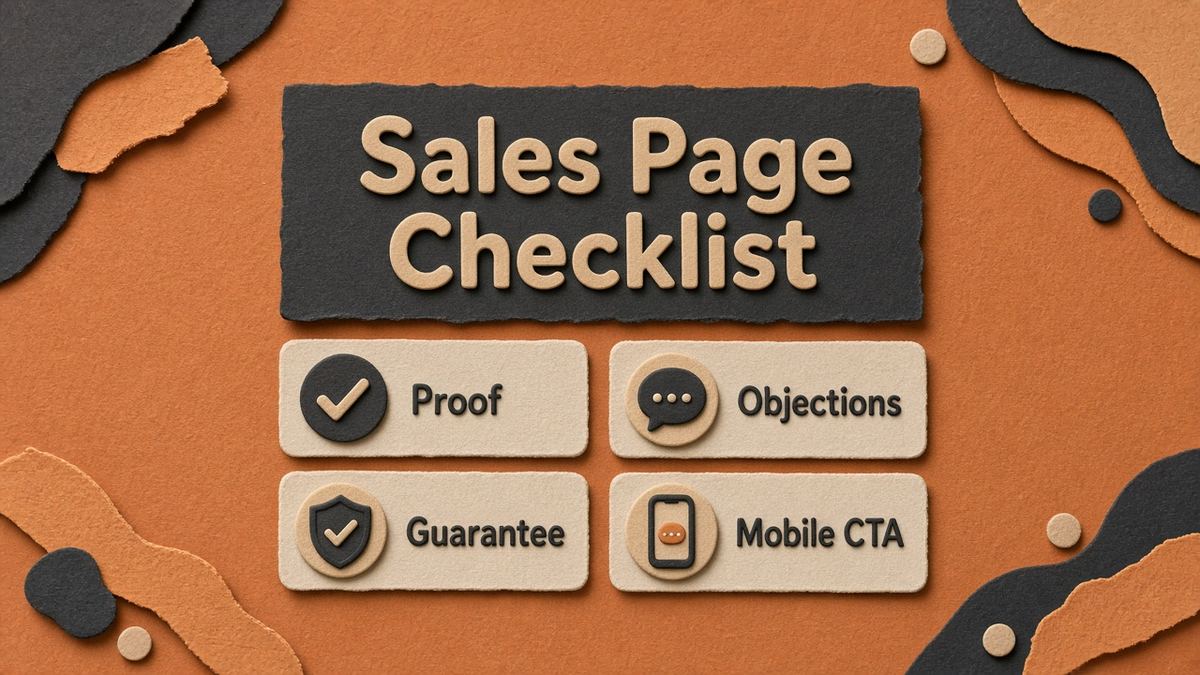
Illustrative sales page checklist covering headline, offer stack, proof, objections, guarantee and mobile call-to-action placement.
You do not need a custom-coded site to ship this. Systeme.io lets you build the page, connect email follow-up and take payment in one account, which is why I use it when the sales page is part of a funnel rather than a one-off PDF. A free plan is available if you want to draft the layout before you pay (Systeme.io’s published USD plans, checked 8 November 2026 on systeme.io/pricing, start at $0, then Startup at $17/month, Webinar at $47/month and Unlimited at $97/month; annual billing is advertised as two months free). If you already think in funnel canvases and want a dedicated builder trial, ClickFunnels is a common alternative — check current pricing on their signup page, because plan names and promotions change. More tool write-ups live in the Reviews hub.
Build the page and the follow-up in one place
Draft your sales page in Systeme.io, connect a welcome sequence, and take payment without stitching three separate tools together.
Affiliate link. I may earn a commission at no extra cost to you.
Honest claims, guarantees and privacy
If you sell to people in the UK or EU, say who you are, what they will pay (including VAT where it applies), and how they can cancel or get support. A guarantee should match what you will actually honour. Collect email consent the same way you would on any other form (GDPR/PECR in Europe; CAN-SPAM basics in the US). Health, finance and income claims need extra care. This is general information, not legal advice.
Mistakes that quietly kill the sale
The usual failures are predictable: a headline that could sit on anyone’s page, an offer that lists hours instead of outcomes, proof that is only your opinion, a single CTA buried in the footer, or a price with no context. Another leak is mismatch with your ads or emails. If the ad promised “a 30-minute diagnostic for operations consultants” and the page opens with “scale your empire”, people bounce. Match the message from click to headline to button.
Ship the first version this week
Outline in 20 minutes
Copy the section list above into a doc. Bullet the content of each block. Do not polish.
Write a messy full draft in one sitting
Set a timer for 90 minutes. You are allowed to be blunt. You are not allowed to redesign the colour palette.
Drop in proof you already have
Add two quotes and one specific result. Highlight anything you still need to confirm with a client.
Build it in your page tool
Move the draft into Systeme.io (or ClickFunnels if that is already your builder). Check mobile: headline, first CTA, price and button.
Read it as a sceptic
Print or preview, then argue with every claim. Fix the weakest paragraph, not the font. Ask one customer or colleague who matches the buyer to mark where they got bored.
💡 Ship version one
A clear page that exists will outperform a perfect page you are still tweaking on Friday night. Collect questions from the first ten readers and add them to the FAQ.
Frequently Asked Questions
How do I write a sales page if I am not a copywriter?
Use a fixed outline, write like you talk on a good sales call, and replace adjectives with specifics. You need clarity, proof and one next step — not literary flair.
How long should a sales page be?
Long enough to answer a careful buyer’s questions and short enough that no section is decoration. Higher-ticket offers usually need more proof, objections and FAQ.
What is the difference between a sales page and a landing page?
A landing page captures a click, usually an email or registration. A sales page makes the case for an offer. They can share a builder; they should not share the same copy.
Where should the price appear?
Near the offer stack, with context about what is included, then again near the final CTA. Hiding it until the last line often feels like a trick.
Do I need testimonials before I publish?
Real ones help, but do not invent them. If you are early, use a clear mechanism, a transparent guarantee and any permissioned results you have, then add quotes as they arrive.
What tool should I use to build the page?
Any builder with a clean mobile layout, checkout or form, and follow-up email. Systeme.io covers page, email and payments in one account; ClickFunnels is a funnel-first alternative.
Affiliate disclosure: some links in this post are affiliate links, so I may earn a commission at no extra cost to you. I only recommend tools I’d use myself.