Knowing how to raise prices without losing clients is one of the most profitable skills a small business owner or freelancer can learn. Costs go up every year, your skills improve, and yet many of us charge the same rate we set when we started, because we are afraid the best clients will walk. Most of them will not, if you do it with good timing, fair notice and a clear explanation.
This is a practical playbook, not theory. Below are the six steps I use, a copy-ready email, and the mistakes that actually cause people to leave.
✔ Key takeaways
⏱ About 6 min read · the short version is right here
- Raise prices a little every year rather than a lot every few years; 5% to 15% is easy for most clients to absorb.
- Give 30 days’ notice for monthly work and 60 to 90 days for retainers and B2B contracts.
- Keep the message short: what changes, when, why, and what the client gets.
- Offer a smaller package instead of a discount when someone pushes back.
1. Check the signs that you are undercharging
Before you change anything, make sure the increase is justified. You are probably due if two or more of these are true:
- You are booked out or have a waiting list.
- You have not changed prices in 12 months or more, while inflation and your own costs have risen.
- Prospects say yes immediately, with no negotiation at all.
- Your results, credentials or speed have clearly improved.
- Competitors with similar quality charge noticeably more.
If you set your original price by gut feel, revisit the basics in my guide on how to price your product or service. It walks through cost-plus, value-based and competitor pricing.
2. Decide how much, and for whom
Small, regular increases feel normal. Big, rare ones feel like a shock. For most service businesses an annual increase of 5% to 15% is easy to absorb; anything over 20% needs a stronger story, such as a new deliverable or a clearly better outcome.
You also do not have to treat every client the same. A common approach is to raise prices for new clients first, then move existing clients up after a notice period, and keep a small ‘loyalty’ gap for your longest-standing accounts if you want to.
| Approach | Best for | Risk of churn |
|---|---|---|
| New clients only | Testing a much higher price | Very low |
| Everyone, 5–10% yearly | Retainers and subscriptions | Low |
| Everyone, 15–25% once | Long overdue corrections | Medium; add more value |
| Tiered: old rate stays on a reduced package | Price-sensitive clients | Low; keeps them in your world |
💡 Grandfather with an end date
If you protect existing clients from an increase, give the protection a date (for example, ‘your current rate holds until 31 March’). Open-ended grandfathering quietly becomes a permanent discount.
3. Give proper notice
Surprise is what upsets clients, not the number itself. Aim for at least 30 days’ notice for monthly work and 60 to 90 days for retainers, annual contracts or B2B clients who need to update a budget. Check your contracts too: some terms in the US, UK and EU require written notice before prices change, and subscription rules in several countries require clear notice before a renewal at a higher price.
Time it well. Avoid announcing a rise straight after a missed deadline or a complaint. The best moment is right after a visible win, such as a successful launch or a strong quarterly report.
4. Explain it simply (with a script)
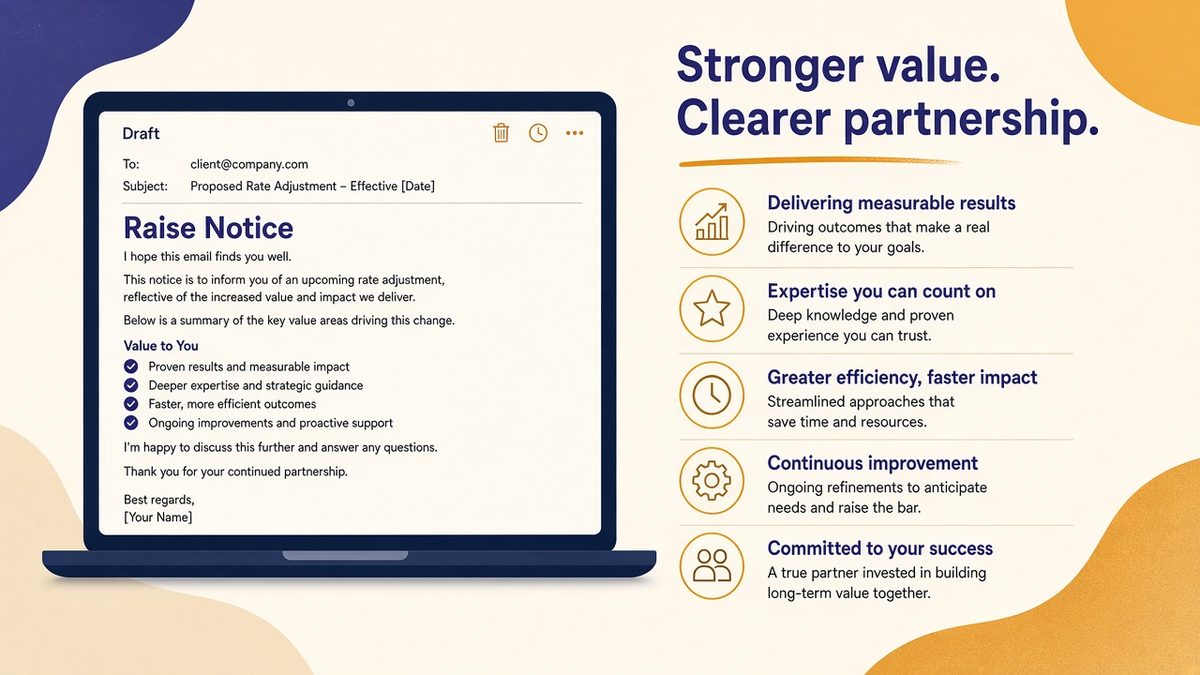
A short, confident price increase message: what changes, when, why, and what stays the same.
Keep the message short, warm and specific. You do not need to apologise or justify every cost. Clients want to know four things: what is changing, when, why, and what they get. Here is a template you can adapt:
Subject: An update to my rates from 1 February
Hi Sarah,
Thank you for another great year working together. Seeing your sign-ups grow 40% since spring has been a highlight for me.
I’m writing to let you know that from 1 February my monthly retainer will move from $1,500 to $1,650. This reflects the extra reporting we added this year and rising software and running costs. Everything you get today stays the same, and I’m adding a quarterly strategy call at no extra charge.
If you’d like to talk it through, or look at a lighter package, just reply and we’ll find a time.
Best,
Neeraj
⚠️ Do not over-explain
Long paragraphs about your rent, your software bills and your personal life invite negotiation. One sentence of reason is enough. Confidence reads as value; apology reads as doubt.
5. Add value people can see
An increase lands far better when it comes with something new. It does not have to be expensive to deliver:
- A monthly or quarterly results report.
- Faster response times or a priority support channel.
- A short strategy session each quarter.
- Templates, checklists or a resource library.
- A clearer package structure with good, better and best tiers.
Tiers are especially useful. When clients can choose a smaller package at roughly their old price, the conversation changes from ‘pay more or leave’ to ‘which option suits you’. If you sell online, an all-in-one tool such as Systeme.io makes it easy to set up tiered checkout pages and an onboarding email sequence for each package without paying for separate software.
6. Handle pushback calmly
Some clients will ask questions. A few will push back. That is normal and usually not a sign they are leaving.
Listen first. Ask what concerns them: budget timing, scope, or value. Each needs a different answer.
Offer options, not discounts. A smaller scope, a later start date for the new rate or a longer commitment at a slightly lower price all protect your rate card. Discounting the new price on the spot teaches clients that every increase is negotiable.
Accept that a few may go. If you lose 5% of clients after a 15% increase, you usually earn more and work less. The clients who leave on price are often the ones who also take the most time. My piece on the habits of successful salespeople has more on holding firm without being pushy.
📌 Track the result
Watch revenue, churn and average deal size for three months after the change. If churn barely moves, you probably raised too little. My free KPI tracker template has columns for exactly these numbers.
Products and subscriptions: a slightly different playbook
If you sell physical or digital products rather than services, you rarely send personal emails. Instead, announce the change on your site and to your list a couple of weeks ahead, which often creates a useful ‘buy before the price rises’ bump. For subscriptions, honour the current price until the next renewal, state the new amount and date clearly, and make cancellation easy. Clear notice is both good practice and, in many places, a legal requirement for recurring billing. Launching a new version or bundle at the higher price, while the old one sells out, is another low-friction route.
Mistakes that actually lose clients
- Announcing the increase on the invoice, with no warning.
- Raising prices right after a service problem.
- Sending a vague message with no date or new figure.
- Caving instantly the first time someone objects, then raising everyone else anyway.
- Waiting three years and then jumping 40% in one go.
Final thoughts
Raising prices is not a betrayal of loyal clients. It is how you keep delivering the quality they hired you for. Check the signs, choose a sensible amount, give fair notice, explain it in a few lines, add visible value and stay calm when someone asks questions. Do that once a year and price increases stop feeling dramatic for you and your clients.
Affiliate disclosure: some links in this post are affiliate links, so I may earn a commission at no extra cost to you. I only recommend tools I’d use myself.