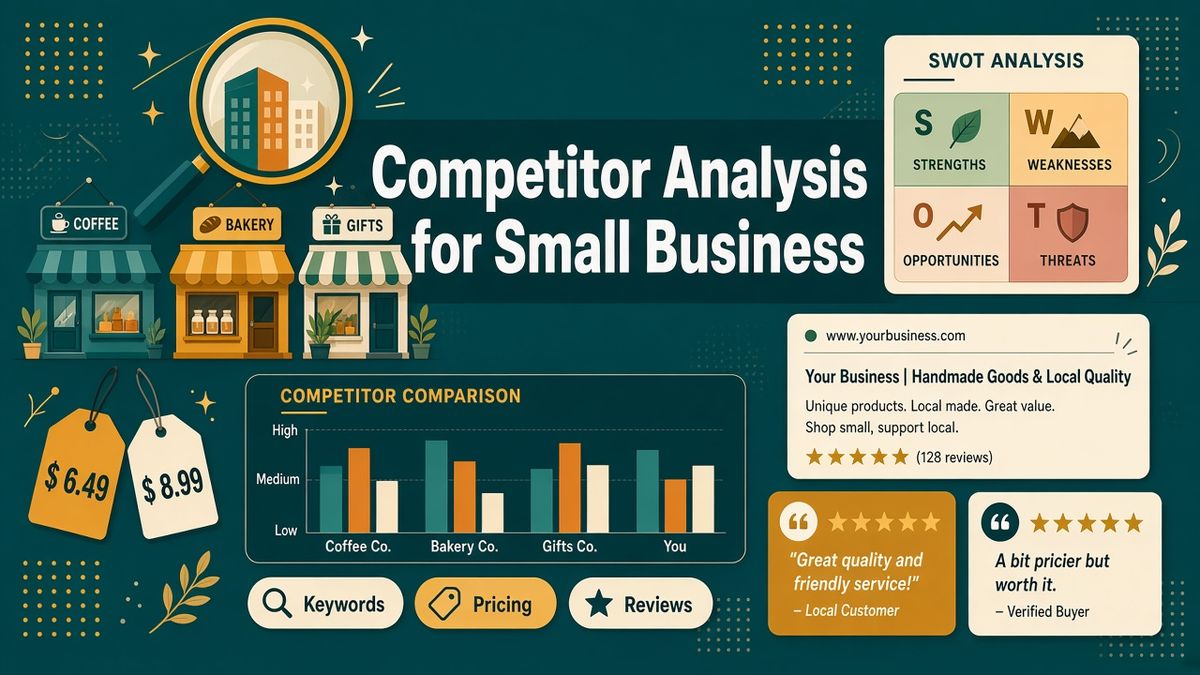
A competitor analysis for small business owners is a simple, structured look at who else your customers could buy from, what those rivals do well and where they leave gaps you can win. You do not need an agency or a 40-page report. With a free afternoon, a spreadsheet and a few tools, you can find the keywords your competitors rank for, the prices they charge, the complaints their customers post and the content they have not written yet. This guide walks you through the whole process step by step, with a ready-to-copy template, examples for businesses in the US, UK and Europe and a clear plan for turning findings into action.
✔ Key takeaways
- A competitor analysis for small business should take hours, not weeks: focus on 3 to 5 real rivals.
- Include direct competitors, indirect competitors and the businesses that outrank you on Google.
- A keyword gap analysis shows the searches your rivals win that you are missing.
- Customer reviews are the fastest way to find a competitor’s real weaknesses.
- Put everything in one template table, then turn the gaps into 3 to 5 concrete actions.
- Repeat a light version every quarter, because markets and search results change.
📋 In this guide
- What is a competitor analysis?
- Why small businesses need one
- How to do a competitor analysis in 7 steps
- Competitor analysis template (copy this table)
- SEO and keyword gap analysis
- Reviews and SWOT: finding real weaknesses
- Free and paid competitor analysis tools
- Turn your findings into actions
- Common mistakes to avoid
- Frequently Asked Questions
- Final thoughts
What is a competitor analysis?
A competitor analysis is the process of identifying the businesses that compete for your customers and comparing them with your own business across the things that matter to buyers: product, price, positioning, marketing channels, search visibility and customer experience.
For a large company, this can be a formal market research project. For a small business, it is much more practical. You want answers to a few questions: Who do customers compare me with? Why would they choose them instead of me? What could I do better, faster or differently? Where is there demand nobody is serving well?
📌 Competitors are not only the obvious ones
Your competitors include anyone solving the same problem for the same customer. A local accountant competes with other firms, but also with Xero’s built-in tools, freelancers on Upwork and the free advice blog that ranks above them on Google.
Why small businesses need one
Small businesses often skip competitor research because they feel too busy, or because they assume they already know the market. In practice, a quick structured analysis pays off in several ways:
- Better positioning: you see what everyone else says, so you can say something different and clearer.
- Smarter pricing: you understand where you sit on price and what customers get at each level.
- Faster SEO wins: you find keywords and topics competitors rank for that you can target with better pages.
- Product ideas: complaints in competitor reviews show features, services or guarantees customers want.
- Less wasted spend: you see which channels competitors invest in and which ones they have abandoned.
It also feeds directly into your planning. If you are writing a marketing plan this quarter, your competitor analysis becomes the market section, and it makes every later decision easier.
How to do a competitor analysis in 7 steps
Here is the step-by-step process I recommend. Work through it in order and fill in the template table in the next section as you go.
Identify your real competitors
List 3 to 5 direct competitors (same product, same customers), 2 to 3 indirect competitors (different solution, same problem) and the sites that rank on page one of Google for your main keywords. Ask a few customers who else they considered. Their answers are often surprising.
Run an SEO and keyword gap check
Enter each competitor domain into an SEO tool and compare the keywords they rank for with yours. Note their estimated organic traffic, top pages and the keywords where they rank but you do not. This is your keyword gap.
Audit their content
Look at their blog, guides, videos and lead magnets. Which topics do they cover? How deep and up to date is the content? Which pages earn the most links or traffic? Note topics they cover badly or not at all.
Compare pricing and offers
Record their prices, packages, free trials, guarantees, minimum contracts and payment options. Check whether prices include VAT for UK and EU buyers. Note how they present value, not just the number.
Read their customer reviews
Read 20 to 30 reviews per competitor on Google, Trustpilot, G2, Capterra, Amazon or Yelp. Group the praise and the complaints. Three-star reviews are often the most useful because they are balanced.
Check their social media and email
Look at which platforms they use, how often they post, what gets engagement and how they collect email subscribers. Join their newsletter to see their welcome emails and offers.
Summarise with a SWOT and pick actions
Write a short SWOT for your own business in light of what you found, then choose 3 to 5 specific actions with owners and deadlines. An analysis that does not change anything is wasted time.
💡 Set a time limit
Give yourself about 60 to 90 minutes per competitor. That is enough for a useful picture without turning research into procrastination.
Competitor analysis template (copy this table)
Copy this table into Google Sheets or Excel. Add one column per competitor and keep one for your own business so the gaps are obvious at a glance.
| Area | What to record | Where to find it |
|---|---|---|
| Basics | Name, website, location, size, years in business | Website, LinkedIn, Companies House or local registry |
| Target customer | Who they serve and the main problem they solve | Homepage headline, About page, ads |
| Offer and pricing | Packages, prices, trials, guarantees, VAT shown or not | Pricing page, quote requests |
| Positioning | Main promise and how they differ | Homepage, taglines, ad copy |
| SEO visibility | Estimated traffic, top pages, top keywords, keyword gap | SEO tool, Google search |
| Content | Blog topics, frequency, depth, lead magnets | Blog, resources page, YouTube |
| Reviews | Average rating, common praise, common complaints | Google, Trustpilot, G2, Amazon, Yelp |
| Social and email | Main platforms, posting frequency, newsletter offer | Social profiles, sign-up forms |
| Strengths | What they clearly do better than you | Your notes from all of the above |
| Weaknesses / gaps | What customers dislike or what nobody offers | Reviews, content gaps, keyword gap |
📌 Keep it to one page
If your template grows beyond one screen per competitor, you are probably recording detail you will never use. Keep only what can change a decision.
SEO and keyword gap analysis
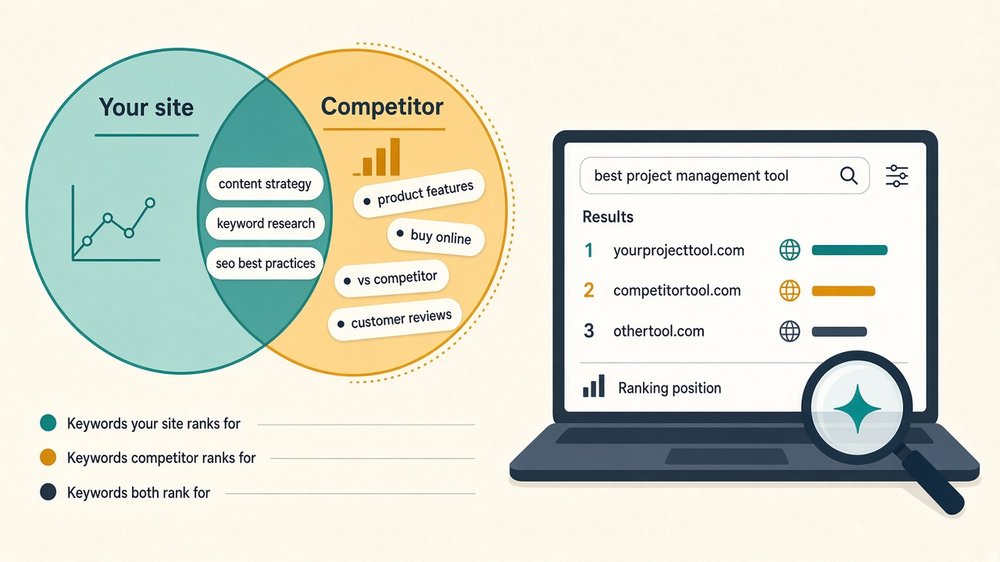
A keyword gap analysis compares the keywords each competitor ranks for with yours, so you can spot the searches you are missing.
For many small businesses, the most valuable part of a competitor analysis is search. If a rival appears on Google every time a customer searches for your service, they win enquiries you never see. A keyword gap analysis shows exactly which searches those are.
- Missing keywords: terms all your competitors rank for but you do not. These are usually the clearest opportunities.
- Weak keywords: terms where you rank, but lower than competitors. Improving an existing page is often faster than writing a new one.
- Unique keywords: terms only one competitor ranks for. These can reveal a niche service or a clever content idea.
- Top pages: the competitor pages that bring the most traffic. Study their format, depth and structure.
You can do a rough version for free by searching your main keywords in a private browser window and noting who ranks. For a full list, you need an SEO tool. I use SE Ranking for this because its competitive research and keyword gap reports are easy to read and much cheaper than enterprise tools. You enter your domain and up to a few competitor domains, and it shows the overlapping and missing keywords with volume and difficulty.
Once you have the list, filter for keywords with clear buying intent and realistic difficulty, then map each one to a page. My guide to keyword research for small business explains how to judge volume, difficulty and intent before you commit to a topic.
⚠️ Do not copy competitor pages
Use competitor pages to understand what searchers expect, then make yours more useful, more current and more specific. Copying content can hurt your rankings and your reputation.
Reviews and SWOT: finding real weaknesses
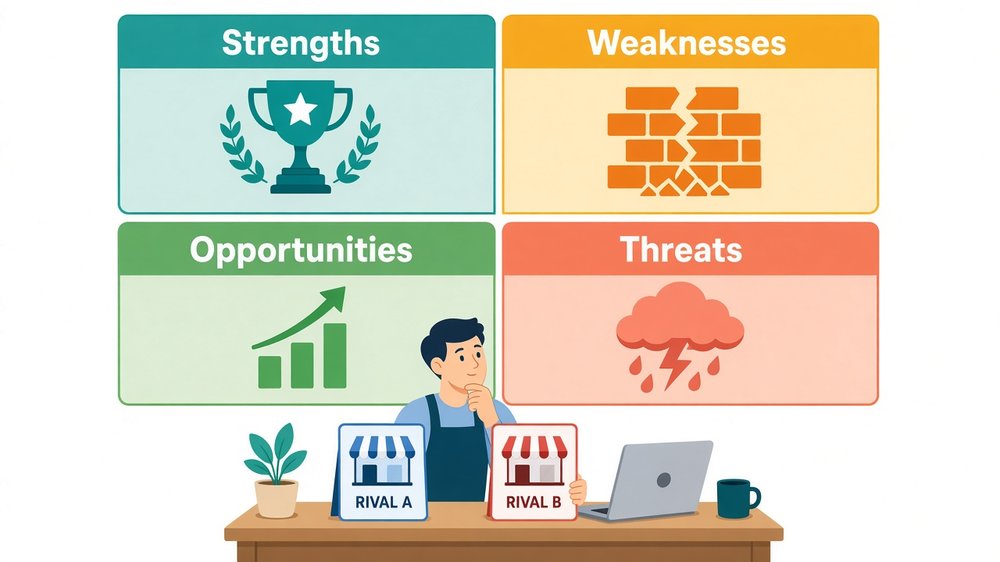
A simple SWOT grid turns your competitor research into strengths, weaknesses, opportunities and threats for your own business.
Reviews are the closest thing to free customer research. When people complain about a competitor, they are telling you exactly what they would pay for. Look for patterns, not one-off rants:
- “Never answers the phone” suggests responsiveness could be your edge.
- “Hidden fees” suggests transparent, all-in pricing could win trust.
- “Great product but slow delivery” suggests speed is a real buying factor.
- “Wish they offered…” points directly at a gap in the market.
Then write a short SWOT analysis for your own business, using what you learned about competitors:
| SWOT area | Questions to answer | Example (local bookkeeping firm) |
|---|---|---|
| Strengths | What do customers praise us for that rivals lack? | Same-day replies, fixed monthly fees |
| Weaknesses | Where do competitors clearly beat us? | Few online reviews, weak Google visibility |
| Opportunities | What gaps or unmet needs did we find? | No local rival offers bookkeeping for Etsy and Shopify sellers |
| Threats | What could take customers away? | Cheaper app-based services, a national firm opening locally |
Keep each box to 3 to 5 bullet points. The goal is focus, not a long document.
Free and paid competitor analysis tools
You can start a competitor analysis for small business with free tools and upgrade only when you need more data:
| Tool | Cost | Best for |
|---|---|---|
| Google search (private window) | Free | Seeing who ranks for your main keywords |
| Google Search Console | Free | Your own keywords and positions to compare against |
| Meta Ad Library | Free | Ads competitors are running on Facebook and Instagram |
| Review sites (Google, Trustpilot, G2) | Free | Customer praise and complaints |
| SE Ranking | Core plan $129/month, or $103.20/month billed yearly (14-day free trial) | Competitor traffic, keyword gap, backlinks and rank tracking |
I checked SE Ranking’s pricing page on 28 October 2026: the Core plan was $129 per month, or $103.20 per month on annual billing, and the Growth plan was $279 per month. Prices are shown in USD, so readers in the UK and Eurozone should check the final amount in their currency. If you want to compare it with other options, see my roundup of Semrush alternatives for small business.
⚠️ Check prices before you buy
Software prices change often. The figures above were correct when I checked, but always confirm on the official pricing page.
📌 GDPR and ethical research
Stick to public information. Do not scrape personal data, pose as a customer to extract confidential details or collect competitors’ customer lists. If you are in the UK or EU, personal data you gather, even from public profiles, is still covered by GDPR.
Turn your findings into actions
This is where most competitor analyses fail. Turn every insight into a specific action:
| Finding | Action | Timeframe |
|---|---|---|
| Competitors rank for 15 service keywords you miss | Create or improve 3 service pages targeting the best ones | Next 30 days |
| Rivals have poor reviews for slow replies | Promise and publish a 2-hour response time | This week |
| Nobody offers a starter package | Launch a simple entry-level offer with clear pricing | Next quarter |
| Competitors post weekly guides that get links | Publish one in-depth guide per month on gap topics | Ongoing |
| A rival runs the same Facebook ad for months | Test a different angle on the same audience | Next 30 days |
Then ask the bigger question: how will you stand out? My older post on 7 ways to dominate a competitive market covers positioning ideas, and your findings should slot straight into your marketing plan.
Common mistakes to avoid
- Tracking too many competitors: 3 to 5 is enough. More just creates noise.
- Only looking at the biggest brand: compare yourself with businesses your customers actually consider.
- Copying instead of differentiating: matching a rival feature for feature makes you a cheaper copy.
- Ignoring indirect competitors: DIY tools, apps and free content can be bigger threats than other firms.
- Doing it once and forgetting it: set a quarterly reminder for a 1-hour refresh.
- Making no decisions: every analysis should end with a short action list.
Frequently Asked Questions
How do I do a competitor analysis for a small business?
List 3 to 5 direct competitors plus a few indirect ones, then compare their SEO visibility, content, pricing, reviews and social media with yours in one template table. Finish with a short SWOT analysis and 3 to 5 concrete actions.
How many competitors should I analyse?
Most small businesses should analyse 3 to 5 direct competitors and 2 to 3 indirect ones. Add the sites that rank on page one for your main keyword, even if they are not businesses like yours.
What is a keyword gap analysis?
A keyword gap analysis compares the keywords your website ranks for with the keywords your competitors rank for. It shows searches you are missing or ranking lower for, so you can create or improve pages to target them.
Can I do a competitor analysis for free?
Yes. Google search, Google Search Console, the Meta Ad Library, review sites and competitor websites cover the basics. A paid SEO tool such as SE Ranking adds traffic estimates, keyword gaps and backlink data when you need more detail.
How often should I update my competitor analysis?
Do a full analysis once a year or when you launch something new, and a light 1-hour check every quarter for pricing changes, new competitors and shifts in search rankings.
Is competitor analysis legal under GDPR?
Researching public business information such as websites, prices, ads and reviews is normal and lawful. Avoid collecting or storing personal data about individuals without a lawful basis, and never use deceptive methods to obtain confidential information.
Final thoughts
A competitor analysis for small business is not about obsessing over rivals. It is about understanding the choices your customers have, so you can give them a clearer reason to choose you. Pick 3 to 5 competitors, fill in the template, find your keyword gaps, read their reviews and finish with a short list of actions.
Block out one afternoon this week, run the seven steps above and choose the one action that would make the biggest difference to your next month.
Find your competitors’ keyword gaps
Use SE Ranking’s 14-day free trial to see the keywords and top pages driving your competitors’ traffic, then decide if it is worth keeping.
Start your free SE Ranking trial →
Affiliate link. I may earn a commission at no extra cost to you.
Affiliate disclosure: some links in this post are affiliate links, so I may earn a commission at no extra cost to you. I only recommend tools I’d use myself.