If you have been wondering how to start affiliate marketing without a big budget, a product of your own or a tech background, you are in the right place. Affiliate marketing simply means recommending other companies’ products and earning a commission when someone buys through your unique link. It is not a get-rich-quick scheme, but it is one of the most beginner-friendly online business models in the US, UK and Europe. This guide walks you through seven practical steps, the real costs, the rules you must follow and a realistic timeline.
What Is Affiliate Marketing (and How Do You Get Paid)?
There are three players in every affiliate sale: the merchant (the brand selling the product), the affiliate (you) and the customer. When you join a program, you get a tracking link. A small cookie records the click, and if the visitor buys within the cookie window (anything from 24 hours to 90 days), the sale is credited to you.
Commissions vary a lot by industry:
- Physical products (e.g. Amazon Associates): usually around 1-10% per sale, depending on the category.
- Digital products (e.g. online courses on ClickBank): often 30-75% per sale.
- Software and SaaS tools: frequently 20-40% recurring every month the customer stays subscribed.
That recurring model is why many beginners focus on software: one sign-up can pay you for years.
How to Start Affiliate Marketing: 7 Ways for Beginners
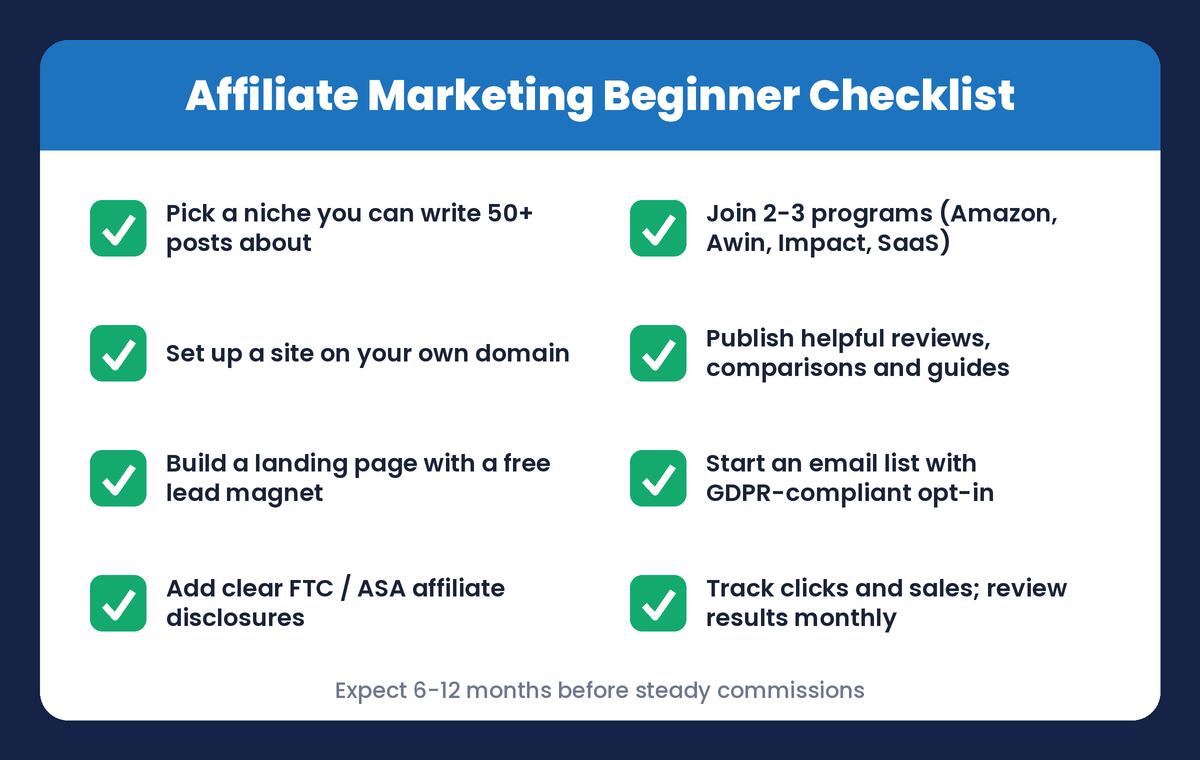
The steps below build on each other. You do not need to do everything at once, but skipping the foundations (niche, content and trust) is the most common reason new affiliates give up.
1. Choose a Niche You Can Stick With
A niche is the topic and audience you will serve. The sweet spot sits where three things overlap: something you understand or enjoy, a problem people actively search for, and products that pay a fair commission. Good beginner niches include home office gear, personal finance apps, fitness at home, pet care, travel gear and small-business software.
A quick test: can you list 50 article ideas for this topic? If not, it is probably too narrow. Also check that brands in the niche actually run affiliate programs before you commit.
2. Join the Right Affiliate Programs
Start with two or three programs that match your niche rather than signing up for everything. Popular options for beginners in the US, UK and EU include:
| Program / Network | Best for | Typical commission |
|---|---|---|
| Amazon Associates | Physical products, books, gadgets | About 1-10%, short cookie |
| Awin (incl. ShareASale) | UK and European retailers, fashion, travel | Varies by merchant |
| CJ (Commission Junction) | Big US brands, finance, retail | Varies by merchant |
| Impact | SaaS, subscriptions, consumer brands | Often recurring for software |
| ClickBank | Digital courses and ebooks | Often 30-75% |
| Direct SaaS programs | Software you already use | Often 20-40% recurring |
Read each program’s terms carefully. Some ban paid search on brand names, some require a minimum number of sales within a set period, and some (like Amazon) have strict rules on how you display prices.
3. Build a Website and Publish Helpful Content
Social media accounts can disappear overnight, so your own website on your own domain is the best long-term asset. Expect to pay roughly $10-15 (about EUR 10-14) a year for a domain and $3-10 a month for basic WordPress hosting.
The content types that earn the most affiliate commissions are:
- Product reviews based on real use, with honest pros and cons.
- Comparisons (“Tool A vs Tool B”) for readers who are close to buying.
- “Best X for Y” lists, such as the best budget laptops for students.
- Tutorials and how-to guides that naturally mention the tools you use.
Aim for depth over volume. One genuinely useful 2,000-word comparison will usually out-earn ten thin 300-word posts.
4. Create Landing Pages and a Simple Funnel
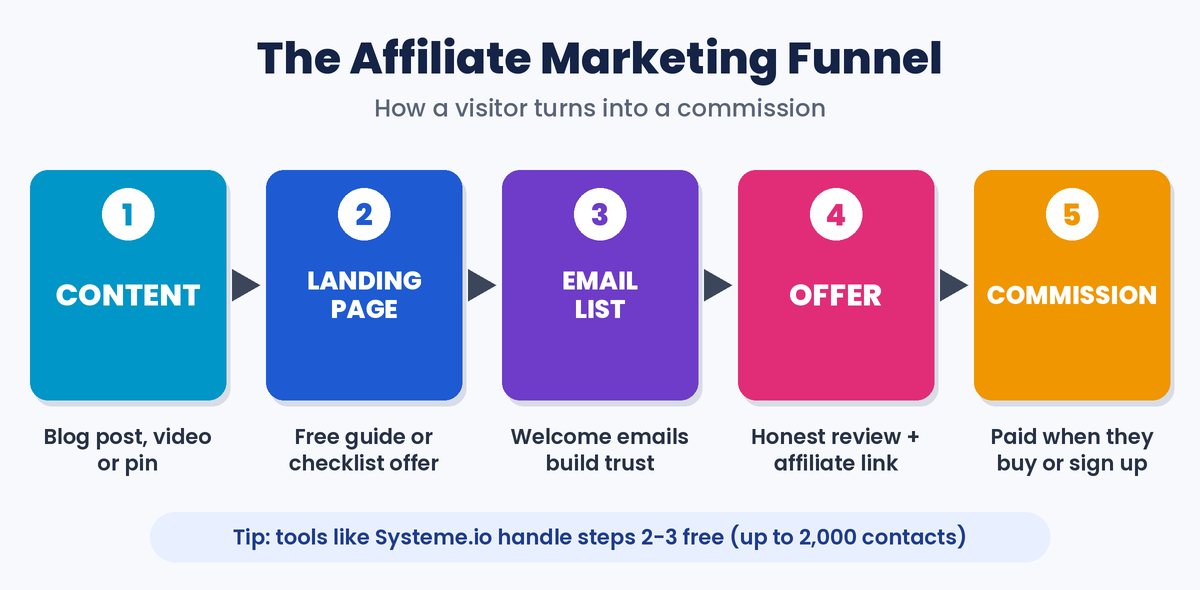
Most visitors will not buy on their first visit. A funnel gives them a reason to stay in touch. The classic beginner funnel looks like this: content -> landing page -> email list -> offer -> commission. Your landing page offers something free and useful (a checklist, a short email course or a template) in exchange for an email address.
You do not need to pay hundreds of dollars for software to do this. Systeme.io has a free-forever plan that includes up to 2,000 contacts, 3 sales funnels and unlimited email sends, with no credit card required. Paid plans start at $17 a month on the Startup plan once you outgrow it. For a full walkthrough of its features, see my Systeme.io review.
Start Your Free Systeme.io Account
5. Grow an Email List (the GDPR-Friendly Way)
Your email list is the one audience you truly own. A short welcome sequence of three to five emails can introduce yourself, deliver the freebie, share your best content and then recommend one product that solves the subscriber’s problem. A good rule of thumb is to send several genuinely helpful emails for every promotional one.
If you have subscribers in the UK or EU, GDPR (and the UK GDPR plus PECR) applies:
- Get clear, opt-in consent. No pre-ticked boxes.
- Explain what people are signing up for and link to your privacy policy.
- Make unsubscribing easy in every email.
In the US, the CAN-SPAM Act also requires an unsubscribe link and a valid postal address. My guide to email marketing for small business covers list building in more detail.
6. Drive Traffic: SEO, Pinterest, YouTube and Paid Ads
Content without visitors earns nothing. Pick one or two channels and get good at them before adding more:
- SEO (Google search): slow to start but the best free, long-term traffic. Target specific, lower-competition phrases such as “best standing desk under $300”. New to this? Start with this beginner’s guide to SEO.
- Pinterest: works well for home, food, fashion, travel and DIY niches, and pins can drive traffic for months.
- YouTube: reviews, unboxings and tutorials build trust fast, and links go in the description.
- Paid ads: Google, Meta or Pinterest ads can speed things up, but only once you know a page converts. Check each program’s rules first, as many ban bidding on their brand name.
7. Track Results and Disclose Every Affiliate Link
Use your network dashboards plus a free analytics tool to see which pages get clicks and which actually convert. Review the numbers monthly, then update and improve your best-performing posts.
Disclosure is not optional. In the US, the FTC’s Endorsement Guides require a “clear and conspicuous” disclosure close to the link, not hidden in a footer. In the UK, the ASA and the CAP Code require affiliate content to be obviously identifiable as advertising (for example, a clear “Ad” label on social posts). EU countries have similar consumer-protection rules. A short, plain-English note near the top of each post and next to your links keeps you on the right side of regulators and readers.
Scaling Up: When to Consider More Advanced Tools
Once you have consistent traffic or you start building funnels for clients, you may want an all-in-one CRM with SMS, booking calendars and automation. GoHighLevel is built for agencies and marketers at this stage. Its Starter plan is $97 a month and it offers a 14-day free trial. For most beginners, though, a free plan is more than enough. Start with the free option and upgrade only when your business genuinely needs the extra features.
A Realistic Timeline for Beginners
- Months 1-2: pick a niche, set up your site and join programs. Publish 10-15 solid posts.
- Months 3-6: keep publishing, build your landing page and email list, and expect first small commissions.
- Months 6-12: SEO traffic starts to compound. Update what works and add comparison posts.
- Year 2: many consistent affiliates reach a few hundred to a few thousand dollars a month, though results vary widely.
Common Beginner Mistakes to Avoid
- Promoting everything. Recommend only products you would happily use yourself.
- Chasing high commissions over fit. A 50% commission on a product nobody in your audience needs is worth nothing.
- Thin, copied content. Google rewards original, experience-based content.
- Ignoring email. Relying on one traffic source is risky.
- Skipping disclosures. It damages trust and can break program terms and the law.
- Quitting too early. Most affiliate sites take six to twelve months to gain momentum.
Affiliate Marketing FAQ
Can I start affiliate marketing with no money?
Yes, technically. You can use free tools, a free funnel builder and social platforms. However, spending around $50-100 a year on your own domain and hosting gives you a far more stable business.
Do I need a website to do affiliate marketing?
No, but it helps. You can start with YouTube, Pinterest or an email list built on a landing page, then add a website later.
How much do beginners earn?
In the first six months, most earn little or nothing while they build content. Income grows with traffic and trust, not overnight.
Is affiliate marketing legal in the UK and EU?
Yes, as long as you clearly disclose affiliate relationships and follow data-protection rules such as GDPR when collecting emails.
Conclusion
Now you know how to start affiliate marketing step by step: choose a focused niche, join a few well-matched programs, publish genuinely helpful content, capture leads with a simple funnel, grow your traffic and always disclose your links. Start small, stay consistent and treat it like a real business. A free tool like Systeme.io lets you build your first landing page and email list today without spending a cent.
Disclosure: This post contains affiliate links. If you sign up or buy through them, I may earn a commission at no extra cost to you.